November 14, 2026·Nataliia Rumiantsewa· 8 min read All posts
What does PR on a budget mean for a local business?
PR on a budget means earning attention from local reporters, neighbors and partner businesses instead of buying it. For a coffee shop, salon, pet groomer or fitness studio, the main cost is time: a clear story, a short pitch, a few photos and a follow-up. Cash goes to small items such as signs or event supplies.
Some distribution is free. The press release site openPR states that submitting a release is free of charge (secondary). The sections below sort tactics by cost and effort, lay out a six-week calendar and run a worked example with assumed numbers.
Free→
openPR release submission
openPR page (secondary)
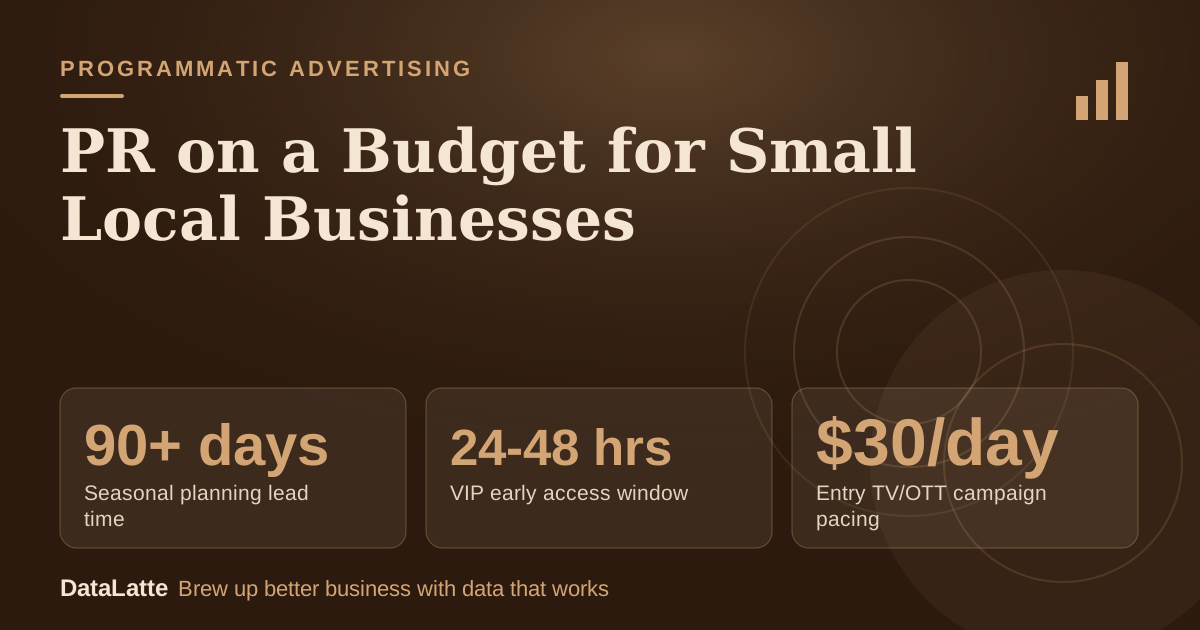
90+ days↑
Seasonal planning lead time
Retail planning guide cited by Adwave (secondary)
24-48 hrs↓
VIP early access window
Planning framework cited by Adwave (secondary)
$30/day→
Entry TV/OTT campaign pacing
Adwave product description (secondary)
See Sources at the end of the article. Cards marked Assumption are examples, not results.
What costs money and what is free?
Most PR tactics cost little cash and a lot of attention. The table below compares common options. The cost and effort ratings are planning assumptions, not sourced benchmarks, except where a source is named. Adjust them to local conditions, since print prices and event costs vary by city.
Tactic
Cash cost (assumption)
Effort (assumption)
Best for
Pitch to a local reporter or newsletter
$0
Medium: story angle, photo, follow-up
New openings, milestones, community stories
Free press release posting (openPR lists submission as free)
$0
Low to medium: writing and editing
A public record and a link to cite
Community event at the shop
Low: supplies and signs
High: planning and staffing
Foot traffic and photos
Partnership with a nearby business or shelter
Low: product or a shared giveaway
Medium: coordination
Cross-promotion to a second audience
Sponsoring a local team or fundraiser
Low to medium
Low once agreed
Name placement and goodwill
Paid amplification of a story
Variable
Low
Extending reach after earned coverage
Free tactics are not free of risk. A pitch can go unanswered, and an event can fall flat. Treat each one as a small test, and track what produces calls, bookings or visits.
Do local press pitches still work for small businesses?
Local press remains the core of budget PR, and the local-news sector is the subject of active organizing. Free Press Action launched a "Local News for the People" agenda that lays out five pillars for local-news policy. Ten community-media leaders authored it, and more than 50 journalism, pro-democracy and civic-information organizations have endorsed it, including LION Publishers.
That source says nothing about how often outlets run business pitches, so no response rate is claimed here. What a pitch needs is practical. Lead with a local angle: a first-of-its-kind class, a fundraiser, a long-time employee, a new service for an underserved group.
Keep the email short. One subject line, two or three sentences on why readers in that town care, a date, and a photo or two attached. Name a person who can be interviewed and a time they are free.
Send pitches to the right desk: community, lifestyle or business. Small neighborhood newsletters and independent outlets are often easier to reach than metro dailies. Follow up once, then move on.
When does a press release actually help?
A press release helps when there is something concrete to announce: an opening, an anniversary, a partnership, a charity drive. It gives reporters facts in one place. It does not replace a personal pitch.
Free posting has limited reach. One openPR page for a release published January 6, 2026 by an Australian marketing agency lists 74 views (secondary). That is a single page, not an average, but it shows why a posted release works better as a citable record than as a traffic source.
A release is worth writing when it can do three things: answer who, what, when and where in the first paragraph; include one quote from the owner; and give a contact. Anything beyond a page is usually too long for a local reporter.
When there is no real news, skip the release and send a pitch or post on the shop's own channels. A release with no news value costs time and returns nothing.
How do community events and partnerships earn coverage?
Events and partnerships give a reporter something to photograph. A groomer hosting an adoption day with a shelter, a salon running a free haircut morning for job seekers, or a studio offering an outdoor class for a local charity all create a visual and a reason to cover it.
Partnerships also share the work. A partner brings its own mailing list and social following, so the announcement reaches people who have never heard of the shop. Agree in writing who posts, who pitches, and who supplies photos, so that nothing is missed or sent twice.
Plan the event around the story, not the other way round. Decide the one-sentence headline first, then build the day to match it. Photograph it. Collect permission for any images of customers or pets.
For seasonal tie-ins, start earlier. A retail planning guide cited by Adwave recommends starting at least 90 days (secondary) before the target season, and the same page suggests four campaign stages: teaser, early access, main push and last-chance urgency. Those stages translate well into PR.
What does a 6-week budget PR calendar look like?
The calendar below fits a single event or announcement. It assumes six weeks is enough lead time. For a holiday or seasonal peak, the guidance cited above points to 3-6 months (secondary), so treat these six weeks as the final stretch. The week assignments are assumptions that borrow the four-stage structure.
Week
Stage
Tasks
1
Plan
Pick one story and one date. Draft the headline. Test the angle with a few regulars, since the cited article recommends testing messages 4-6 weeks ahead.
2
Build
Confirm the partner. Write the pitch and a short release. Take photos. Print signs.
3
Teaser
Send pitches to local reporters and newsletters. Post a teaser on the shop's channels.
4
Early access
Offer regulars 24-48 hours of early access, a window the cited planning framework recommends. Follow up once with reporters.
5
Main push
Hold the event or launch. Capture photos, quotes and sign-ups. Post the release on a free site.
6
Last chance and review
Send thank-yous and a recap. Pitch a follow-up angle. Count coverage, redemptions and new customers.
What does a worked example cost?
This coffee shop example uses assumptions throughout. The shop plans a "Meet the Roaster" morning with a nearby bakery, and every number below is an assumption chosen for illustration.
Assumed six-week budget: $400.
Printed signs and flyers: $60 (assumption)
Event supplies, cups and sampling: $150 (assumption)
Bakery partner giveaway product: $90 (assumption)
Paid boost of the event post: $100 (assumption)
Photography: $0, taken on the owner's phone (assumption)
The total is $400. Everything else is time: pitches, partner calls and follow-ups.
For a sense of scale, a $30 per day entry point, taken from Adwave's published product description (secondary), would cover about 13 days of that kind of TV campaign ($400 divided by $30). Spent on PR, the same $400 pays for a full event, the partnership and some amplification.
Track three things: how many outlets ran the story, how many promo-code redemptions came from the event flyer, and how many new customers signed up for the mailing list. All three targets are the shop's own to set. Google Analytics 4 can show whether the event page drove web visits.
When should paid media sit next to PR?
Paid media works best once PR has produced something worth amplifying: a published story, a strong photo, an event date. It does not replace earned coverage, but it can extend it to people the outlet's audience misses.
Costs differ by channel. Media Dynamics estimated the 2026-27 primetime upfront average streaming CPM for adults at $25.90 (secondary), and the ANA Q1 2026 benchmark recorded an overall programmatic CPM of $4.42 across web, mobile and CTV combined. Adwave's own estimated TV/OTT range is $15-$35.
CPM is the cost per thousand impressions. As arithmetic, a $400 budget at $15 buys about 26,700 impressions, and at $35 about 11,400. Those are illustrations, not forecasts.
Whether rates will rise or fall later in the year is not documented in these sources. Ask any vendor for current rates, and note that one rate guide cited on the same page says its rates are negotiable.
The distribution can be free, since openPR lists release submission as free of charge. The cost is time, plus small cash items such as signs, supplies or a giveaway. Budget both, and count the owner's hours as part of the real cost.
Does every announcement need a press release?
No. A release helps when there is concrete news, such as an opening, a partnership or a charity drive. For smaller stories, a short personal pitch with a photo is usually the better use of an afternoon.
How far ahead should a local business pitch an event?
No source here sets a standard for pitch timing. The calendar above assumes pitches go out in week 3 of 6. Ask the outlet about its own lead times, since newsletters and weeklies often plan further ahead than daily outlets.
How can a business measure PR results?
Count published mentions, promo-code redemptions, mailing-list sign-ups and web visits. Set up tracking before the event starts. A basic setup in Google Analytics 4 covers the web portion.
When is paid advertising worth adding?
Paid works best after earned coverage exists and there is a date or offer to promote. Compare quoted CPMs from several vendors and ask for current rates before committing budget.
Local marketing strategist with 10+ years at global agencies — OMD, Dentsu, GroupM, and BBDO. Now helping small businesses get the same data-driven edge. Based in Europe, working with clients in the US, UK, Australia, and beyond.