Local Lead Generation for Small Business: 7 Channels
November 14, 2026·Nataliia Rumiantsewa· 9 min read All posts
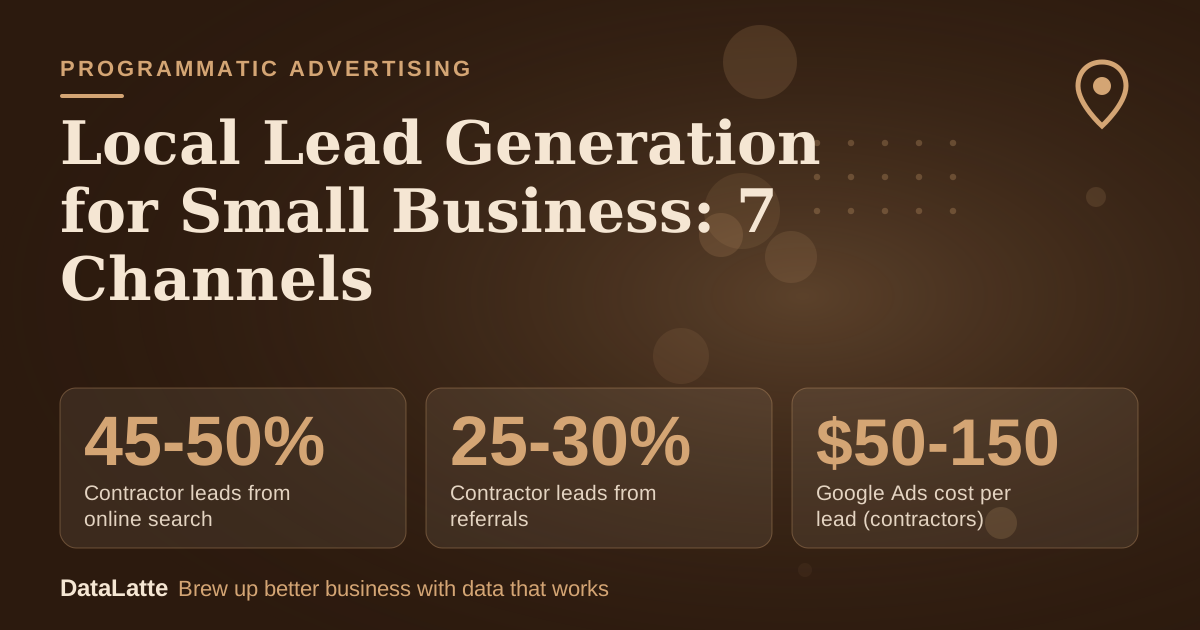
Local lead generation for a small business runs through seven channels: Google Business Profile, local search, Local Services Ads, referrals, social ads, email and text follow-up, and streaming TV. In one contractor lead breakdown, online search drives 45-50% of leads and referrals 25-30% (Adwave, secondary). The order matters: fix the profile and reviews first, add paid search, then test social and TV.
Documented cost per lead in the sources below runs from $25 to $200 depending on the channel. Most figures come from vendor pages describing contractors and gyms, so they work as planning ranges, not guarantees.
45-50%→
Contractor leads from online search
Adwave citing HomeAdvisor (secondary)
25-30%↑
Contractor leads from referrals
Adwave citing HomeAdvisor (secondary)
$50-150↓
Google Ads cost per lead (contractors)
Adwave contractor guide (secondary)
98%→
Consumers who used the internet to find local business info, 2024
BrightLocal, retold by Adwave (secondary)
See Sources at the end of the article. Cards marked Assumption are examples, not results.
Where do local leads actually come from?
The most detailed split in the sources is for contractors. Citing HomeAdvisor and similar platforms, Adwave (secondary) puts online search at 45-50% of leads, referrals at 25-30%, direct brand awareness at 15-20%, and everything else, including social, local advertising and community involvement, at 10-15%.
A split for coffee shops, salons, groomers or studios is not documented in the sources, so the contractor numbers show the shape of the problem and not a universal rule. Search and word of mouth carry most of the weight, and both depend on how the business looks when someone checks it.
That checking is nearly universal. BrightLocal reports that 98% of consumers used the internet to find information about local businesses in 2024, according to Adwave's retelling (secondary). One contractor guide also notes that more than 60% of website visitors are on phones, so a site that loads poorly on mobile wastes the lead before it starts.
A local digital strategy can combine local SEO, profile optimization, website SEO, social, content, reviews, paid ads and lead capture, according to Creators Pakistan (secondary).
How should a Google Business Profile be set up to generate leads?
Eligibility comes first. Google's guidelines allow a profile for a business with a physical location customers can visit, or one that travels to customers. P.O. boxes, remote mailboxes and virtual offices do not qualify. There should be one profile per business, and a service business with separate locations, service areas and staff can have one per location.
Several rules affect the profile's content:
The business name must not include taglines, store codes, hours, phone numbers, URLs, service information or location information. Extra information can lead to suspension.
Categories should be the fewest needed to describe the core business.
The description cannot contain links and should not focus on promotions or prices.
After that, the work is photos and reviews. Per BrightLocal, as retold by Adwave (secondary), businesses with more than 100 photos get 520% more calls than average. That is a correlation reported by a vendor, not a promise. The same article recommends replying to every review within 24 hours and aiming for 5-10 new reviews per month.
Google has discontinued Business Profile Q&A, per Adwave's API guide (secondary), so common questions belong on the website and in review replies instead.
What does a lead cost on each channel?
Cost per lead varies by channel and by what counts as a lead. Contractor figures below are Adwave's; gym figures describe trial passes, not inquiries. All are vendor estimates (secondary), and ad prices change, so current rates should be confirmed before budgeting.
Channel
Main work
Time to results (documented)
Documented cost
Google Business Profile
Eligibility check, categories, photos, 5-10 new reviews a month, replies within 24 hours
Organic channels take 6-12 months to gain real traction (gym vendor)
No cost per lead documented. Citation tools run $30-50 a month
Local search ads
Mobile-friendly site, keyword and budget management
Searcher is already shopping (gym vendor); timeline not documented
$50-150 per lead, 10-20% close rate (contractors). Start at $500-1,000 a month
Local Services Ads
Background check, license verification, proof of insurance
Screening takes 2-4 weeks (plumbing vendor)
Start at $500-2,000 a month. One $40 lead example in the plumbing guide
Referrals
Ask, track, thank
Organic, 6-12 months to traction (gym vendor)
Cash bonuses of $50-200 depending on job value
Social ads (Meta)
Video creative, local targeting
60-90 day play (plumbing vendor)
$25-75 per lead (contractors); $8-25 per trial (gyms)
For trades, the vendor argues yes. Adwave's plumbing guide (secondary) says Google's screening, covering a background check, license verification and proof of insurance, takes 2-4 weeks, so the application should start before leads are needed. It suggests $500-2,000 a month to begin, and $1,000-1,500 in a mid-size metro to stay competitive.
The same guide shows why lead price alone misleads. A $40 lead with a 40% close rate on a $350 average job costs $100 per new customer. The vendor treats this as an illustration, and the inputs vary by business.
Compare that with search keyword costs. Third-party benchmarks from 2022 put plumbing keyword clicks on Google Ads at $6-20, with emergency terms higher, according to the same guide.
Which categories can run Local Services Ads is not documented in the sources. A coffee shop, salon, groomer or studio should check Google's current category list before planning around them.
How do referrals and social ads fit in?
Referrals are the second-largest lead source in the contractor breakdown, at 25-30%. The same guide suggests cash referral bonuses of $50-200 depending on job value. A salon or studio might use a service credit instead, but a credit amount is not a sourced figure.
Social takes patience. The plumbing vendor calls social advertising a 60-90 day play and says homeowners need to see ads roughly 3-5 times to build recognition. Its cited home services CPM on Meta is $10-25, and it suggests starting at $500-1,000 a month. The contractor guide suggests starting at $300-500 a month.
For gyms, Adwave (secondary) plans $800-$3,500 a month on Meta and claims Reels under 15 seconds with captions routinely deliver 3-5x the reach of static photos. Most members live 10 minutes or less from the gym, so tight geographic targeting is the sensible default.
Nextdoor reports more than 90 million verified U.S. users, per the plumbing guide, which makes it a neighborhood-level option for home services.
Why does follow-up matter as much as the channel?
A lead that goes cold costs the same as one that converts. Adwave (secondary) cites claims that 78% of customers buy from the first responder, that a response within 5 minutes is 21x more effective than one at 30 minutes, and that 80% of sales need 5 or more follow-ups. These are vendor-cited statistics, not independent measurements, but the direction is consistent across sources.
Gyms show the same pattern. People who priced a gym but did not join often need 3-5 more touches, and many shoppers compare 4-7 facilities first, according to the gym vendor.
The recommended cadence is a follow-up on day 1, day 3, day 7, day 14 and day 30. Email and text can carry most of it. Their cost is not documented in the sources, so it is better to price whatever tool is already in use than to assume a figure.
Tracking which channel produced each lead is the other half. GA4 for small business covers the basics of setting that up.
What does streaming TV add to a local lead mix?
Streaming TV is the newest option in the table. The contractor guide says connected TV lets local businesses target homeowners on platforms such as Hulu, Peacock and Tubi for budgets starting at $50, and lists TV advertising at $75-200 per lead with 15-25% close rates and a $400-1,200 net cost per acquisition. It is a vendor claim (secondary), and a $50 start does not mean $50 buys many leads.
Search and the profile capture people already looking, while TV reaches people who are not. That is why it sits after the first four channels in the plan below, not before.
What does a worked example look like for a fitness studio?
Take a studio that tests Meta before Google. The gym vendor puts Meta cost per trial at $8-25, trial-to-member conversion at 30-55%, and cost per new member at $20-80. The inputs below sit inside those ranges but are assumptions for this example.
Monthly Meta spend: $1,200 (assumption)
Cost per trial pass: $20 (assumption)
Trial-to-member conversion: 40% (assumption)
The math: $1,200 / $20 = 60 trial passes. At 40%, that is 24 new members. Cost per member is $1,200 / 24 = $50.
The vendor values a member paying $80 a month with a 24-month tenure at roughly $1,900 in revenue. Using that figure, 24 members represent about $45,600 in revenue over two years (24 x $1,900). That is revenue collected over time, not profit, and tenure varies by studio.
The vendor also says most gym owners cap cost-per-acquisition at $40 and miss the bigger picture. In this example, $50 sits above that cap but far below the member's revenue value.
Timing matters too. January, March-April and September drive 60-70% of new sign-ups for most gyms, per the vendor. More ideas are in CTV ads for fitness studios.
What does a 6-week plan look like?
Order the work so that cheap, slow-compounding assets start first and paid channels launch once the basics can convert leads.
Week
Task
1
Audit the Google Business Profile against Google's rules: name, one profile, fewest categories, no links in the description, eligible address. If the business is a trade, start Local Services Ads screening (2-4 weeks).
2
Add photos. Set a review-request routine aiming for 5-10 reviews a month. Reply to every review within 24 hours. Check the website on a phone.
3
Set up lead tracking. Launch local search ads at a starting budget, for example $500-1,000 a month for contractors. Set a 5-minute response target.
4
Build the follow-up sequence for day 1, 3, 7, 14 and 30. Announce a referral offer; contractor bonuses run $50-200.
5
Test short video on Meta at a modest budget, such as $300-500 a month for contractors. Run it with a clear local offer, such as a trial pass for a gym.
6
Compare cost per lead, close rate and cost per customer for each channel. Keep winners, pause the rest, and consider a streaming TV test.
Organic channels need 6-12 months to compound, so a six-week plan sets the foundation instead of finishing the job. The assumption to test in week 6 is whether paid channels pay back faster than the profile and referrals can.
For a second opinion on the mix, a free audit reviews the profile, search presence and ad setup against this list.
FAQ
What is a good cost per lead for a local business?
No single figure applies to every trade. The sources give $50-150 for Google Ads, $25-75 for Facebook and $75-200 for TV advertising in contractor work, and $8-25 per trial on Meta for gyms. Net cost per customer depends on close rate, so a cheap lead that never closes can cost more than a pricier one.
How much should a small business spend per month?
Contractor starting points are $500-1,000 on Google Ads and $300-500 on Facebook and Instagram. Gym ranges are $600-3,000 on Google and $800-3,500 on Meta. Streaming TV starts at $50, per the vendor. All are vendor suggestions, so start at the low end and scale only after tracking leads.
Can a service-area or home-based business have a Google Business Profile?
Google's guidelines allow a profile for a business that travels to customers, as well as one with a visitable location. P.O. boxes, remote mailboxes and virtual offices are not eligible. Businesses selling age-restricted products such as alcohol cannot be service-area businesses without a storefront.
How long before lead generation efforts show results?
It depends on the channel. Organic channels such as the profile and referrals take 6-12 months to gain traction, per the gym vendor. Social advertising for plumbers is described as a 60-90 day play. Local Services Ads screening takes 2-4 weeks. Paid search timelines are not documented.
Local marketing strategist with 10+ years at global agencies — OMD, Dentsu, GroupM, and BBDO. Now helping small businesses get the same data-driven edge. Based in Europe, working with clients in the US, UK, Australia, and beyond.