LLM Seeding for Local Business: Get Mentioned by AI
November 14, 2026·Nataliia Rumiantsewa· 8 min read All posts
LLM seeding means putting accurate, easy-to-quote facts about a business in the places AI answer tools read, so the business gets named when someone asks for a recommendation. The same idea is sold as generative engine optimization (GEO) or answer engine optimization (AEO). For a local business, the proven part is plain: consistent listings, a maintained Google Business Profile, real reviews, and a website that states facts clearly. Tactics such as llms.txt have no documented effect in the sources cited here.
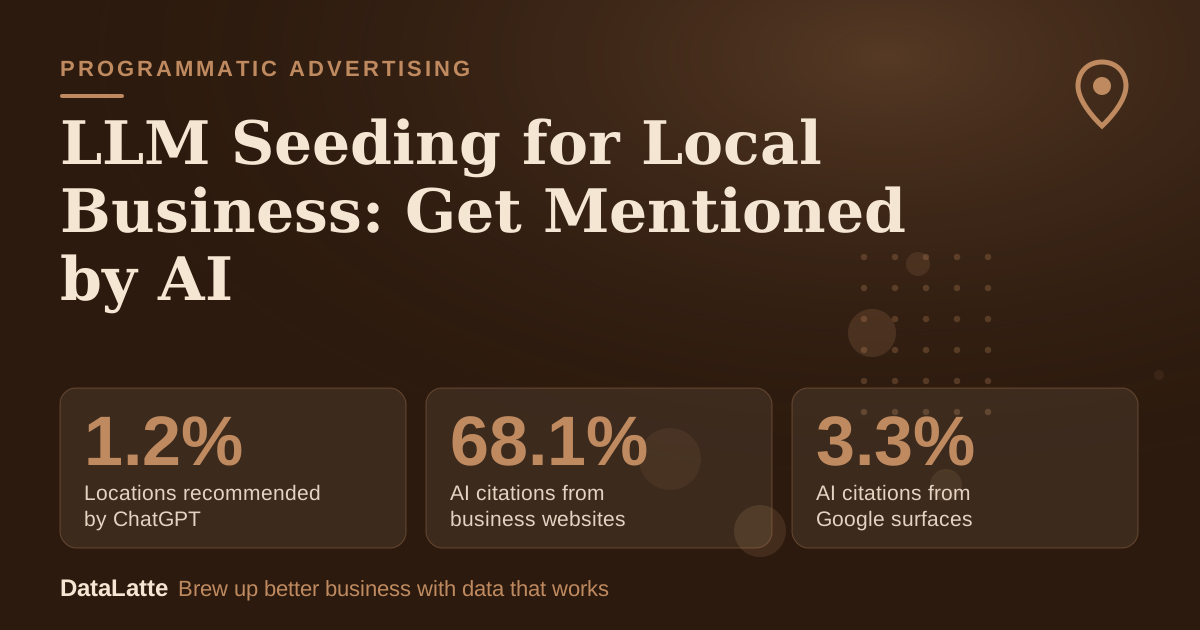
1.2%→
Locations recommended by ChatGPT
SOCi 2026 Local Visibility Index (secondary)
68.1%↑
AI citations from business websites
Cheers Market Baseline, 28 days to Sep 2, 2026 (secondary)
3.3%↓
AI citations from Google surfaces
Cheers Market Baseline, same window (secondary)
1%→
Clicks to source links in AI summaries
StackAdapt article (secondary)
See Sources at the end of the article. Cards marked Assumption are examples, not results.
Why does AI visibility matter if most people still use Google?
Most searching still happens on traditional engines. A survey cited by StackAdapt (secondary) found 79.8% of users continue to rely on Google or Bing for general information searches, and just 14% use AI search tools daily. The same article, citing eMarketer, says Google still commands roughly 92% of the global search market.
The shift is visible inside Google, though. According to StackAdapt, AI Overviews now appear on about 18% of all Google searches. Users end their browsing session entirely 26% of the time after seeing an AI summary, compared with 16% when only traditional listings appear.
Clicks are the weak spot. The article says a mere 1% click through to the actual source links in AI summaries. A mention in an AI answer may shape a decision without producing a website visit, and none of the sources cited here measure how often that turns into a booking.
The competitive gap is large. SOCi's 2026 Local Visibility Index, as reported on the SOCi blog (secondary), puts business profile accuracy on AI platforms like ChatGPT at 68.3%. It also says only 1.2% of locations are recommended by ChatGPT, and that this is 30 times harder to achieve than ranking highly in Google search.
What do AI tools pull from when someone asks a local question?
Answer engines assemble responses from existing web material. A Sky SEO Digital article (secondary, agency blog, published April 3, 2025) describes Perplexity as offering direct answers supported by citations rather than a list of links. It says Perplexity often pulls data from Google along with sources like YouTube or Wikipedia.
ChatGPT works similarly in one respect. Cheers (secondary) cites OpenAI's documentation: ChatGPT can search the web and provide answers with links to relevant web sources.
Cheers' Market Baseline gives the clearest local snapshot. Across 49,677 local-intent runs and 356,019 citations in 100 metros and four engines, in the 28 days ending September 2, 2026, business websites supplied 68.1% of pooled citations. Google surfaces supplied 3.3%. The figures were corrected on September 23, 2026, and are vendor data, not an independent study.
Google also says Business Profile information can come from business owners, publicly available web content, licensed third-party data, user contributions, reviews, and photos. Inconsistent facts anywhere on that list can end up in an answer.
Which tactics have evidence and which are speculation?
The table separates what the cited sources document from what they do not. "Documented" here means a source states it, not that a controlled test proves AI mentions follow.
Tactic
What the cited sources say
Evidence level
Consistent name, address, hours, categories
Google chain guidelines say locations providing the same service should generally keep consistent names and categories; profile data comes from many sources
Guidance documented; effect on AI mentions not measured
Current Google Business Profile
Google Search Central guidance to keep profile information current for AI search was updated July 10, 2026 (via Cheers, secondary)
Documented guidance
Reviews and rating
Google says review count and rating can factor into local ranking
Documented for local ranking; AI link not tested
Citable pages on the business website
Business websites supplied 68.1% of pooled AI citations in Cheers' baseline
Observational vendor data
Presence on Wikipedia, YouTube, Reddit
Together 15% of citations in Google AI Overviews, per Pew via StackAdapt (secondary)
Observed for AI Overviews overall; local effect not documented
FAQ content
No cited source tests it
Not documented
llms.txt
No cited source documents it
Not documented
Do reviews and ratings help a business get mentioned?
Google states that local results are mainly based on relevance, distance, and prominence, and that review count and rating can factor in. That is the documented link. Whether the same signals drive ChatGPT or Perplexity picks is not established by the sources here.
SOCi's blog claims AI systems consistently recommend businesses with 4.2–4.3 star ratings, but cites no source for the figure. It is a vendor assertion and should not be treated as a threshold. The same page says fewer than half of top-performing brands in traditional search appear in AI recommendations, again with no source or year.
A practical audit step from Cheers: read a review sample from the last 60 to 90 days. Recent reviews show what customers currently say about service, prices, and hours, and those are the details an AI answer can repeat.
Automated replies carry risk. SOCi lists the main risks of AI agents in marketing as lack of context in sensitive situations, inconsistent brand voice without training, and over-automation. For a single-location shop, owner-written replies avoid all three.
What about llms.txt and FAQ content?
No source cited here documents llms.txt changing which businesses ChatGPT, Perplexity, or Google mention. Treat it as unproven. Time spent on it is time not spent on listings, reviews, and the website, which have at least some documented support.
FAQ content sits in a similar position. No cited source tests whether an FAQ block increases mentions. A reasonable case exists on logic alone: answer engines respond to questions, and a page that states hours, prices, parking, and services in plain sentences is easy to quote. That is reasoning, not evidence.
Quality matters more than volume. Google's profile guidelines prohibit low-quality or irrelevant content in Business Profile descriptions, so keyword-stuffed descriptions work against the goal.
Service-area businesses, such as mobile groomers, should follow Google's guidance: set service areas by city, postal code, or another area type, not by a radius. Mismatched area data creates exactly the conflicts that listings audits are meant to remove.
What does a 6-week LLM seeding plan look like?
The sequence goes from foundation to publishing to measurement. Each week fits a few hours of owner time.
Week 1: List every place the business appears (Google Business Profile, Apple and Bing listings, Yelp, social pages, directories). Record name, address, phone, hours, categories, and service area in one sheet. Mark every mismatch.
Week 3: Publish or rewrite the website pages that state services, prices or price ranges, location, and hours as plain text, not only in images or PDFs.
Week 4: Add an FAQ section drawn from real customer questions (calls, DMs, front-desk notes). Start a standing review request at a fixed point in the customer journey.
Week 5: Answer new reviews personally. Read the last 60 to 90 days of reviews and fix any operational issue that keeps recurring.
Week 6: Ask ChatGPT, Perplexity, and Google a dozen local questions a customer might type. Record whether the business appears and what it says. Repeat monthly.
How would the plan work for a fitness studio?
All inputs below are assumptions for illustration, not benchmarks.
Assumptions: a studio has 80 Google reviews at a 4.15 average, gets 60 new trial members per month, asks every one for a review at day 14, and 15% leave one, averaging 4.8 stars. A listings audit across 10 sites finds 4 with an old phone number.
Math: 60 trial members × 15% = 9 new reviews per month. Over six weeks (about 1.4 months) that is roughly 12 reviews. The new average is (80 × 4.15 + 12 × 4.8) ÷ 92 = (332 + 57.6) ÷ 92 = about 4.23. The listings mismatch rate falls from 4 of 10 (40%) to 0 after week 2.
What the example does not show: whether the studio is then recommended by ChatGPT. The 4.2–4.3 range is an uncited vendor claim, and the 1.2% recommendation rate shows how rare mentions are. The documented gains are cleaner data and a stronger review profile for Google's map results, which list local businesses for queries like "personal training studios near me."
How should a local business measure results and paid options?
Start with direct observation. The monthly prompt test from week 6 shows whether the business is named, and whether the details are correct. Then check referral traffic in analytics; Google Analytics 4 for small business covers setup. Because only 1% click through to sources in AI summaries, per StackAdapt, traffic from AI tools may stay small even when mentions improve.
Timing is not guaranteed. Sky SEO Digital says results from optimizing for Perplexity typically range from a few weeks to several months, depending on the level of optimization and ongoing effort. That is an agency claim, not a measured result.
Paid placement inside AI answers is limited. StackAdapt says Perplexity uses only about 0.1% of its revenue from ads and serves roughly 22 million active users. Its sponsored follow-up questions are AI-generated prompts placed beside answers, not brand-written copy, and are priced on a CPM basis. Current rates are not documented in the sources, so ask any platform for them directly.
They overlap but are not identical. Search Engine Land, as quoted by the Association of Fitness Studios, defines SEO as improving a website to increase visibility in Google, Microsoft Bing, and other search engines. Answer engines such as Perplexity return direct answers with citations rather than a list of links, so being quotable matters alongside ranking.
Is a Google Business Profile enough to get mentioned by AI?
The cited data suggests not on its own. In Cheers' baseline, Google surfaces supplied 3.3% of pooled citations and business websites 68.1%. This is observational vendor data, so a complete profile plus a clear website is the safer reading.
Can a business pay to be mentioned in ChatGPT answers?
No source cited here documents a way to buy a mention in organic answers. Perplexity's sponsored follow-up questions exist and are priced on a CPM basis, but current rates are not documented. Ask the platform for current pricing before budgeting.
How long does it take to see results?
No fixed timeline is documented. One agency source says Perplexity-focused work typically shows results in a few weeks to several months. Monthly prompt tests give a local business its own baseline.
Listings, reviews, and website facts are also the foundation of strong local search ads. Request a free audit to see where a business's local presence stands.
Local marketing strategist with 10+ years at global agencies — OMD, Dentsu, GroupM, and BBDO. Now helping small businesses get the same data-driven edge. Based in Europe, working with clients in the US, UK, Australia, and beyond.