November 13, 2026·Nataliia Rumiantsewa· 9 min read All posts
Multi-channel advertising pays for a local business when each channel reaches people the others miss and the budget is large enough for every channel to produce results that can be read. In 2023 research by StackAdapt and Advertiser Perceptions, 50% of advertisers using a multi-channel strategy saw a better ROI (secondary). Below a certain budget, two channels are easier to run and judge than four thin ones.
The same research flags the cost of complexity: advertisers have difficulty measuring goals across channels. The sections below cover where several channels help, how to split a small budget, how to cap repetition and how to measure the result.
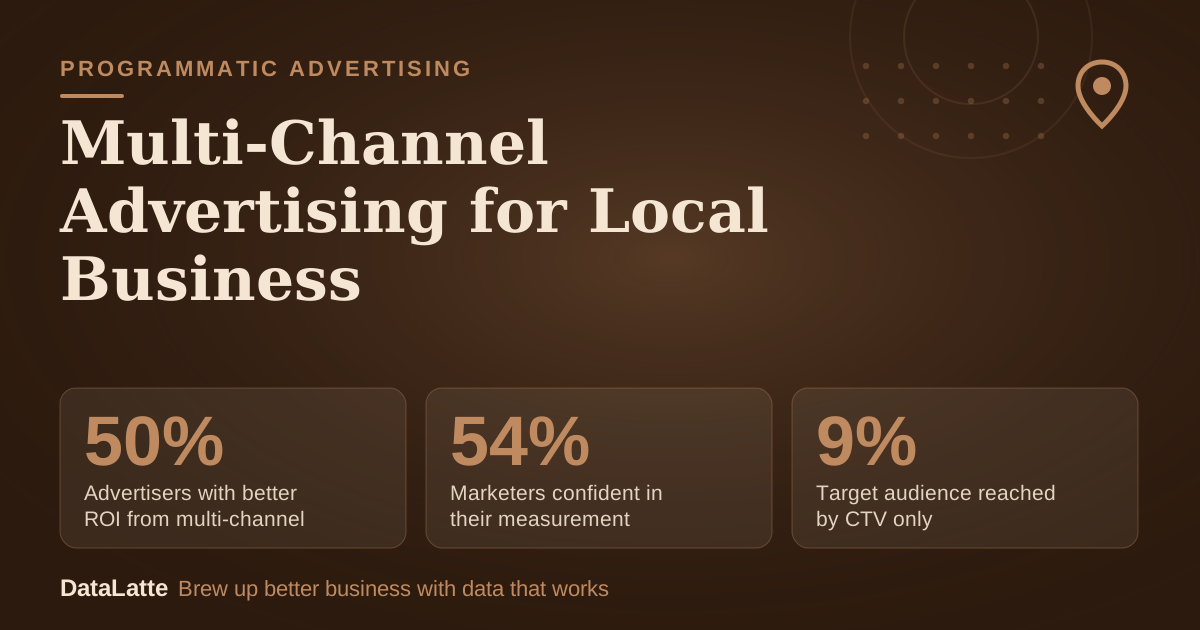
50%↑
Advertisers with better ROI from multi-channel
StackAdapt and Advertiser Perceptions, 2023 (secondary)
54%→
Marketers confident in their measurement
Nielsen, cited by Adwave (secondary)
9%↓
Target audience reached by CTV only
StackAdapt platform data (secondary)
27.5%→
TV viewers annoyed by repetitive ads
TiVo 2025 report, cited by StackAdapt (secondary)
See Sources at the end of the article. Cards marked Assumption are examples, not results.
When does multi-channel advertising actually pay for a local business?
It pays when customers need more than one touch before booking. StackAdapt's report found that more than 40% of advertisers call multi-channel advertising extremely important for upper- and lower-funnel goals, and 33% say the same for mid-funnel goals (StackAdapt, secondary). Another 60% of marketers believe multi-channel campaigns meet or exceed their KPIs at least most of the time.
For a neighborhood business the funnel is easy to map. A streaming TV or social ad introduces the shop. A Google search catches the person who then looks for a service nearby. A retargeting ad reminds the visitor who left the booking page. Each step suits a different channel.
What does the research say, and how far can it be trusted?
The headline figures are large. Omnisend's analysis, relayed by Adwave (secondary), found that marketers using three or more channels earned a 287% higher purchase rate than single-channel campaigns, with purchase frequency about 250% higher and retention roughly 90% higher.
The same page cites a Harvard Business Review study of 46,000 shoppers. Omnichannel customers spent 4% more in store and 10% more online than single-channel customers, and the heaviest multi-channel users made 23% more repeat trips.
These are group comparisons passed along by a vendor. They do not prove that adding a channel causes the lift, since businesses running several channels may also be larger or better organized. Treat them as direction, not a forecast for one shop.
Measurement is the weak spot. Nielsen figures cited by Adwave say marketers juggle about 15 channels on average and only 54% are confident in their awareness and conversion measurement. Nielsen's ROI work also found about half of media plans were underinvested by roughly 50%, with ROI able to improve by around 50% at ideal spend levels. For a small account, that argues against spreading money so thin that no channel gets enough to matter.
How much extra reach does a second channel add?
StackAdapt's platform data shows how reach stacks when channels are combined. These are illustrations from one platform, not guarantees for a local campaign (StackAdapt, secondary).
Channel combination
Share of target audience reached
Native only
53%
Native plus display
87%
Native plus video
83%
CTV only
9%
CTV plus video
77%
Two readings follow. First, a single channel can leave much of an audience unreached, and the CTV-only figure of 9% is the sharpest example. Second, the jump from 9% to 77% came from pairing CTV with video, not from spending more on CTV alone.
For a local business, the practical lesson is to pair a premium channel with one that covers more people per dollar, then check the overlap in each platform's reporting.
How should a small budget split across channels?
No source documents a universal split. The table below is an illustrative assumption built on the funnel logic above: capture existing demand first, then add reach, then add reminders.
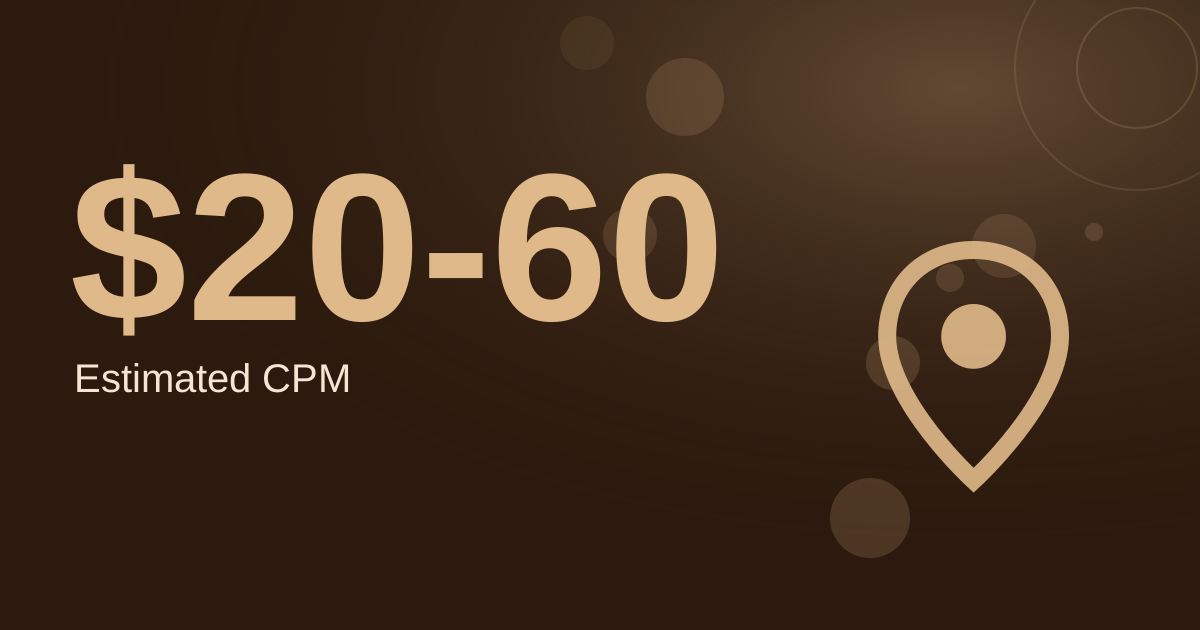
Whether a $600 CTV line buys enough impressions depends on current rates. Check real CPM data and the small-budget worth-it breakdown before committing. The vendor also cites a forecast that pay TV will fall below 50% of US households before the end of 2026, which is one reason streaming belongs on the list.
CTV ads are often unskippable and shown in high-definition formats such as 4K, so a repeated ad cannot simply be tapped away.
Several channels make the problem harder to see, because each platform counts only its own impressions. A household may meet the same offer on streaming and on social in one week, and neither report will show it.
Three habits keep repetition in check. Set a frequency cap in every platform that allows one. Ask the CTV platform how frequency is controlled before launch. Rotate at least two creative versions that share one message.
StackAdapt's automotive guide states that the key to a successful multi-channel campaign is a cohesive message across all channels (secondary). Same offer, varied execution.
How can a local business measure results across channels?
Perfect cross-channel attribution does not exist for a small account. StackAdapt's guide notes that privacy laws such as GDPR and CCPA restrict certain tracking tools, so brands may have limited visibility into individual customer journeys (secondary). The goal is a set of cheap signals that point the same way.
Start with conversions. Set up booking, call and form events in Google Analytics, and tag every ad link with its channel. The GA4 guide for small business covers the setup.
Add the platform's own reporting. StackAdapt lists impressions, CPMs and view-through conversions in real-time CTV reporting, and describes cost per completed view (CPCV) as the budget spent on each ad watched from start to finish (secondary).
Finally, ask new customers how they found the business. Newer shoppable and QR code formats can also give CTV a direct response path.
What does a $3,000 monthly plan look like for a fitness studio?
Every input below is an assumption, chosen to show the arithmetic and not to predict results.
Monthly ad budget: $3,000, split as in the table above ($1,200 search, $900 social, $600 CTV, $300 retargeting display).
Membership price: $70 per month.
Average membership length: 6 months.
Frequency cap: 4 views per household per week on CTV and social.
Revenue per new member is $70 x 6 = $420. Break-even on revenue is $3,000 / $420 = 7.14, so the plan needs 8 new members in the period to cover spend. At 8 members, spend per member is $375 against $420 of revenue, leaving $45 per member before rent, staff and other costs.
That makes the decision rule concrete. If tracked sign-ups, the "how did you hear about us" answers and branded search all show nothing from the CTV line after the test period, move its $600 to the best-performing channel. If two channels carry nearly all the sign-ups, the other lines need a clear job or should be cut. More on the category in CTV ads for fitness studios.
What does an eight-week rollout look like?
This calendar is a suggested sequence, not a documented benchmark. It stages the channels so each can be read before the next is added.
Week 1: Set up GA4 conversion events for bookings, calls and forms. Add channel tags to every link. Record baseline weekly sign-ups and branded search volume.
Week 2: Launch search and social with one core offer and one core message.
Week 3: Review search terms and social audiences. Remove waste. Keep budgets unchanged.
Week 4: Add the retargeting display line. Start asking every new lead how they heard about the studio.
Week 5: Ask the CTV platform for current CPMs and frequency controls, then launch the CTV flight with a cap.
Week 6: Check reach and frequency in each platform. Compare branded search with the week 1 baseline.
Week 7: Compare cost per sign-up by channel. Swap in a second creative version.
Week 8: Decide whether to keep, shift or pause each line. Move money from the weakest channel in steps, not all at once.
When is a single channel the better choice?
Several channels lose to one when the budget is too thin. Nielsen's finding that about half of media plans were underinvested by roughly 50% is a reminder that a channel without enough spend produces noise, not insight.
A single channel also wins when tracking is not ready. If bookings cannot be tied to a source, extra channels only add reports that nobody can reconcile.
Channel choice matters too. Platform differences, such as inventory types and private marketplaces, are covered in CTV platforms compared. A sensible path is to run search and one social channel until sign-ups are steady and measured, then add streaming as the third line with its own test window.
FAQ
How many channels should a local business start with?
The sources do not set a number. In the illustrative table above (assumption), a $1,000 monthly budget uses two channels and a $3,000 budget uses four. The deciding factor is whether each channel gets enough spend to be judged on its own results.
Does multi-channel advertising cost more than a single channel?
Not necessarily. The total budget is the owner's choice, and spreading it across channels does not raise it. StackAdapt's guide notes that digital platforms often allow easy budget adjustments, while linear TV and OOH may need larger upfront commitments (secondary). Ask each platform for current rates and minimums before planning.
Which channel gets credit for a sale?
No single report settles it. Privacy laws limit visibility into individual customer journeys, and Nielsen figures cited by Adwave show only 54% of marketers are confident in their measurement (secondary). Combine GA4 conversions, platform reports, branded search trends and a "how did you hear about us" question.
Is CTV worth adding to the mix?
It can be, once search and social are tracked and the budget supports a test. Compare current CPMs and minimums first. The small-budget CTV breakdown walks through the trade-offs.
A free review of the current ad mix can show which channels deserve budget first. Request a free audit.
Local marketing strategist with 10+ years at global agencies — OMD, Dentsu, GroupM, and BBDO. Now helping small businesses get the same data-driven edge. Based in Europe, working with clients in the US, UK, Australia, and beyond.