November 13, 2026·Nataliia Rumiantsewa· 9 min read All posts
Generative AI ad creatives are headlines, body copy, images and other ad assets produced by software that learns patterns from training data, then reviewed and approved by a person. For a coffee shop, salon, groomer or studio, the practical gain is speed: many draft options in minutes. The practical risk is publishing something inaccurate or off-brand. A review checklist closes that gap.
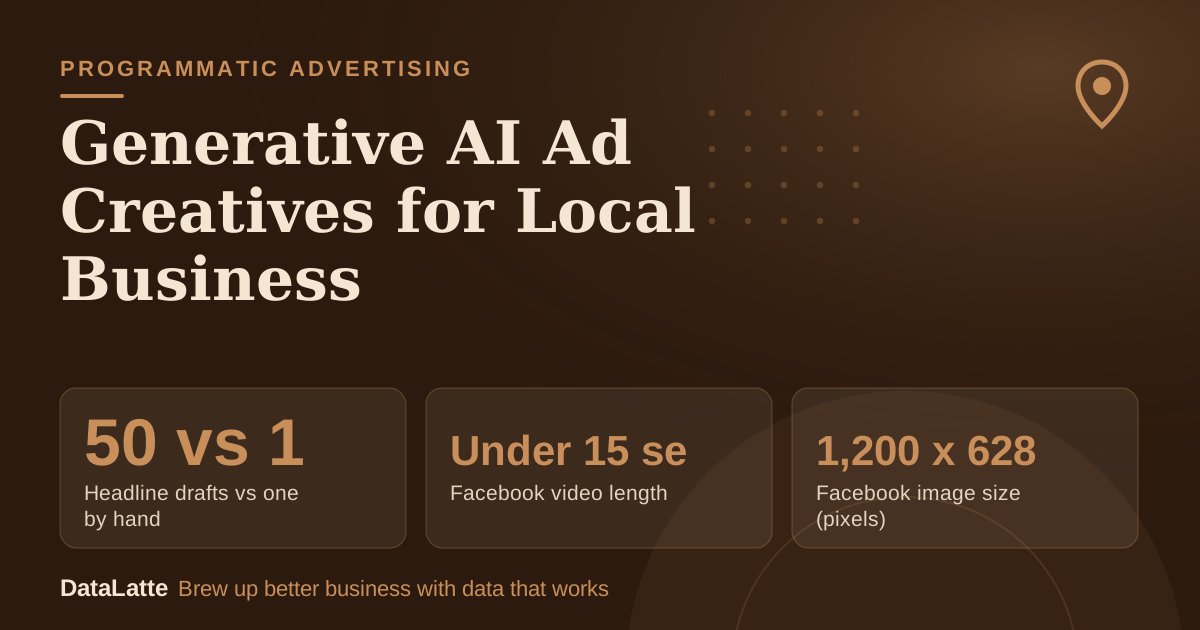
50 vs 1→
Headline drafts vs one by hand
StackAdapt creative team claim, vendor-reported (secondary)
See Sources at the end of the article. Cards marked Assumption are examples, not results.
What counts as a generative AI ad creative?
Salesforce describes two types of AI that matter most for marketers: predictive AI and generative AI. Predictive AI analyzes patterns in data to anticipate what might happen next (secondary). Generative AI, by the same page, creates new text and images based on patterns learned from the data it was trained on.
Salesforce also says it is anticipated that generative AI will produce more nuanced content, including videos, music and images. That is an expectation, not a documented capability for any specific tool. Any tool should be judged by its output on the business's own offer, not by a promise.
What can generative AI do for a local business ad today?
The best-documented use is copy volume. StackAdapt's Creative Project Manager James Targett says the team can produce 50 headlines as quickly as they could historically produce one (secondary, vendor-reported). That is one company's workflow claim, not a benchmark for a small shop.
The same article says that, based on its click-through rate tracking, AI-generated copy often outperforms client-supplied and internally written content. No numeric CTR figures are given, so the claim cannot be sized. Treat it as a reason to test, not a reason to switch.
For a local owner, the useful pattern is simple. Use AI to generate many options for one offer, cut the list to a handful, and let live results decide. Volume matters only when each draft is checked against real prices, hours, services and tone.
Which use cases, tool types and risks matter most?
The table maps common creative jobs to the type of tool that handles them and the main thing to check. Tool types are generic categories, not endorsements. The risk column is review guidance, not a measured failure rate.
Use case
Tool type
Risk to check
Headline and body copy variations
Text generator
Invented offers, wrong prices, tone that does not sound like the business
Message testing across value propositions
Text generator plus A/B test
Changing too many things at once, so no result is readable
Static ad images and backgrounds
Image generator
Pictures that misrepresent the real space, products, staff or results
Short video from stills
Video generator or slideshow builder
Misleading before-and-after impressions, wrong length for the placement
Targeting, placements and budget
AI built into the ad platform
Less manual control over where the ad runs
Retargeting follow-ups
Text generator plus platform audiences
Repeating one message until it reads as noise
Every row ends with a person approving the final asset. Nothing in the sources supports skipping that step.
Where does generative AI go wrong in ads?
The StackAdapt article notes that some campaigns, including those from Coca-Cola and Toys "R" Us, faced backlash for lacking a human touch, citing 2024 Forbes coverage (secondary). Those are national brands with large review teams, which shows the problem is not limited to careless use.
For a local business, the human touch is the whole point. Customers choose a groomer or studio partly because of the people. An ad that looks generic, or shows a space that does not exist, undercuts that.
Two failure types are worth separating. Factual errors, such as a wrong price or a service not offered, create customer disputes. Tone errors, such as stiff or overly polished language, quietly weaken trust. A checklist can catch the first type reliably. The second type needs someone who knows how the owner actually talks.
What should be reviewed before an AI-made ad goes live?
A short checklist applied to every asset is more useful than a long policy. Each item below is a yes or no question.
Does every price, discount, hour and service in the text match what the business offers today?
Does any image show a space, product, person or result that the business cannot actually deliver?
Does the copy sound like the owner, or like a generic template?
Is there any claim, such as "best in town" or a health or results promise, that cannot be backed up?
Are people in images or video free of visible distortions?
Does the ad name the real location, booking method and contact details correctly?
Has a second person, not the one who generated it, read the final version?
Is the file in the right size and length for the placement?
Anything that fails one question goes back for editing. Anything that cannot be fixed gets dropped, however good the rest looks.
Do format specs still matter for AI-made assets?
Yes. Generation does not change placement rules. AdEspresso recommends a Facebook ad image size of 1,200 x 628 pixels, a 1.9:1 ratio (secondary), and Facebook suggests keeping video ads under 15 seconds. Slideshow ads use 3 to 10 images, and Instant Experience ads work best with five to seven components, per the same guide.
Carousel guidance is similar. StackAdapt recommends two to six items in a rich media carousel (secondary), and says engagement can drop beyond six images. That is the vendor's own claim, made in a college marketing context, not a third-party study.
Worked example for a pet groomer. All inputs below are assumptions for illustration, not benchmarks.
Assumption: monthly test budget of $450 for one three-week test.
Assumption: three value propositions, each given $150: first-visit discount, easy online booking, gentle handling for nervous dogs.
Assumption: AI drafts 30 headlines; the owner and a staff member shortlist three per message.
Assumption: results after three weeks are 3, 6 and 4 booking requests.
Cost per booking request is $150 divided by requests: $50.00, $25.00 and $37.50. In this illustration, easy online booking wins at $25.00, so the next round tests new wording of that message, not a new theme.
The numbers are invented to show the arithmetic. Real results depend on the market, offer and season. Tracking requests accurately matters here, and the Google Analytics 4 guide for small business covers the setup.
What does a four-week rollout look like?
A calendar keeps the test small and the review honest. The plan below fits a single location with one owner or manager.
Week
Task
Output
1
List current offers, prices, hours and brand voice notes; pick three value propositions to test
One-page fact sheet used to check every draft
2
Generate many headline and body drafts per message; shortlist; run the review checklist
Three approved ads per message
3
Launch the test with equal budget per message; confirm tracking records booking requests
Live campaign, no edits mid-test
4
Compare cost per booking request; retire weak messages; write notes on what to change
Winning message and next test plan
The fact sheet in week 1 is the most useful step. Feeding it to the generator, then checking drafts against it, prevents most factual errors. Keeping edits out of week 3 preserves a readable result.
Does generative AI change CTV and streaming creative?
Generative tools can help draft scripts, on-screen text and variations for a TV-screen spot, but length and format rules still come from the platform. The CTV worth-it analysis for small budgets is a useful companion before committing money to video production of any kind. Fitness operators can see how creative choices play out in CTV ads for fitness studios.
One market note. AdImpact projects political CTV spending of $2.4 billion in 2026 (secondary, via Basis). The sources do not document how that affects local advertiser rates after the election. Ask any platform for current rates instead of assuming a change.
FAQ
Can generative AI write an entire ad campaign for a local business?
It can draft text and images, but Salesforce describes generative AI as creating content from patterns in its training data. It does not know current prices, hours or promotions. A person has to supply those facts and approve the result.
Does AI-written copy perform better than human copy?
StackAdapt says its CTR tracking shows AI-generated copy often outperforms client-supplied and internally written content, but gives no numbers (vendor claim, secondary). The reliable answer for one business comes from running a small A/B test.
What should be tested first?
StackAdapt suggests testing value propositions, such as price, prestige or safety, instead of button colour or images. For a local business, that could be discount, convenience or service quality. Run each message with equal budget and compare cost per booking or call.
What image size works for Facebook ads?
AdEspresso recommends 1,200 x 628 pixels at a 1.9:1 ratio, and lists a minimum width of 254 x 133. Check the current requirements inside the ad platform before uploading.
Local marketing strategist with 10+ years at global agencies — OMD, Dentsu, GroupM, and BBDO. Now helping small businesses get the same data-driven edge. Based in Europe, working with clients in the US, UK, Australia, and beyond.