Personalization in Digital Marketing for Local Business
November 13, 2026·Nataliia Rumiantsewa· 9 min read All posts
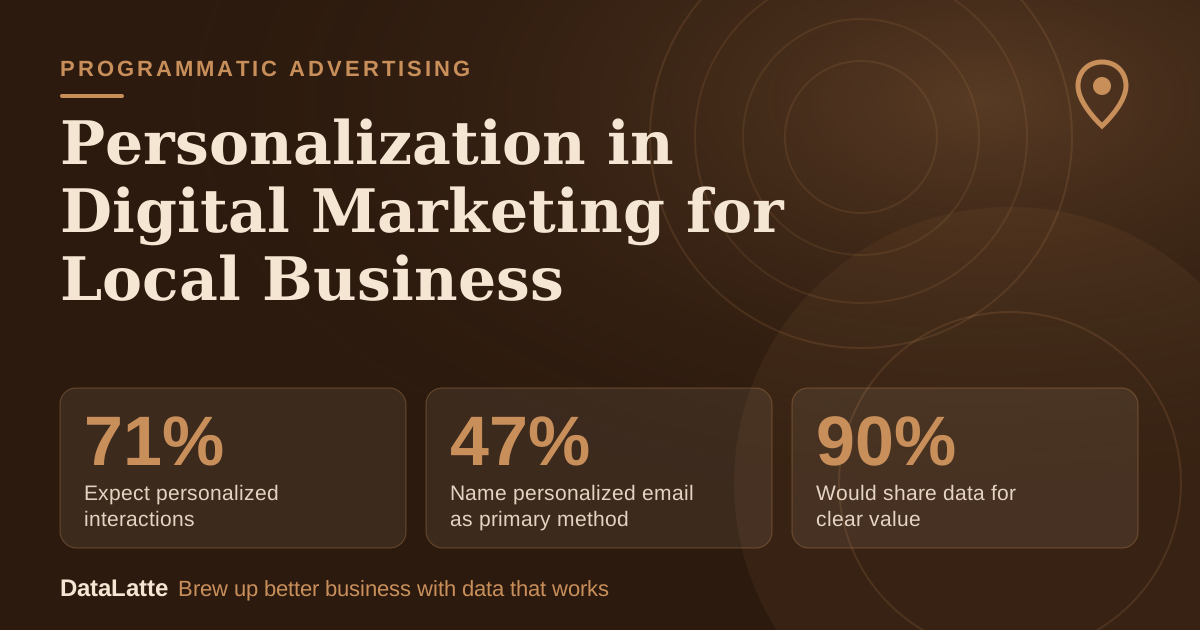
Personalization in digital marketing means tailoring a message, offer or ad to what a business already knows about a person: a name, a past visit, a service type or a birthday. A local business can start with data it already holds, such as an email list, booking records and point-of-sale history. Email is the usual entry point: 47% of brand marketers surveyed by StackAdapt name personalized email as their primary method (StackAdapt, secondary).
71%→
Expect personalized interactions
McKinsey study, cited by StackAdapt (secondary)
47%↑
Name personalized email as primary method
StackAdapt survey of brand marketers (secondary)
90%↓
Would share data for clear value
BCG study from 2022, cited by StackAdapt (secondary)
44%→
Gen Z (16-24) view personalized ads negatively
EMARKETER-cited study, via StackAdapt (secondary)
See Sources at the end of the article. Cards marked Assumption are examples, not results.
What does personalization mean for a local business?
Personalization is not limited to large brands with data teams. At its simplest, it is the use of first-party data: information collected directly through a business's own interactions with customers, rather than bought from outside sources (StackAdapt, secondary). Other names for the same thing are owned data, in-house data or customer data.
For a coffee shop, salon, groomer or studio, that data usually lives in a POS, booking system, loyalty program or email list. EMARKETER lists customer service data, mobile apps and transaction data among the top collection methods marketers use (same source, secondary).
The demand side is documented, though the figures come from large-company research. A McKinsey study found 71% of consumers expect personalized interactions, and an IAB study found 79% feel more positive toward brands that tailor ads to their preferences (StackAdapt, secondary). Those numbers describe attitudes, not guaranteed results for any one shop.
Which personalization tactics work with little data?
Most useful tactics need only a few fields: an email address, a visit date and one preference. The table below compares common options. Effort ratings are editorial judgment based on typical setup work, not sourced figures.
Tactic
Data needed
Effort
Fits
Name and location in email
First name, preferred location
Low
All four business types
Welcome series (2+ emails)
Email address, signup source
Low to medium
Coffee shops, studios
Post-visit sequence (3 to 5 emails)
Visit or appointment date, service type
Medium
Salons, groomers, studios
Birthday email
Birth month and day, with consent
Low
All four
Opt-in SMS reminders
Phone number plus recorded opt-in
Low to medium
Salons, groomers, studios
Customer-list ad audiences (retarget or suppress)
Email list segments by status
Medium
All four
Website banner by campaign or location
Which ad or link the visitor came from
Low to medium
All four
Start at the top. Each row builds on data the rows above already collect, so the list grows without a separate project.
How does email personalization work for a small shop?
Email carries most of the load because the data requirement is small. Square's data, cited by AdWave, shows personalized emails with 29% higher open rates than non-personalized ones, and segmented campaigns with 30% more opens than unsegmented ones (AdWave, secondary).
A welcome series is a sensible first build. Stripo's roundup reports an introductory series of two or more messages can lift revenue by up to 51% compared with a single welcome email (AdWave, secondary).
After a visit, AdWave suggests 3 to 5 emails across 30 to 90 days, and says five is enough for many small businesses to start. A service-business version includes a follow-up after the appointment, a simple education email, a satisfaction check-in and a later maintenance, referral or seasonal touchpoint.
If response drops after the third email, the page says the problem is usually message fit, not volume.
Birthday emails are the lowest-effort personal touch. Omnisend's report cites a 43.3% open rate for birthday automation, and AdWave recommends a teaser 2 to 3 days before the birthday plus one or two reminders afterward (AdWave, secondary). The same page quotes a 481% transaction-rate lift as a vendor claim with no source or date, so it is not a planning number.
Can SMS, ads and the website use the same data?
Yes, with the same customer list feeding each channel. SMS follows one condition: AdWave states it works for loyalty outreach only if the customer opted in (AdWave, secondary).
For paid ads, StackAdapt says first-party segments can retarget existing customers, suppress them from acquisition campaigns, build lookalike audiences and improve bidding decisions (StackAdapt, secondary). Suppression is the quiet win for small budgets: existing regulars stop absorbing impressions meant for new customers.
StackAdapt also reports that Jiffy Lube Ontario, working through an agency, cut cost per acquisition by 80% with digital coupons in native ads (StackAdapt, secondary). That is one vendor-reported case, not a typical result.
For the website, the cited sources give no benchmark. A banner or landing page matched to the ad or link that brought the visitor is a low-risk start.
What are the privacy limits of personalization?
Personalization can backfire when it feels intrusive. An EMARKETER-cited study found 44% of Gen Z consumers aged 16 to 24 and 50% of Gen X consumers aged 45 to 54 view personalized ads negatively (StackAdapt, secondary). A BCG study cited by StackAdapt found 57% of consumers believe companies sell their personal data (StackAdapt, secondary).
Trust has a counterweight. The same BCG work found 90% of consumers say they would share personal information if they receive clear value in return, such as convenience or more relevant offers (2022 study, secondary). The practical reading: ask for little, explain the benefit, and deliver it.
Practical guardrails drawn from the sources:
Collect only fields that a message will actually use.
Record SMS opt-in before any text goes out.
Remove unsubscribed customers from promotional loyalty emails and keep only operational messages they still need (AdWave, secondary).
Keep data practices in line with privacy rules such as GDPR and CCPA, and make sure any sign-up incentive complies with local requirements (StackAdapt, secondary).
Legal specifics vary by state and channel, so a lawyer should review SMS and data-collection wording.
What does a four-week rollout look like?
A small team can ship the first version in a month. The checklist below assumes one person spends a few hours a week; that time is an assumption, not a benchmark.
Week 1, inventory: list every place customer data sits (POS, booking tool, loyalty app, email list). Mark which records have consent and which fields are filled in.
Week 2, capture: add birth month and day plus one preference (usual drink, service or pet size) to the signup form, with a one-line reason for asking. Add an SMS opt-in checkbox that is unchecked by default.
Week 3, build: write a welcome series of two or three emails and a post-visit sequence, starting with a short version of the five-email pattern: confirmation or follow-up, education, satisfaction check-in, and one loyalty or referral message.
Week 4, launch and measure: turn on the birthday email with a teaser 2 to 3 days ahead and one reminder after. Upload a customer-list segment to ads for suppression. Set a baseline for repeat-visit rate before judging anything.
Platforms named by AdWave that can run this kind of automation include Klaviyo, Mailchimp, ActiveCampaign, Drip and HubSpot, provided triggers, segments and reporting are set up correctly.
What could a coffee shop expect? A worked example
This example uses assumptions only; none of the inputs are benchmarks.
Email list: 1,500 subscribers (assumption)
Share who gave a birthday at signup: 40%, or 600 people (assumption)
Birthday offer: one free drink costing $1.50 to make (assumption)
Redemption rate across the year: 10%, or 60 redemptions (assumption)
Extra spend per redeeming customer, such as a pastry or a friend's drink: $4.50 (assumption)
Cost of free drinks: 60 x $1.50 = $90. Added sales: 60 x $4.50 = $270. Before labor and the email tool subscription, the program nets about $180 for the year under these inputs.
The result is small in absolute terms, and it should be. The point is that the program runs on a list the shop already owns and costs almost nothing per send. If redemption were 5%, the same math gives 30 redemptions, $45 in drink cost, $135 in added sales and $90 net. Real numbers should replace every assumption after the first quarter.
How can a local business tell whether personalization is working?
Open rates alone mislead. AdWave notes that Klaviyo recommends tracking business-impact metrics such as repeat purchase rate, customer lifetime value increase and email engagement rather than relying only on opens (AdWave, secondary).
For a local shop, repeat-visit rate by segment is the cleanest signal: compare customers who received a sequence against similar customers who did not, over the same weeks.
Measurement is a known sore spot at every size. Roughly one-third of brands and agencies in StackAdapt's research name it as their biggest obstacle to personalization, and 77% of agency marketers say they struggle to demonstrate the impact of personalized campaigns to clients (StackAdapt, secondary).
Does a small business need a customer data platform to personalize?
The cited sources do not describe one as a requirement. AdWave names email platforms such as Klaviyo, Mailchimp, ActiveCampaign, Drip and HubSpot as able to run post-purchase automation when triggers, segments and reporting are configured correctly. That covers the email tactics in this article.
How many emails should a post-visit sequence include?
AdWave, citing Klaviyo guidance, points to 3 to 5 emails across 30 to 90 days, and says five is enough for many small businesses to start. If response falls after the third email, revisit the message before adding more sends.
Do customers actually like personalized ads?
Evidence is mixed. An IAB study found 79% of consumers feel more positive toward brands that tailor ads, while an EMARKETER-cited study found 44% of Gen Z consumers aged 16 to 24 view personalized ads negatively. Audience age and how the data was collected both matter.
Is it worth offering a discount to collect customer data?
A BCG study cited by StackAdapt found 90% of consumers say they would share information for clear value. Incentives should comply with local requirements, and the benefit should be stated plainly at sign-up.
For a review of what data a business already holds and which of these tactics fits first, request a free audit.
Local marketing strategist with 10+ years at global agencies — OMD, Dentsu, GroupM, and BBDO. Now helping small businesses get the same data-driven edge. Based in Europe, working with clients in the US, UK, Australia, and beyond.