Marketing for Freelancers and Consultants: 8-Week Plan
November 14, 2026·Nataliia Rumiantsewa· 9 min read All posts
Freelancers and consultants get inbound clients by narrowing the offer to one buyer and one problem, backing it with visible proof, and then running a few channels on a fixed weekly schedule. Referrals and direct outreach usually produce the first conversations. LinkedIn and search take longer but keep working after the effort stops. The sections below cover each piece, a channel comparison, a worked example for a consultant serving hair salons, and an 8-week calendar.
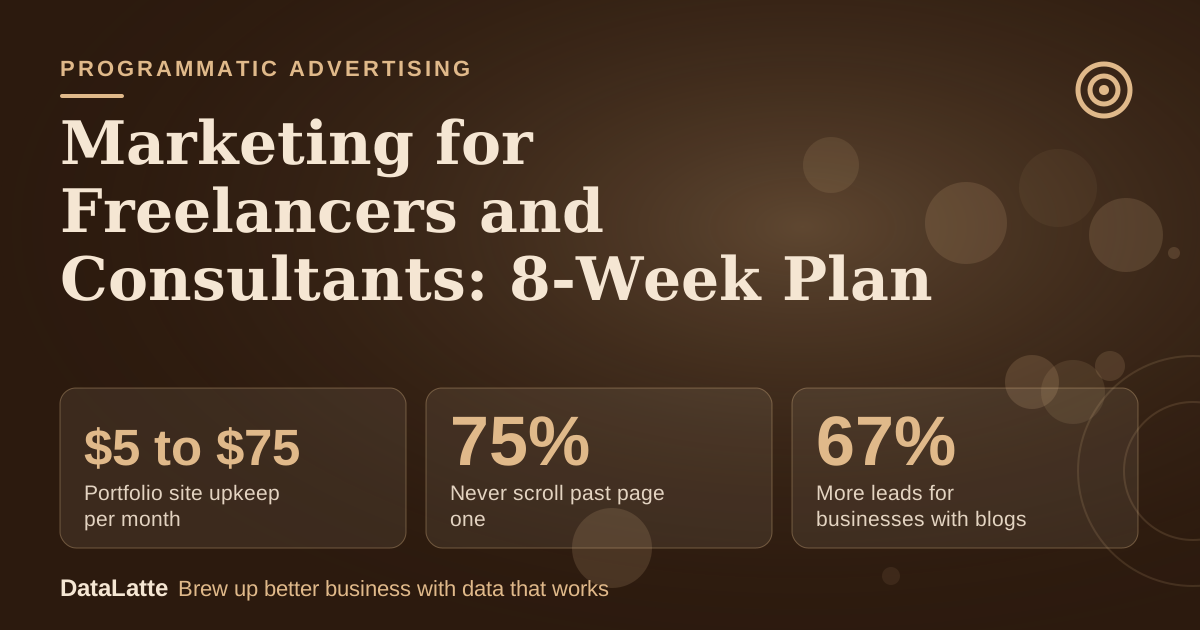
$5 to $75→
Portfolio site upkeep per month
The CSS Agency planning range for a personal blog or portfolio (secondary)
75%→
Never scroll past page one
HubSpot study as cited by C-Suite Strategy (secondary)
67%↑
More leads for businesses with blogs
Content Marketing Institute as cited by C-Suite Strategy (secondary)
42%→
Freelance disputes tied to unclear IP
2025 Upwork report as cited by Indeed, via AdWave (secondary)
See Sources at the end of the article. Cards marked Assumption are examples, not results.
What should be settled before any marketing starts?
A vague offer such as "marketing help" forces every prospect to guess whether the freelancer fits. A narrow offer is easier to remember, easier to refer and easier to test. The working formula has four parts: one buyer type, one problem, one outcome and one place. An example is a consultant who helps independent hair salons in one metro area turn Google searches into booked consultations.
The niche can widen later. It cannot be tested while it is blurry, and local buyers tend to trust someone who clearly works with businesses like theirs. The local lead generation guide shows what those buyers are trying to achieve.
Buyer language comes next, and job boards show how companies describe the work they pay for. Remote Rocketship lists 64 remote marketing consultant positions (secondary). Jobgether lists 102 jobs (secondary), with titles ranging from a contractor brand consultant role to a marketing advisor role for sports clubs and leagues.
Reading ten listings is a free way to collect the phrases buyers use. Those phrases belong in the profile headline and the first line of the website.
What counts as proof when there are no clients yet?
Proof answers the question every prospect has: has this worked before? With no client history, proof comes from pilot work, such as a discounted or free first project in exchange for a written result and permission to publish it. The baseline needs recording before work starts (calls per week, bookings, site visits). Otherwise the later result is only an opinion.
A portfolio site holds the proof. The CSS Agency's 2026 price guide gives a planning range of $5 to $75 per month, or $60 to $900 per year, for a personal blog or portfolio, covering hosting, domain and light updates (secondary). The same page puts DIY upkeep at $0 to $50 per month in tools plus 4 to 8 hours of the owner's time each month.
One page per case, an about page and a contact form are enough to start.
Contracts are part of proof because they signal a professional operation. A 2025 Upwork report, as cited in Indeed's guidance, found that 42% of freelance disputes involve unclear IP rights (secondary). A short clause stating who owns the work after payment removes that risk.
The same guidance notes that a 1099 form is required for freelancers hired for social media work, so tax paperwork should be sorted before the first invoice.
How do LinkedIn and search bring inbound leads?
LinkedIn works as a searchable résumé plus a feed. HireLab data cited by AdWave puts recruiter activity at 78% on LinkedIn, ahead of Facebook at 65% and Instagram at 58% (secondary). That figure describes hiring behavior, not service buyers, so it shows where professionals get looked up rather than predicting inbound leads.
It still supports treating the profile as a landing page. A strong one has a headline naming the buyer and outcome, a featured case and an obvious way to make contact.
Posting once a week from real client questions keeps the profile active. A post that names a specific local problem (for example, why a salon's Google listing gets calls but no bookings) attracts the right reader better than general advice.
Search is slower and more durable. A HubSpot study, as retold by C-Suite Strategy, states that 75% of users never scroll past the first page of search results (secondary). A page therefore has to rank near the top to matter, which favors narrow phrases such as service, niche and city.
The same article cites the Content Marketing Institute for the claim that businesses with blogs generate 67% more leads. As a retelling, that is a direction, not a promise.
Which channel gives the first lead fastest, and what does it cost?
Channels differ in speed and in effort. The time column below is a planning assumption, not a measured benchmark. Only the website figure comes from a source.
Core features free on some boards; premium features paid
Reading listings, tailored applications
The pattern is that the cheapest, fastest channels depend on existing relationships, while the channels that scale take months. Running two fast channels and one slow channel at the same time covers both horizons. The multi-channel advertising guide explains how channels support each other.
How do referrals and an email list keep leads coming?
Referrals fail mostly because the ask is vague. "Know anyone who needs help?" gives the contact nothing to act on. A better ask names the buyer type and the trigger: an owner of an independent salon whose online bookings have stalled. The easiest moment to ask is right after a client confirms a result.
Referral conversations need the same structure as any other lead. A repeatable sales process keeps those introductions from stalling after a friendly first message.
Clear expectations also protect repeat work. Twine's guide on managing freelance social media managers links misaligned expectations to a 48% turnover rate and suggests weekly 30-minute standups to review KPIs (secondary). The finding is about social media managers, but a short weekly or biweekly metrics check works for any retainer.
An email list captures people who are not ready to buy yet. One short monthly note with a single insight, such as what changed in local search this month, keeps the freelancer in mind. The list is slow to build but belongs to the freelancer, unlike a social feed.
What do salary figures say about pricing?
Two public figures show how loose the data is. Remote Rocketship's page title lists remote marketing consultant jobs at $94K to $106K (secondary). A Payscale survey cited by C-Suite Strategy puts the average marketing consultant salary at around $62,000 per year (secondary). The two sit about $32,000 apart at their low ends.
Neither is a freelance rate. Both describe employee pay, which excludes unpaid selling time, tools, taxes and gaps between projects. Setting a price from a salary figure alone will usually undercharge.
A sturdier method works backward from a target monthly income and the delivery hours each client needs, then adds a margin for marketing time. The next section runs that math with labeled assumptions.
Some vendor and blog statistics circulate without a named source. C-Suite Strategy, for example, says 72% of companies believe successful campaigns hinge on a consultant's expertise but gives no source for it. Claims like that should stay out of proposals. Prospects trust a baseline measured on their own account more than a borrowed percentage. Realistic sales goals cover how to set targets from a funnel instead of a hope.
What does the math look like for a consultant serving hair salons?
All inputs below are assumptions for a consultant selling a monthly local marketing retainer to independent hair salons. Only the website cost range comes from a source.
Retainer price: $750 per month per client (assumption)
Goal: 3 retainer clients by the end of week 8 (assumption)
Outreach: 10 personalized messages per week for 8 weeks, or 80 messages (assumption)
Reply rate: 15% (assumption)
Replies that book a call: 50% (assumption)
Calls that become clients: 1 in 3 (assumption)
Referrals: 10 asks, 2 introductions, 1 in 2 introductions become clients (assumption)
Delivery time: 6 hours per client per month (assumption)
Website: $75 per month, the top of the sourced portfolio range (secondary)
The outreach funnel runs like this: 80 messages at 15% gives 12 replies. Half book a call, giving 6 calls, and one in three of those closes, giving 2 clients. Referrals add 1 client (2 introductions at one in two). The total is 3 clients.
Revenue is 3 × $750 = $2,250 per month, or $27,000 per year if every client stays 12 months. After the $75 website, $2,175 remains. Delivery takes 3 × 6 = 18 hours, so the figure is about $121 per delivery hour. That is before taxes, software, admin and the continuing time spent on marketing.
Now test one weak link. If the reply rate is 10%, 80 messages give 8 replies and 4 calls, which closes about 1.3 clients. With the referral client, that is roughly 2 clients and $1,500 per month. The reply rate is the lever to fix first, usually by tightening the first message rather than sending more of them.
What does an 8-week plan look like?
The calendar assumes about 5 to 8 hours of marketing time per week alongside client work.
Week 1: Write the one-sentence offer for one buyer type. Read 10 job or competitor listings to collect buyer wording. List 30 past contacts.
Week 2: Rewrite the LinkedIn headline and about section. Draft a short contract with an IP ownership clause. Choose a pilot client and record baseline numbers.
Week 3: Publish the portfolio site with an about page, a contact form and a placeholder case. Ask 10 past contacts for specific introductions. Send the first 10 outreach messages.
Week 4: Publish the first niche-plus-city page. Add an email sign-up form. Post twice on LinkedIn and send 10 more messages.
Week 5: Send the first monthly email note. Follow up on every open conversation. Send 10 more messages.
Week 6: Turn the pilot into a one-page case with before and after numbers. Hold the first 30-minute metrics review with the pilot client.
Week 7: Ask the pilot client for a referral and a testimonial. Pitch one local mention or link, using the PR on a budget tactics. Send 10 more messages.
Week 8: Count messages, replies, calls, proposals and closes. Keep the two channels producing conversations, pause the weakest, and set the next 8-week goal.
The same review discipline applies to any paid channel added later. The pause guide explains when to stop spending.
FAQ
How much should a freelancer spend on a portfolio website?
The CSS Agency's planning range for a personal blog or portfolio is $5 to $75 per month, or $60 to $900 per year (secondary). A small business site costs more, at $50 to $500 per month. A portfolio rarely needs more than the lower range.
How long until the first client arrives?
No source documents a timeline for freelancers. The time estimates in the channel table are planning assumptions. Referrals and direct outreach tend to move first, while search pages take the longest.
Is LinkedIn enough on its own?
LinkedIn is a useful profile and a place to post, but one channel leaves the pipeline exposed to a single algorithm. Pairing it with referrals and an email list adds channels that do not depend on a feed. The recruiter-activity figure cited above describes hiring behavior and does not measure client demand.
Does a freelancer need a contract before the first project?
Yes. A 2025 Upwork report, as cited in Indeed's guidance, found that 42% of freelance disputes involve unclear IP rights (secondary). A written scope and an ownership clause address the most common cause. Tax questions, including the 1099 form, belong with an accountant.
Local marketing strategist with 10+ years at global agencies — OMD, Dentsu, GroupM, and BBDO. Now helping small businesses get the same data-driven edge. Based in Europe, working with clients in the US, UK, Australia, and beyond.