November 14, 2026·Nataliia Rumiantsewa· 9 min read All posts
Marketing for multi-location businesses works when headquarters owns the data and the standards, and each store owns local content and customer response. Google recommends that each eligible physical location have its own verified Business Profile (AdWave, secondary). The core build is one profile, one location page and one review routine per store, a budget weighted by store health, and monthly reporting. A 90-day rollout is below.
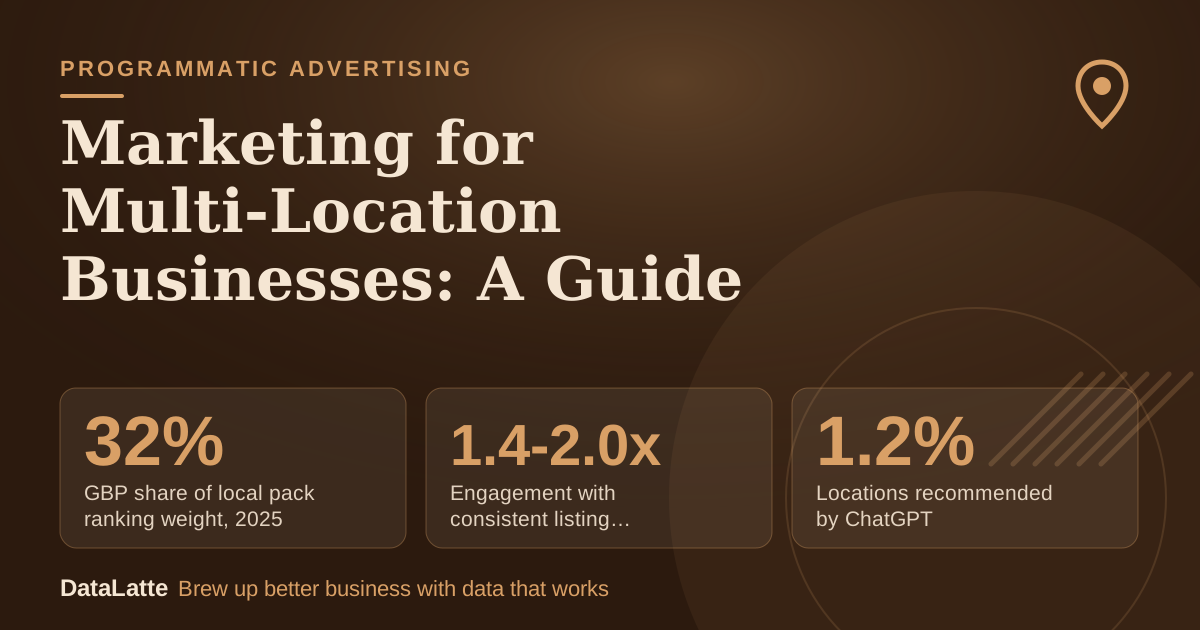
32%→
GBP share of local pack ranking weight, 2025
AdWave citing a 2025 benchmark (secondary)
1.4-2.0x↑
Engagement with consistent listing data vs inconsistent
AdWave citing a 2025 benchmark (secondary)
1.2%↓
Locations recommended by ChatGPT
SOCi 2026 Local Visibility Index (secondary)
10+→
Locations where Google bulk management guidance applies
Google guidance as described by AdWave (secondary)
See Sources at the end of the article. Cards marked Assumption are examples, not results.
Who should control what: headquarters or each location?
Control splits along one line. Anything that must match everywhere sits at headquarters, and anything that depends on the neighborhood sits with the store. Only the Google naming and profile rules in the table are documented; the rest is a recommended split.
Area
Centralized (headquarters)
Local (store manager)
Business name
One naming standard; Google says same-country locations should share a name unless the real-world representation consistently varies
Reports signage changes
Address, phone, hours
Master record and bulk updates
Flags holiday and temporary changes
Google Business Profile
Verification, templates, bulk management
Photos, posts, local details
Location page
Template, schema, page speed
Staff, parking, neighborhood copy
Reviews
Tone guide and escalation rules
Replies with local details, fixes the issue
Ad budget
Total spend and tier rules
Capacity info such as open appointments
Reporting
One scorecard, fixed cadence
Works its own fix list
Consistency is the reason to centralize. AdWave reports that brands with consistent listing data reportedly achieved 1.4 to 2.0 times higher engagement than brands with inconsistent data, and that Google Business Profile signals represented 32% of local pack ranking weight in 2025 (AdWave, secondary).
How should each location set up its Google Business Profile?
Google recommends that each eligible physical location have its own verified Business Profile. The location must be a real, staffed, customer-facing place, not a virtual office or PO box. For organizations with 10 or more locations, Google's bulk management guidance is intended to make that maintenance practical (AdWave, secondary).
Start with one master record per store: name, address, phone, hours, categories. Every profile, citation and page then pulls from that record. Hand-edited profiles drift, and drift is costly. The same AdWave page cites a 2025 benchmark in which only 68% of business contact information matched between ChatGPT and Perplexity data and Google Business Profile data.
In the 0 to 100 location score described by AdWave, GBP completeness and accuracy carries the largest single weight at 25%. Citation consistency adds another 20%. A complete, accurate profile is the first fix at any store that scores poorly.
What belongs on a location page?
Each store needs its own page rather than one shared "locations" list. Location-page quality carries a 20% weight in the AdWave score, and technical health, including local schema and page speed, carries 15%. The audit benchmark also checks for unique copy above 300 words per page, which AdWave frames as a quality flag, not a substitute for usefulness (AdWave, secondary).
A practical page covers that store's services, team, parking, hours and the neighborhoods it serves, plus the same name, address and phone as the profile. Copying one paragraph across twelve pages and swapping the city name fails the 300-word test in spirit even when it passes in count.
Local links to each page matter too. The scoring example on the AdWave page assigns "Strengthen local links" as the action for a top-tier branch. The tactics are covered in local link building for small businesses.
How do reviews work across many locations?
Review velocity and sentiment carry a 20% weight in the AdWave score. Reviews have to be managed per store, because a chain-wide average hides the one shop with a problem.
SOCi's 2026 article makes two claims without citing a source: AI systems consistently recommend businesses with 4.2 to 4.3 star ratings, and consumers expect review responses within 24 hours (SOCi, secondary). Treat both as vendor assertions. They still make a reasonable internal target for a reply routine.
SOCi describes review response automation as AI generating personalized replies, adjusting tone by sentiment and including location-specific details. It also lists the main risks: lack of context in sensitive situations, inconsistent brand voice without training, and over-automation. A workable rule is automation for routine praise and human review for complaints, with headquarters writing the tone guide and each store manager owning the follow-up.
Does AI visibility matter for multi-location brands?
Two vendor benchmarks point the same way. SOCi's 2026 Local Visibility Index puts business profile accuracy on AI platforms like ChatGPT at 68.3% and says only 1.2% of locations are recommended by ChatGPT. It also says that visibility is 30 times harder to achieve than ranking highly in Google search (SOCi, secondary).
AdWave adds a sixth audit input, AI discoverability, which checks how consistently ChatGPT, Perplexity and Gemini represent the brand and its branches (AdWave, secondary).
The practical step is cheap: ask each AI tool about a few stores each month and compare the answer with the master record. Wrong hours or a wrong phone number usually trace back to an inconsistent listing, which the central data fix already addresses.
How should budget be split across stores?
Equal splits ignore that stores differ. A tiered split is easier to defend. AdWave groups branches into Top, Mid and Bottom using the top quartile, middle 50% and bottom quartile of the location score (AdWave, secondary). Headquarters then sets a percentage per tier. The percentages are a judgment call, not a documented standard.
Management fees scale per location, which is easy to overlook. One pet-grooming agency, TailWerks, lists Essentials at $297 per month per location, Foundation from $997 and Growth from $1,497. Foundation plus Essentials starts at $1,294 and Growth plus Essentials at $1,794, per location per month. Usage and third-party charges are separate, and final deliverables are agreed in writing (TailWerks, secondary).
Contracts matter as well: Foundation has an initial six-month commitment, and Essentials and Growth use six-month rolling contracts. Standalone Essentials does not include advertising, SEO, a website or AI phone answering, so ad budget sits on top. For the wider framework, see the local marketing budget guide and multi-channel advertising for local businesses.
What does a worked budget example look like for a four-shop pet groomer?
Every input below is an assumption for illustration, not reported data. A groomer runs four shops and sets a $4,000 monthly local ad budget. Each shop is scored on the five AdWave pillars: GBP 25 points, citations 20, location page 20, reviews 20, technical 15.
Shop
GBP
Citations
Page
Reviews
Technical
Score
Tier
Share (assumption)
Ad budget
A
21
16
17
15
12
81
Top
30%
$1,200
B
18
14
13
14
10
69
Mid
25%
$1,000
C
15
12
12
11
9
59
Mid
25%
$1,000
D
12
8
6
10
5
41
Bottom
20%
$800
Shop D's weakest pillars are the page (6 of 20) and citations (8 of 20), so its first 30 days go to fixing those and not to buying more clicks. If its score has not moved by the quarterly audit, the question of pausing its ads comes up, covered in when to pause an ad campaign.
For comparison, four shops at TailWerks' listed Foundation plus Essentials starting price would be 4 x $1,294 = $5,176 per month before any ad spend or usage charges (TailWerks, secondary). Ask any agency for current rates and a written scope.
How should reporting work?
One scorecard, one cadence. The reporting guidance on the AdWave page recommends monthly review of location health and a full local audit quarterly. It also suggests keeping the executive layer quarterly while the operational tier report runs monthly (AdWave, secondary).
In practice, store managers see their own pillar scores and a short fix list every month. Leadership sees tier movement and spend per tier every quarter. Add business results beside the score: calls, direction requests and bookings per store, the same signals tracked in local lead generation for small businesses.
Targets should come from each store's own history. A score is a diagnostic, not a revenue forecast, and no source here ties a given score to a given number of customers.
What does a 90-day rollout look like?
The calendar below runs the build in order: data first, profiles second, pages third, reviews fourth, budget last. Spending before the data is clean pays to send customers to wrong hours.
Confirm a verified profile for each staffed location
No eligible store without a profile
4
Align profiles and citations to the master sheet; first monthly review
Baseline scores recorded
5
Build the location-page template with schema and speed checks
Template approved
6
Publish pages for Bottom-tier stores first
Local copy over 300 words each
7
Publish remaining pages; start local link outreach
All stores have a page
8
Write review reply guide and escalation rules; second monthly review
Guide shared with managers
9
Start review requests and reply routine in each store
Each store has a named owner
10
Set budget by tier and launch ads
Spend matches tier shares
11
Ask AI tools about sampled stores
Mismatches logged and fixed at the source
12
Third monthly report against the week 4 baseline
Fix lists updated
13
Full local audit and quarterly summary
Reallocate or pause decisions made
FAQ
Does every location need its own Google Business Profile?
Google recommends that each eligible physical location have its own verified profile. The place must be real, staffed and customer-facing, not a virtual office or PO box (AdWave, secondary).
When does bulk management make sense?
Google's bulk management guidance is intended for organizations with 10 or more locations. Below that, a shared master sheet and manual updates are usually enough.
What does outside management cost per location?
One pet-grooming agency lists Essentials at $297 per month per location, Foundation from $997 and Growth from $1,497. Usage and third-party charges are separate (TailWerks, secondary). Other providers price differently, so ask for a current written quote.
Can AI write review replies for every location?
SOCi describes tools that generate replies adjusted to sentiment and location details, and lists the risks: lack of context in sensitive situations, inconsistent brand voice and over-automation (SOCi, secondary). Human review of complaints is the safer rule.
A free audit of each store's profile, page and ad setup is a quick way to find the weakest location first: request a free audit.
Local marketing strategist with 10+ years at global agencies — OMD, Dentsu, GroupM, and BBDO. Now helping small businesses get the same data-driven edge. Based in Europe, working with clients in the US, UK, Australia, and beyond.