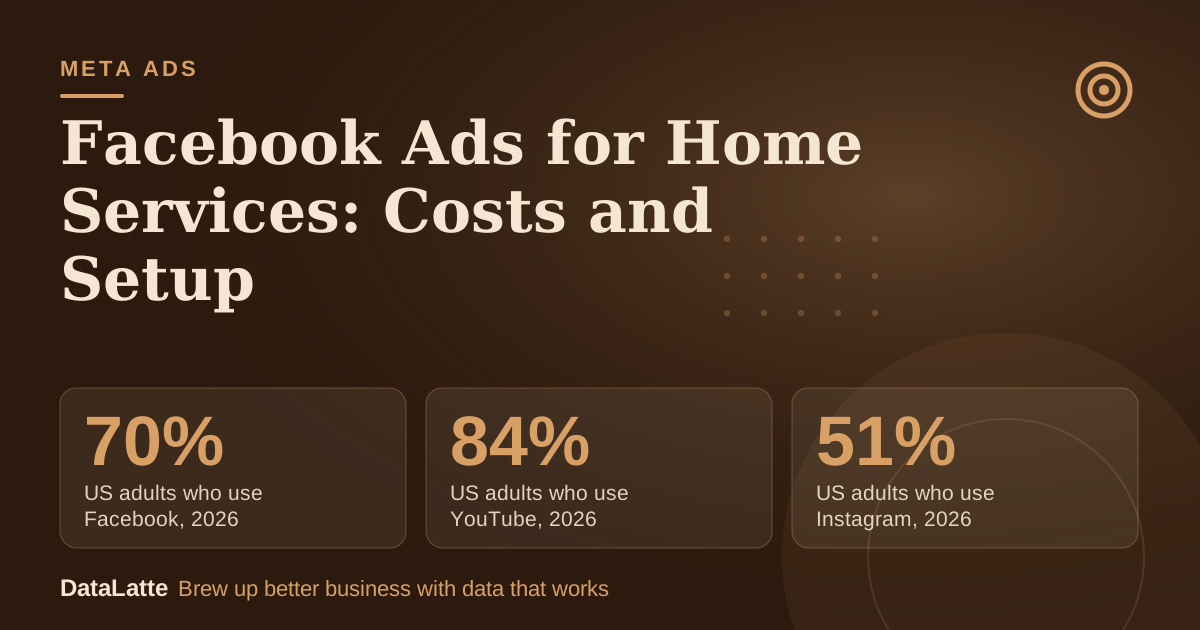
Facebook lead ads can work for home services such as plumbers, cleaners, roofers and landscapers, but the campaign should be judged by cost per booked job, not cost per lead. Facebook has a large audience: Pew Research Center's 2026 survey found 70% of US adults use it, so many local customers are likely there too. The sources behind this guide do not include a verified Facebook cost-per-lead figure for home services, so this guide gives a formula and an example built on labelled assumptions. Use your own numbers before scaling.
↓
US adults who use Facebook, 2026
vs 71% in 2025
→
US adults who use YouTube, 2026
vs 84% in 2025
↑
US adults who use Instagram, 2026
vs 50% in 2025
↑
US adults who use Nextdoor, 2026
vs 13% in 2021
See Sources at the end of the article. Cards marked Assumption are examples, not results.
Who Can You Reach on Facebook for Home Services?
Facebook is the second most used platform among US adults in
Pew's 2026 social media fact sheet, behind YouTube at 84%. Its share has stayed between 68% and 71% in every survey since 2016, so it is a stable channel rather than a short-lived trend. Instagram is used by 51% of adults and Nextdoor by 18%, up from 13% in 2021.
These figures describe who uses a platform, not who is planning a job. Pew does not measure homeowners or hiring intent, so treat the numbers as the size of the audience, not a targeting promise. A plumber in a town of 50,000 still needs to reach the right streets, which means the service area and offer matter more than the platform total.
Is Facebook or Google Better for Home Services?
They catch different moments. Google's
Display Network reaches people as they browse websites, apps and Google-owned properties such as YouTube and Gmail, and Google states that Display can reach people across 35 million websites and apps. Search ads appear when someone types a request, such as a burst pipe, so the intent is usually stronger.
| Factor | Facebook lead ads | Google Search |
|---|
| Typical moment | Browsing or planning | Active need |
| Usual intent | Lower | Higher |
| Best for | Planned jobs such as gutters, painting, seasonal tune-ups | Urgent or same-week jobs |
| Audience control | Service area and form questions | Keywords and location |
These intent patterns are general and are not measured in the sources for this guide. Compare the cost per booked job for each channel in your own records. The
Google Ads vs Facebook Ads comparison covers the trade-offs in more detail, and the
Google Local Services Ads guide explains that search option for trades.
How Much Should a Home Service Business Spend on Facebook Ads?
There is no sourced Facebook benchmark for home services in this guide, so the best starting point is a budget that can be sustained for at least four weeks. WordStream's
Google Ads benchmarks list an all-industry average of $2.69 per search click and $0.63 per Display click. That page is a vendor benchmark first published in 2016 and is not specific to home services, so treat it as context only.
The useful question is how many booked jobs a budget buys. Divide the monthly budget by cost per lead, then multiply by the share of leads that are reached, quoted and won. The
budget guide for local businesses explains how to set the starting number, and the worked example below shows the arithmetic with every input labelled.
What Does a Monthly Budget Look Like? A Worked Example
Every input in this table is an assumption. Replace each one with your own figures.
| Input | Value |
|---|
| Monthly budget (assumption) | $1,000 |
| Cost per lead (assumption) | $50 |
| Leads | 20 ($1,000 divided by $50) |
| Share of leads reached and quoted (assumption) | 60%, so 12 quotes |
| Share of quotes won (assumption) | 25%, so 3 jobs |
| Cost per booked job | $333 ($1,000 divided by 3) |
| Average job value (assumption) | $450 |
| Revenue from 3 jobs | $1,350 |
| Revenue per $1 of ads | $1.35 |
If the win rate falls to 10%, the campaign books 1.2 jobs and the cost per booked job rises to about $833. Follow-up speed and the quote itself often move this number more than extra budget does. Record the average job value and win rate before starting, because without them it is not possible to tell whether any cost per lead is good.
Can You Target Homeowners on Facebook?
The sources for this guide do not describe Meta's current targeting options for homeowners, so check Ads Manager before assuming a homeowner filter exists. Do not build the campaign around a "homeowner" label until the option has been confirmed.
What can be controlled is the geography, the offer and the form. Draw the service area around the towns or postcodes that can be reached on the same day. Name the area in the ad copy, such as "Serving [town] and nearby suburbs". Then add a qualifying question to the lead form, such as the postcode or suburb, so out-of-area enquiries are easy to spot and drop.
How Do You Test Facebook Ads Fairly?
Meta's
A/B testing guide describes a test as comparing two versions of an ad strategy by changing one variable, such as the image, text, audience or placement. Each version is shown to a separate segment, so nobody sees both. Meta recommends choosing a hypothesis first, for example that a custom audience will outperform an interest-based one.
Use the same budget for both versions so the comparison is fair. Meta advises against informal testing by switching ad sets on and off manually, because that can create overlapping audiences and unreliable results. For a broader view of whether the channel pays, read
whether Facebook ads actually work for local businesses. For creative ideas, the
home remodeling marketing guide covers how project photos can be used.
How Should You Set Up a Local Campaign?
- Choose a lead generation goal, and decide whether leads will come through a form or a phone call.
- Draw the location around the area that can be reached the same day, and keep it tight.
- Make one offer for one service, with one clear next step, such as requesting a quote.
- Keep the form short: service needed, postcode or suburb, and when the job is needed.
- Call or text each lead quickly. A lead nobody answers is wasted spend, whatever it cost.
- Track each lead to a booked job in a spreadsheet, so cost per booked job is always visible.
FAQ
How much should a home service business spend on Facebook ads?
No sourced benchmark in this guide sets a Facebook budget for home services. Start with an amount that can be sustained for at least four weeks, then scale only if cost per booked job holds up in your own records.
Are Facebook leads worse than Google leads?
Usually they carry lower intent, because people were often browsing rather than searching for an urgent job. The sources here do not measure lead quality, so compare cost per booked job across both channels in your own account.
Do I need a landing page?
Not necessarily. If traffic goes to a website, the page should show the service area, phone number and one clear offer.
Can I exclude people outside my service area?
Set a tight location and add a qualifying question to the form. The sources do not confirm how precisely Meta can exclude out-of-area users, so check the current location options in Ads Manager.
Sources
Want a local campaign set up and tracked by cost per booked job?
Book a free audit and the review will cover your service area, offer and lead follow-up.
Free for local businesses
Want this applied to your business?
I'll review your Google presence, local SEO, and ad accounts — and send you a specific action plan within 48 hours. No pitch, no pressure.