Google Ads works for a Lexington coffee shop when it reaches people already searching for coffee nearby. Use a tight local radius, start with exact and phrase match on a few high-intent terms, and send clicks to a page where visitors can call, book, or get directions. Hold broad match for later. Set up the Google Business Profile first, since verification takes time, and judge the campaign only after enough conversion data has built up. The sections below cover keywords, budget math, setup order, and tracking.
→
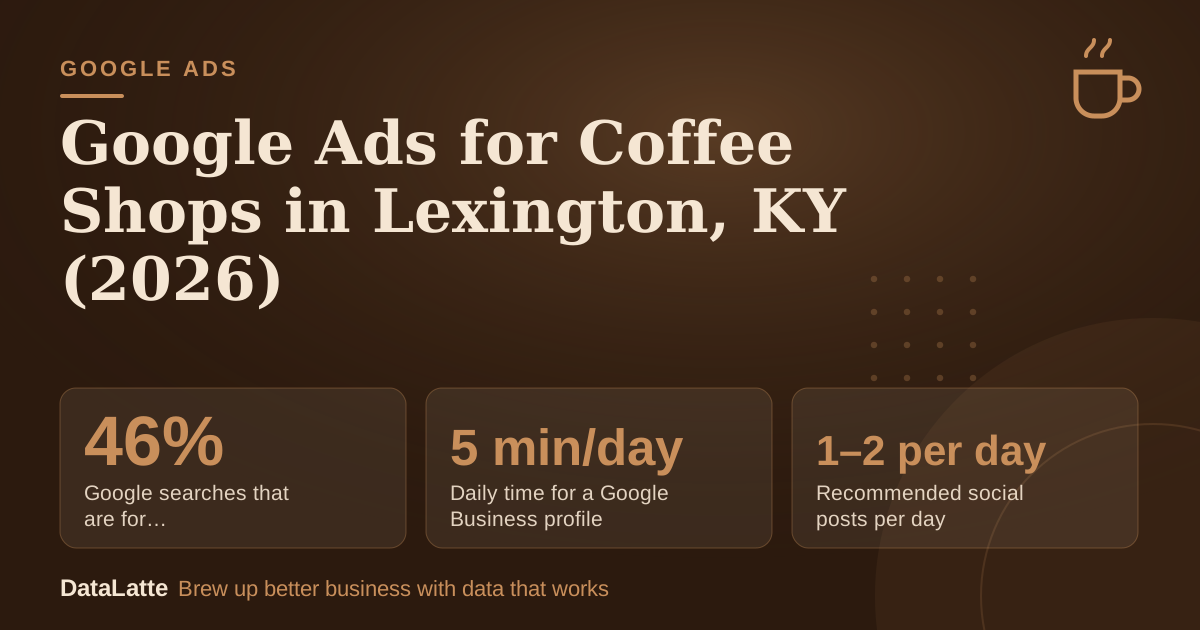
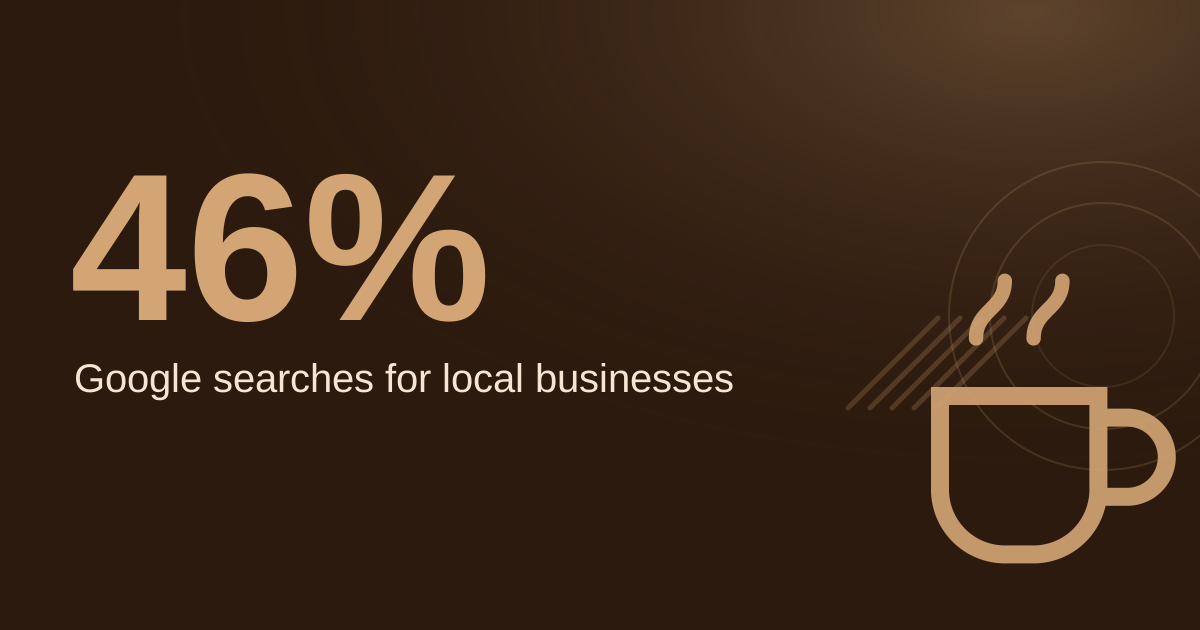
Google searches that are for local businesses
BrewRound, 2020, uncited, secondary
→
Daily time for a Google Business profile
Bellwether Coffee, secondary
→
Recommended social posts per day
The Restaurant HQ, ideal range, secondary
→
Minimum social posts per week
The Restaurant HQ, minimum, secondary
See Sources at the end of the article. Cards marked Assumption are examples, not results.
Why does local search matter for a Lexington coffee shop?
BrewRound states that 46% of all Google searches are for local businesses. The page cites no source and dates from 2020, so treat the figure as a rough signal rather than a benchmark.
BrewRound (secondary)
The profile and the ad do different jobs. The ad captures a search click at the moment someone wants coffee nearby. The profile holds the details that help that person choose you: hours, directions, and answers to practical questions. Per Diem recommends answering common questions in the profile's Q&A section proactively, such as whether a shop offers free Wi-Fi, dairy-free options, or dogs on the patio.
Per Diem (secondary)
Which keywords should a Lexington coffee shop bid on?
A seoplus+ guide compares a localized phrase such as "coffee shop downtown Phoenix" with the generic "coffee shop", stating that the localized phrase is likely to have less competition and can lead to a lower cost per click.
seoplus+ (secondary) The example is from Phoenix, but the same logic applies to place-based terms in Lexington, such as a neighborhood near your address.
Group keywords by intent and set the match type for each group:
| Keyword group | Example terms | Match type to start with |
|---|
| Near-me service | coffee shop near me, café near me | Exact |
| Neighborhood plus service | coffee shop Chevy Chase, coffee shop Hamburg | Phrase |
| Quality-focused | best coffee Lexington, specialty coffee Lexington | Phrase, then test |
| Generic discovery | coffee shop, coffee | Broad, only after conversion data |
The first two groups carry the most purchase intent for a shop near those searchers. Add the discovery group once the tighter campaigns are producing conversions you can measure. For a broader view of keyword selection, see
best Google Ad keywords for coffee shops in 2026.
How much budget does a Lexington coffee shop need?
No sourced cost-per-click benchmark for Lexington is available here, so the example below uses assumptions. Replace each input with figures from your own account before deciding on spend.
Assumed inputs:
- Monthly budget: $1,000 (assumption)
- Average cost per click: $3.00 (assumption)
- Click-to-visit conversion rate: 4% (assumption)
- Average spend per visit: $6 (assumption)
- Visits per customer per year: 24 (assumption)
- Gross margin: 60% (assumption)
Clicks are $1,000 divided by $3.00, which gives 333. New customers are 333 multiplied by 4%, which gives 13.3. Cost per new customer is $1,000 divided by 13.3, or $75, which equals $3.00 divided by 4%. Annual gross profit per customer is $6 multiplied by 24 visits multiplied by 60%, or $86.40.
On these assumptions, a new customer covers the acquisition cost within a year, but only if they keep returning. The table shows how sensitive the result is:
| Scenario (all inputs assumption) | Clicks | New customers | Cost per customer |
|---|
| Base: $3.00 CPC, 4% conversion | 333 | 13.3 | $75.00 |
| Higher CPC: $4.00, 4% conversion | 250 | 10.0 | $100.00 |
| Lower conversion: $3.00 CPC, 2% | 333 | 6.7 | $150.00 |
If visits drop to 12 a year, annual gross profit falls to $43.20, which is below the $75 acquisition cost. The campaign would not pay back in year one under that assumption.
What should you set up before the ads go live?
Set up the Google Business Profile before spending on ads. Google verifies a listing before it goes live, usually by mailing a postcard with a code to the business address, though some businesses can verify by phone or email.
Per Diem (secondary) BrewRound describes the same postcard process in its 2020 guide.
BrewRound (secondary) Because the code can take time to arrive, start the verification early. A new shop launching soon should read
coffee shop grand opening marketing alongside this step.
Work through this checklist before the first click:
- Confirm the listing is verified and live.
- Choose "Coffee shop" or a closely related term as the category, not something broad like "Restaurant". BrewRound notes that only one category can be selected at creation, with more added later.
- Add answers to common questions in the Q&A section before customers ask them.
- Turn on direct messaging, since Google allows users to message businesses through their listings, and check replies daily.
- Add an app or ordering link if you have one. Per Diem reports that Think Coffee, an independent brand, has thousands of app downloads after placing its app link in its Google profile. Per Diem (secondary)
Which conversions should you track?
Set up conversion tracking before the campaign runs, so the first weeks of data are usable. Track these four actions:
- Calls from the ad, using a call tracking number
- Booking or contact form completions on your website
- Direction requests from the Google Business Profile
- Clicks on "book now" or contact buttons, as a micro-conversion signal
Cost per customer, as in the worked example above, depends on which of these you count as a conversion. Count only actions that represent a real customer intention, and keep the list short enough to review each month. Once a lead arrives,
marketing automation for local coffee shops covers how to follow up without manual work.
How do you stop budget going to the wrong searches?
Start with exact match on your top converting terms and phrase match on neighborhood combinations. Broad match on generic terms such as "coffee shop" or "coffee" can pull in a large volume of irrelevant searches, so keep it out of the account until you have conversion data to judge it against.
Add negative keywords from the start. Useful exclusions for a coffee shop include:
- Job-related terms such as "jobs", "hiring", "career", or "coffee shop salary"
- Training terms such as "how to", "course", "training", or "certification"
- Other cities outside your service area
- Irrelevant modifiers such as "franchise", "wholesale", or "supplier"
Target a radius around your shop address instead of the full metro area. Customers are more likely to act on an ad for a shop they can reach, so a tighter radius usually makes better use of the same budget. Review the search terms report weekly during the first months and add new exclusions as they appear.
Do not run broad match on generic coffee terms in a new account. Without tight negative keywords, broad match spends money on searches that will not turn into visits.
Frequently asked questions
How much should a Lexington coffee shop spend on Google Ads?
No fixed figure is sourced here. Divide your monthly budget by your actual cost per click to estimate clicks, then apply your real conversion rate, as the worked example shows. Choose a budget you can keep running long enough to collect meaningful data.
Should the Google Business Profile be set up before running ads?
Yes. Verification usually involves a postcard with a code, so the listing may not be live for some time. Choose the coffee shop category and answer common questions in the Q&A section before spending on ads.
Is broad match a good starting point?
Usually not. Start with exact and phrase match on the terms closest to a purchase decision, and add broad match once conversion data shows which searches produce customers.
How do you know whether Google Ads is working?
Track calls, booking completions, and direction requests, then compare cost per customer with gross profit per customer, as in the worked example. For current account features and reporting options, check Google's live Ads help pages.
If you want a Lexington setup built around your radius, keywords, and tracking, DataLatte's
Google Ads service covers the campaign work. A
free audit can review your current profile and account before any spend changes.
Sources
Free for local businesses
Want this applied to your business?
I'll review your Google presence, local SEO, and ad accounts — and send you a specific action plan within 48 hours. No pitch, no pressure.