Google Ads can put a coffee shop in front of people who are already searching for coffee nearby. For an Oklahoma City shop, the approach that tends to work is narrow: bid on high-intent local phrases, keep the campaign inside an area a customer would realistically travel to, and check every dollar against what a new customer is worth. This guide covers keywords, the Google Business Profile that sits behind every ad click, and a break-even calculation built on assumed inputs. Where a figure is an assumption, the text says so.
→
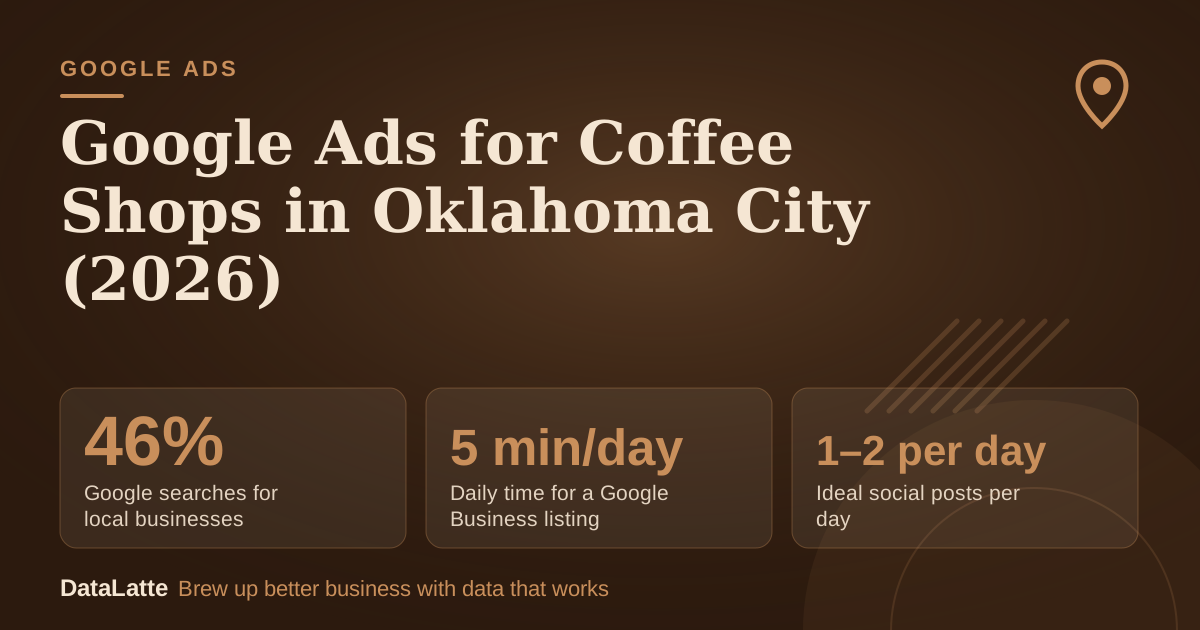
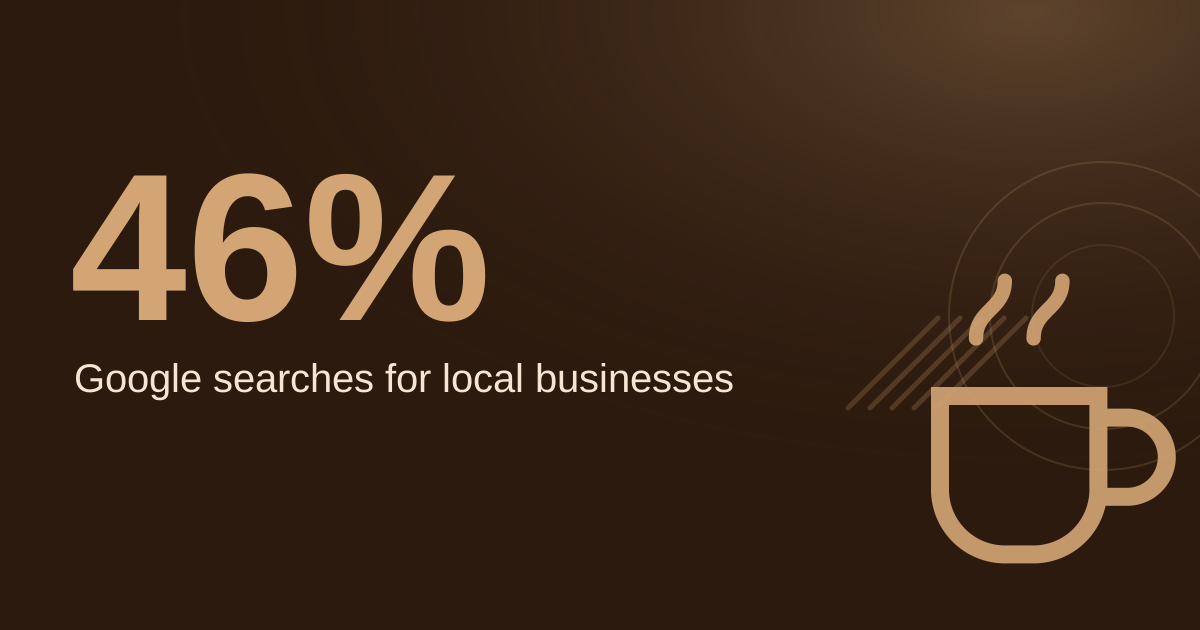
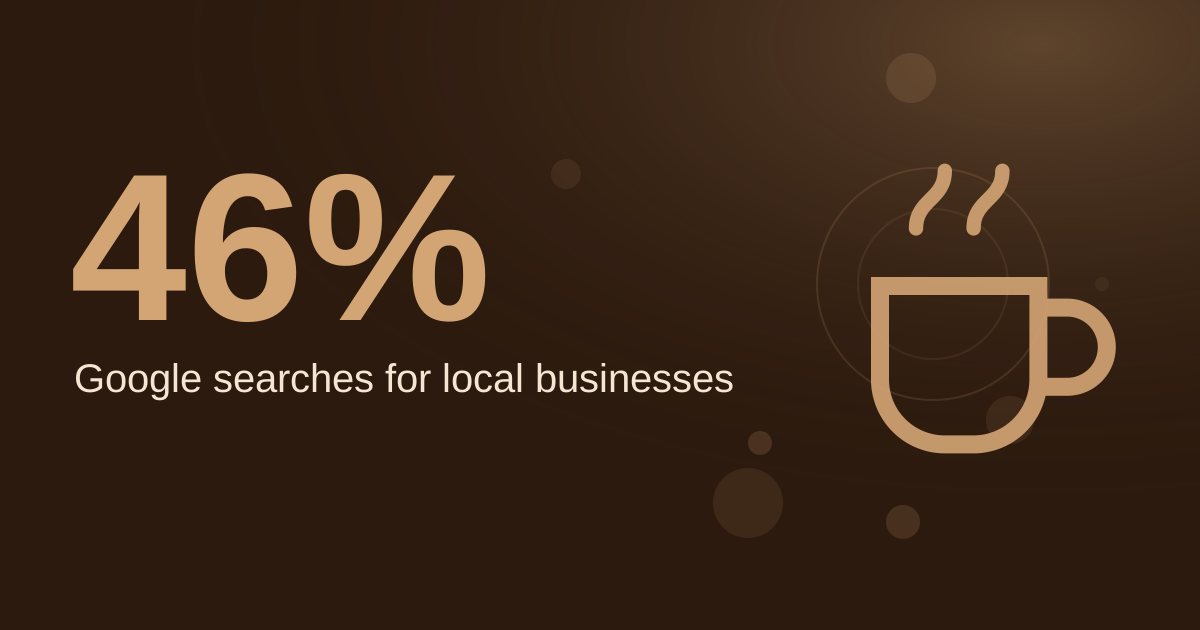
Google searches for local businesses
BrewRound 2020 no source cited (secondary)
→
Daily time for a Google Business listing
Bellwether Coffee guide (secondary)
→
Ideal social posts per day
The Restaurant HQ social guidance (secondary)
→
Category chosen at listing setup
BrewRound one category at setup (secondary)
See Sources at the end of the article. Cards marked Assumption are examples, not results.
Which keywords should an Oklahoma City coffee shop bid on first?
Start with phrases that describe what a customer wants right now. Salesforce gives examples of location-specific long-tail phrases such as "best coffee shop in [city]" (
Salesforce local marketing guide). For an Oklahoma City shop, that means building variations around "best coffee shop in Oklahoma City", "coffee shop near me", and the neighbourhoods your customers actually live and work in.
Localised phrases also tend to be cheaper to bid on. The seoplus+ guide to multi-location campaigns states that a localised phrase such as "coffee shop downtown Phoenix" is likely to face less competition than a generic term like "coffee shop", which can lead to a lower cost per click (
seoplus+ multi-location PPC guide). Treat that as a vendor claim to test in your own account, not a guaranteed result.
Keyword research for a specific shop is covered in more detail in
Best Google Ad Keywords for Coffee Shops in 2026.
How should the Google Business Profile be set up before ads go live?
Ads send people to a listing, so the listing needs to answer their questions. Per Diem recommends choosing the "Coffee shop" category or a related term rather than something broad such as "Restaurant" (
Per Diem Google Business guide). BrewRound notes that only one category can be selected at creation, with more added later (
BrewRound).
Verification takes time, so plan for it. Google usually mails a postcard with a code to the business address, though some businesses can verify by phone or email (
Per Diem). BrewRound adds that the profile does not appear in results until it is verified (
BrewRound). Running ads to a listing that is not yet live wastes the first weeks of spend.
Once live, answer common questions in the Q&A section before customers ask them. Per Diem suggests covering free Wi-Fi, dairy-free options, and whether dogs are allowed on the patio. Google also lets users message businesses directly through their listings. Bellwether Coffee estimates that a Google Business listing needs about 5 minutes a day (
Bellwether Coffee), which is a realistic routine for a small team to maintain.
What does a break-even budget look like at $1,000 a month?
Before choosing a budget, work backwards from what a new customer is worth. The example below uses assumed inputs, not benchmarks. Replace them with your own till data and Google Ads reports.
Assumed inputs:
- Monthly budget: $1,000 (assumption)
- Average cost per click: $3.00 (assumption)
- Click-to-customer rate: 4% (assumption)
- Visits per new customer in their first three months: 3 (assumption)
- Average spend per visit: $6.00 (assumption)
| Step | Calculation | Result |
|---|
| Clicks bought | $1,000 ÷ $3.00 | 333 clicks |
| New customers | 333 × 4% | 13.3 customers |
| Revenue from those customers | 13.3 × 3 visits × $6.00 | $240 |
| Value per new customer | $240 ÷ 13.3 | $18 |
| Customers needed to break even | $1,000 ÷ $18 | 56 customers |
| Click-to-customer rate needed | 56 ÷ 333 | about 17% |
At these assumed inputs, the campaign does not pay back. Revenue is not profit, so gross margin would lower the result further. The levers are the value of each customer, the click-to-customer rate, and the cost per click. Repeat visits matter most here, which is why follow-up matters;
email examples for coffee shops show how shops keep past customers coming back.
Which negative keywords and match types keep spend on target?
Match types control how closely a search must fit your keyword. Exact match suits your strongest converting terms, because it gives the most control. Phrase match works for neighbourhood and service combinations. Broad match is better kept for discovery after exact and phrase campaigns are already converting, since it lets Google show ads for loosely related searches.
Negative keywords stop ads appearing for searches that rarely turn into customers. Common exclusions for a coffee shop include job-related terms such as "jobs", "hiring", "career", and "salary"; learning-related terms such as "how to", "course", and "training"; and commercial terms that do not match a retail café, such as "wholesale", "supplier", and "franchise". Add city names outside your service area as well.
Review the search terms report regularly and add new negatives as they appear. A short, well-maintained negative list usually does more for budget control than adding more keywords.
Does a tight radius around the shop reduce wasted clicks?
Google Ads lets you target a radius around your address, and for a neighbourhood coffee shop a tight radius is usually more relevant than a metro-wide one. The distance is a judgement call. Three to five miles is an assumption for a typical café customer, not a sourced figure. Check it against the locations where your current customers actually come from.
Local intent is a reasonable reason to focus this way. BrewRound states that 46% of all Google searches are for local businesses, but the page cites no source and dates from 2020, so treat it as a rough indication only (
BrewRound).
Narrowing the radius also makes it easier to see what is working. When the area is small, you can compare click volume, calls, and direction requests against the neighbourhoods you named in your campaigns. Marketing automation can then handle follow-up for people who contact you, as described in
Marketing Automation for Local Coffee Shops.
FAQ
How much should an Oklahoma City coffee shop spend on Google Ads?
No sourced benchmark for Oklahoma City is available here. Use the break-even method above with your own cost per click and customer value. Choose a budget you can sustain long enough to collect a useful number of clicks and conversions before judging the result.
Does a coffee shop need a Google Business Profile before running ads?
It helps considerably. Ads drive people to a listing, and a listing that is unverified does not appear in results. Verification can take time, so start it early and make sure the category, hours, and Q&A answers are accurate before spend begins.
Is Oklahoma City a low-competition market for coffee shop ads?
This article does not rely on a sourced figure for competition in Oklahoma City. Check the Auction Insights report inside your Google Ads account, which shows how often you compete with other advertisers for the same searches.
How long does it take to see results from Google Ads?
No reliable timeline is sourced for this article. Set a test period in advance, track clicks, calls, and direction requests from the start, and judge the campaign against the break-even figure once you have enough data.
If you want help building a campaign around your own numbers,
DataLatte's Google Ads service covers setup, keyword structure, and conversion tracking for local businesses.
Sources
Free for local businesses
Want this applied to your business?
I'll review your Google presence, local SEO, and ad accounts — and send you a specific action plan within 48 hours. No pitch, no pressure.