DataLatte☕
Google Ads

Google Ads for Dog Daycare: Cost of a New Regular
Infographic: Google Ads for Dog Daycare: Cost of a New Regular

Part of the guide: Pet Groomer Google Ads

May 21, 2026·Nataliia Rumiantsewa· 9 min read All posts
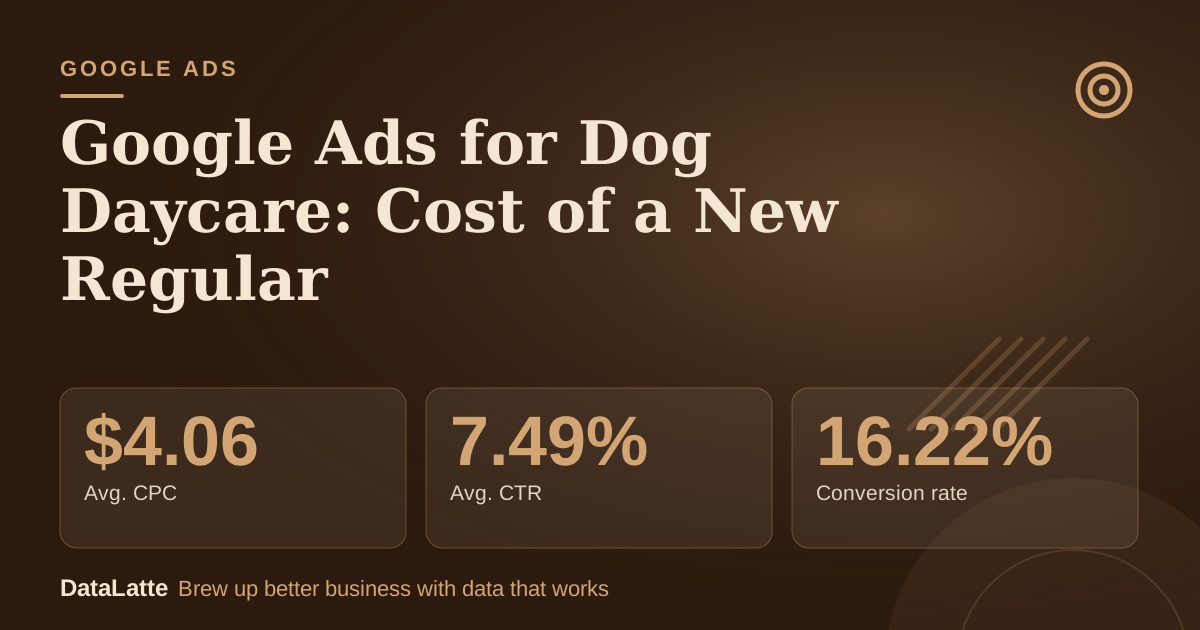
A $300 test budget at the published Animals and Pets average click price of $4.06 buys about 74 clicks. If one in ten becomes an enquiry and three in ten of those book a trial day, that is about two new dogs.
Whether two dogs justify $300 depends entirely on what a regular is worth to you, which is why this guide starts with the maths and ends with a checklist. Most of the inputs are assumptions you can replace in an afternoon.
It is written for dog daycare owners in the US, UK, Australia and Canada. Dollar figures are US benchmarks; run the same sums in your own currency.

What the Benchmarks Say (and Their Limits)

Nobody publishes a clean dog daycare benchmark. The closest is the broad "Animals and Pets" category from the 2026 LocaliQ and WordStream Search Advertising Benchmarks, which Hawky summarises. These figures cover more than 13,000 US Search campaigns across 23 industries from April 2025 to March 2026, blending Google and Microsoft ads.
$4.06→

Avg. CPC

LocaliQ via Hawky

7.49%→

Avg. CTR

LocaliQ via Hawky

16.22%→

Conversion rate

LocaliQ via Hawky

$31.50→

Cost per lead

LocaliQ via Hawky

See Sources at the end of the article. Cards marked Assumption are examples, not results.

These figures come through Hawky's summary of the LocaliQ report, so they are second-hand. A caution about the conversion rate: 16.22% is high compared with the 8.18% all-industry average Hawky reports for the same data set.
The pets category includes vets and emergency searches, where people ring in a hurry, and a daycare enquiry is a more considered decision. Do not expect 16% on "dog daycare near me".
Webtonic's veterinary roundup, which uses MDMPPC account data, shows a 2025 CPC of $1.63 and a conversion rate of 17.3%, but it has no figures for daycare or boarding, so treat vet data as a loose upper bound, not a forecast.
The sensible plan is to test with your own budget and treat the benchmark as a rough ceiling.

Step 1: Research Your Keywords With Real Numbers

Google's Keyword Planner shows estimated monthly searches, forecasts for clicks and conversions, and the average cost for an ad to show on a keyword. Google says you must finish account setup, including billing information, to use basic features, so set that up first. Then check your own town, because a small market and a big metro will price very differently.
Starter list:
Ad groupKeywordsMatch
Core daycare"dog daycare near me", [dog daycare], "doggy daycare [town]"Phrase + exact
Neighbourhood"dog daycare [neighbourhood]", "dog daycare [zip or postcode]"Phrase
Puppy and social"puppy daycare", "puppy socialization class"Phrase (only if offered)
Boarding"dog boarding [town]", "overnight dog boarding"Phrase (only if offered)
Your name[your daycare name]Exact
Exact match, Google says, "gives you the most control over who sees your ad but reaches the fewest searches." With a small budget, avoid broad match until you have conversions, since Google says broad match needs Smart Bidding.

Step 2: Negative Keywords

Add jobs, careers, hiring, franchise, salary, course, certification, training (unless you train dogs), grooming (unless you groom), vet, adopt, rescue, cheap, free, kennel (if you do not board), walker and sitter (people wanting in-home care). The last two are my suggestions, since a dog walker search often means a different customer.
Google notes that asterisks can be used in negative keywords but not in normal ones. Our negative keywords guide covers lists and match types. Check the search terms report each week.

Step 3: Set Up the Campaign

  • Campaign type: Search, one location.
  • Location: a radius or list of postcodes that clients can realistically reach for daily drop-off. Pull your current client addresses first and see how far most travel. Google's default location option, "presence or interest", also includes people merely interested in a place, so I would choose presence only (my advice, not a Google rule).
  • Bidding: Maximize Clicks with a cost-per-click cap to start, then switch to a conversion-based strategy after steady conversions.
  • Schedule: run when someone can answer or when your online booking form works. Be honest about capacity: if you have a waitlist, pause ads.

Step 4: Ads That Answer a Worried Owner

Good dog daycare ads answer: is it close, is it safe, what does it cost, can I book?
  • Headlines: Dog Daycare in [Neighbourhood], Supervised Small Play Groups, Book a Trial Day, Vaccinations Required
  • Description: Staff-supervised play, separated by size and temperament. Webcam updates. Request a tour today.
Use only claims that are true, and avoid "best in town". Responsive search ads take up to 15 headlines of 30 characters and 4 descriptions of 90, per Google. Add a call asset, a location asset linked to your Business Profile, and sitelinks for Prices, Hours, FAQs and Tour.

Step 5: The Landing Page Is Half the Result

Send clicks to a page built for one action. It should have:
  • A headline repeating the ad's promise, and real photos of your space and dogs
  • Prices or ranges, hours, vaccination rules and your temperament evaluation explained in two lines
  • Two or three real reviews
  • A short form (dog name, breed, age, phone) and a tap-to-call button
  • A clear next step: "Book a trial day" beats "Learn more"
Do not send ad traffic only to an Instagram profile. If you do not have a site, a one-page site with a booking button is a better home; see our landing page best practices and website service.

Step 6: Track Calls, Forms and Booked Trials

Without tracking, you are buying traffic, not clients. Set up form submissions, calls from ads and calls from the website. Google's help says call conversions can be set to count only calls that last longer than a minimum length, and that the website phone snippet swaps your number for a Google forwarding number. See our conversion tracking guide for the steps.
Then count what matters yourself: how many trial days happened, and how many became regulars. Ask every new client how they found you and write it down.

The Math

A $500 monthly test, three scenarios. Every row is an assumption for illustration, with CPC anchored to the $4.06 benchmark and the Strong lead rate matched to the 16.22% benchmark (which I treat as optimistic).
ToughBaseStrong
Monthly budget (assumption)$500$500$500
Cost per click (assumption)$5.50$4.06$3.50
Clicks91123143
Click to enquiry rate (assumption)4%10%16.22%
Enquiries3.612.323.2
Cost per enquiry$138$41$22
Enquiry to regular rate (assumption)20%30%40%
New regulars0.73.79.3
Ad cost per regular$687$135$54
Monthly revenue per regular (assumption)$300$300$300
Margin (assumption)35%35%35%
Months of margin to repay ad cost6.51.30.5
How to read it: payback months is ad cost per regular divided by $105 of monthly margin ($300 x 35%). In the Tough case, you need a regular to stay over six months. If your average regular stays four months, you lose money there; at eight months, you win. Pull your real retention from your booking software before scaling.
Your break-even click price: maximum CPC = the most you will pay per regular x enquiry rate x regular rate. If you will pay $200 per regular, at 10% and 30% your ceiling is $200 x 0.10 x 0.30 = $6.00 a click.
Two more points. First, capacity caps the upside. If you only have eight free spots, nine new regulars is a problem, not a win. Second, close rate is a free lever. Calling back a form enquiry within the hour, and offering a trial day rather than a tour, can double the enquiry-to-regular rate without any ad spend.
Test, Then Scale
Run the Base budget for four to six weeks (my rule of thumb) before judging. Then raise spend by about 20% only on campaigns that hit your target cost per regular.

Weekly Routine (20 Minutes)

  1. Read the search terms report and add negatives.
  2. Pause keywords that spend about twice your target cost per enquiry with no enquiries.
  3. Check calls and forms by day and time; match the ad schedule to when you answer.
  4. Rotate one new headline every two weeks.
  5. Compare cost per regular with what a regular is worth.
For related reading, see Google Ads mistakes pet groomers make, Google Ads for pet boarding and Google Ads for dog groomers. Pair ads with a complete Google Business Profile, because owners compare reviews and photos before they click.

Do This Today

  1. Write down your monthly revenue per regular, margin, and average months a client stays. Work out the most you will pay per new regular.
  2. Pull your last 30 client addresses and draw your ad radius from them.
  3. Open Keyword Planner and check cost and volume for "dog daycare near me" and your neighbourhood terms.
  4. Build one Search campaign with the five ad groups above and the negative list, then set up form and call conversions before turning ads on.
  5. Create a landing page with prices, vaccination rules, photos and a "book a trial day" form, and set a one-hour reply rule for every enquiry.

FAQ

Q: How much should a dog daycare spend on Google Ads? A: There is no official figure. A test of about $300 to $500 a month is a reasonable starting point (my suggestion). At the $4.06 Animals and Pets average click, $300 buys about 74 clicks, so judge over several weeks, not days.
Q: Is "dog daycare near me" worth bidding on? A: Yes, as a test, because intent is high. Judge it by cost per regular, not cost per click.
Q: Can I rely on word of mouth and Yelp instead? A: Referrals are valuable, and ads are not a replacement. Ads reach people actively searching who have never heard of you, and you can measure cost per new client.
Q: What if someone clicks but does not book? A: That is normal. Many owners compare several daycares and wait for a free trial slot. Improve the page, follow up quickly and measure cost per booked trial.
Q: Should I run ads on weekends? A: Test it. Drop-offs are mostly weekday, but weekend searches can matter. Review performance by day and time after a few weeks.
Q: Do I need a website? A: You can send traffic elsewhere, but a simple page with prices and a booking form gives you something to measure.

Sources

Want your daycare campaign built with call and booking tracking? See our Google Ads service or contact DataLatte.

Free for local businesses

Want this applied to your business?

I'll review your Google presence, local SEO, and ad accounts — and send you a specific action plan within 48 hours. No pitch, no pressure.

google ads for dog daycaredog daycare marketingpet business advertising

Want hands-on help?

See how DataLatte handles Google Ads Management for local businesses.

Learn more
Nataliia — local marketing expert
Nataliia Rumiantsewa

Local marketing strategist with 10+ years at global agencies — OMD, Dentsu, GroupM, and BBDO. Now helping small businesses get the same data-driven edge. Based in Europe, working with clients in the US, UK, Australia, and beyond.
Want this applied to your business?

Let's review your current marketing setup together — free, no obligations.

Get Your Free Marketing Audit