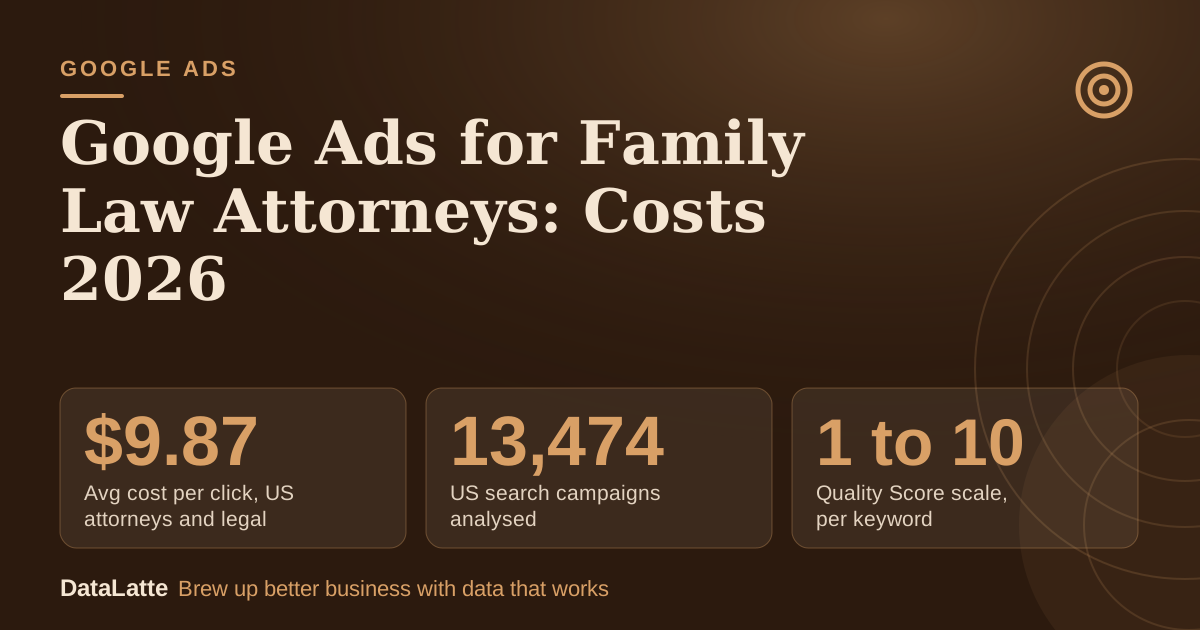
Google Ads for a family law attorney starts with a click cost of roughly $9.87 in the US, based on LocaliQ 2026 benchmark figures for attorneys and legal services as reported by Make It Loud Web. That figure covers all legal practice areas, not family law alone. Budget against cost per signed client rather than cost per click, because a click is not a client. The worked example below shows how a $3,000 monthly budget can produce a few clients or several, depending on the sign rate.
↑
Avg cost per click, US attorneys and legal
LocaliQ 2026 benchmark, via Make It Loud Web (secondary).
→
US search campaigns analysed
Across 23 industries in the same report (secondary).
→
Quality Score scale, per keyword
Google's diagnostic score, not an auction input (primary).
→
Cost per lead, one South Florida divorce firm
$2,500 a month across three counties (secondary).
See Sources at the end of the article. Cards marked Assumption are examples, not results.
What does Google Ads cost for family law in 2026?
According to the LocaliQ 2026 Google Ads benchmarks, summarised by Make It Loud Web, attorneys and legal services have the highest average cost per click of the industries studied, at $9.87. Home and home improvement came next at $8.33, up from $7.85 the year before. The study covers 13,474 US search campaigns across 23 industries, and costs vary by nearly sixfold depending on what a business sells (
Make It Loud Web, secondary).
The summary does not break out family law, so $9.87 should be read as a legal-wide average. A divorce-heavy keyword in a large metro can cost more, and a smaller city can cost less. Check your own auction data during the first two weeks before setting a final budget.
Click cost is only the first number. At $8 to $10 per click, a landing page that converts poorly turns every click into a larger loss. Measure how many clicks become calls, forms and signed clients.
What will $3,000 a month produce? A worked example
The inputs below are assumptions for illustration, not results. Replace them with your own figures before making a decision.
| Input or result | Base case | Low sign rate |
|---|
| Monthly budget (assumption) | $3,000 | $3,000 |
| Cost per lead (assumption, borrowed from one firm's case study) | $50 | $50 |
| Leads per month (budget / cost per lead) | 60 | 60 |
| Sign rate, lead to retained client (assumption) | 15% | 5% |
| Signed clients per month | 9 | 3 |
| Average retained fee (assumption) | $4,000 | $4,000 |
| Fees per month | $36,000 | $12,000 |
| Ad cost per signed client | $333 | $1,000 |
The $50 lead cost comes from a South Florida divorce firm's case study, not a legal benchmark, so it may not match your market. If cost per lead doubles to $100 (assumption), the same budget gives 30 leads and about 4 to 5 clients at a 15% sign rate.
The sign rate is the input you influence most. Slow phone answering, long forms and vague consultation offers all reduce it, and each of those problems is usually cheaper to fix than raising a bid.
Which keywords should a family law firm bid on?
Bid on people who are ready to hire, and exclude people looking for free help or researching without intent to hire. Core terms usually combine a practice area with a city, such as "divorce lawyer" or "child custody attorney" plus the city served. More specific service terms, such as uncontested divorce or modifying child support, tend to attract people closer to a decision.
Add negative keywords on day one. Terms such as free, forms, pro bono, how to file myself, jobs and salary filter out searches that rarely become paying clients. Review the search terms report weekly during the first month, since new negatives save money faster than most bid changes.
Informational searches such as "how much does a divorce cost" often cost less per click but bring readers who are not ready to hire. Test them with a small share of the budget and compare cost per signed client, not cost per click.
Google's Quality Score is a diagnostic from 1 to 10 for each keyword, built from expected click-through rate, ad relevance and landing page experience. Google states it is not an input in the ad auction and should not be optimised as a key performance indicator (
Google Ads Help, primary). Use it to find weak ad groups, not as a target.
How should the campaign be structured by county and practice area?
A South Florida family law firm running $2,500 a month across three counties gave each county its own campaign, so the three markets could be read separately. It also split divorce from custody into separate campaigns with different messaging. About 60% of leads came by phone and 40% by form, so both routes were tracked (
discovermybusiness.co case study, secondary).
Cost per lead was about $50 across the counties, but the firm reported that matters originating in Palm Beach tended to involve clients with more substantial assets and larger cases. Ad data alone could not show that. The firm had to supply which enquiries became real cases.
Ask the firm once a month which leads became consultations and signed matters, then compare that against cost by county or ad group. Without that feedback, budget is set on lead counts alone. The
Google Ads service page explains how this kind of tracking is set up.
Are Local Services Ads worth testing?
Local Services Ads are a separate product from search ads, with their own eligibility and verification rules. The sources reviewed for this article do not confirm which legal practice areas qualify or what a lead costs, so check eligibility inside your account before moving budget. The
complete guide to Google Local Services Ads explains setup, and
whether they are worth it for a local business covers the decision in more depth.
Run any test with a clear spending cap, and compare cost per signed client against search ads over the same period. Lead counts alone do not show which channel earns more.
How do I set up a campaign step by step?
- Limit the campaign to the cities or radius you can serve in court, not the whole state.
- Create one ad group per practice area, such as divorce, custody and support.
- Add negative keywords before launch and review the search terms report weekly.
- Set up call tracking and form conversion tracking before the first click.
- Build a landing page for each ad group, with one clear consultation offer.
- Review after 30 days: leads, consultations booked, clients signed and cost per client.
Thirty days is a minimum sample rather than a verdict. Calls can arrive within days, but a family law sign rate often takes weeks to show, so judge the campaign on signed clients once the data has matured. For a comparison of paid channels for local firms, see
Google Ads vs Facebook Ads for local businesses.
Lawyer advertising is regulated by each state bar. Keep headlines and landing page copy free of guaranteed outcomes, and check your state's rules before launch.
Frequently Asked Questions
Is $9.87 the cost per click for family law specifically?
No. It is the LocaliQ 2026 average for attorneys and legal services across the US, as reported by Make It Loud Web. Family law costs vary by city, keyword and competition, so check your own auction data.
How long before a family law campaign shows results?
Calls can come in within days of launch, but plan for about 30 days of data. Because family law decisions often take weeks, judge the campaign on signed clients rather than early lead volume.
Should I use display ads or search ads first?
Start with search, where people are actively looking for a lawyer. Consider display retargeting only after search campaigns have enough data to show which ad groups convert.
Can I manage Google Ads myself?
You can, but legal keywords are expensive and mistakes cost more. Review the search terms report weekly, keep negative keywords updated, and track signed clients rather than only leads.
Sources
Ready to see what cost per signed client looks like in your city?
Book a free audit.
Free for local businesses
Want this applied to your business?
I'll review your Google presence, local SEO, and ad accounts — and send you a specific action plan within 48 hours. No pitch, no pressure.