Google Ads can bring an Albuquerque pet groomer bookings from people searching for grooming right now, but the budget only pays off when keywords, location and tracking are set up tightly. Start with "dog groomer near me" style searches, plan around a benchmark cost per click of $2–$8, and measure booked appointments rather than clicks. The sections below cover each step, with a worked budget example you can adapt to your own numbers.
→
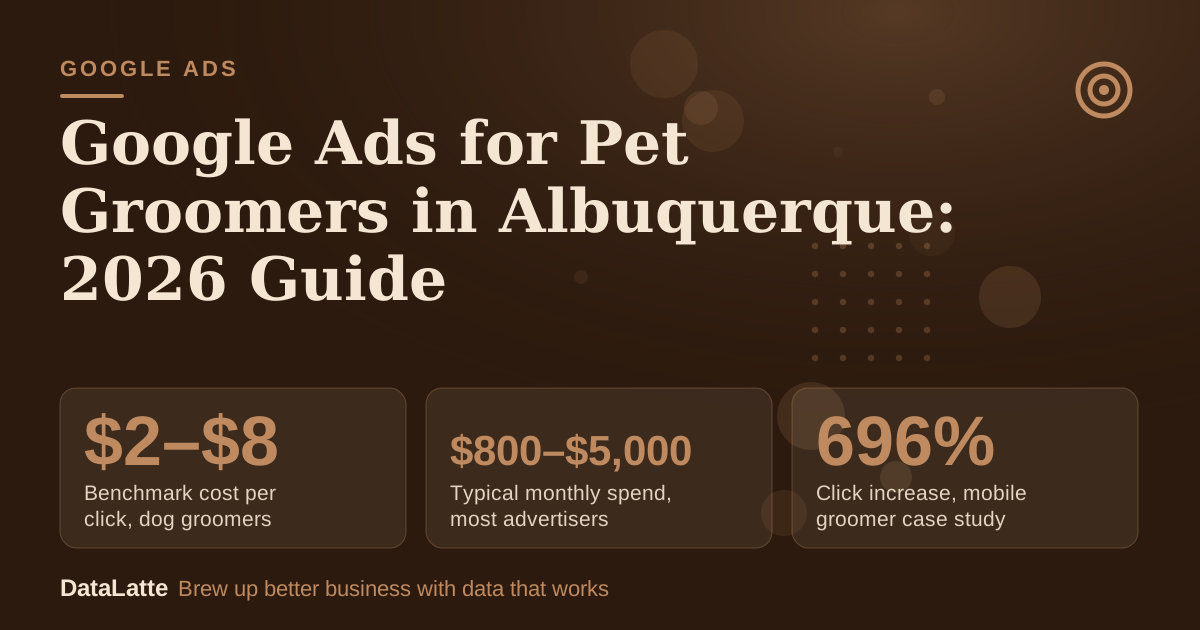
Benchmark cost per click, dog groomers
AdTurbo, per click
→
Typical monthly spend, most advertisers
AdTurbo, per month
↑
Click increase, mobile groomer case study
vs previous 6 months, reported for 2023
→
Groomer negative keywords in one vendor list
GroomerGenie, vendor claim
See Sources at the end of the article. Cards marked Assumption are examples, not results.
How Much Does Google Ads Cost for a Pet Groomer?
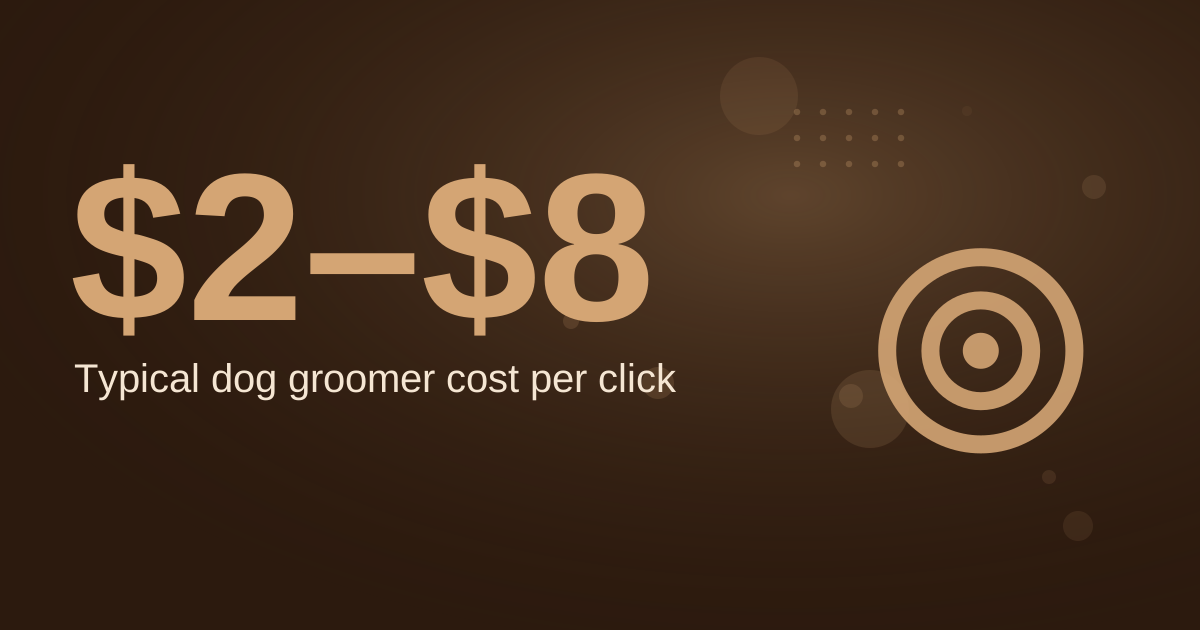
An AdTurbo page gives a benchmark cost per click for dog groomer ads of $2–$8, and notes that a few wasted clicks add up quickly at that level (
AdTurbo, Google Ads for Dog Groomers). The same page states that most dog groomer advertisers spend around $800–$5,000 per month. AdTurbo sells Google Ads management, so treat these as vendor benchmarks rather than audited averages.
Albuquerque-specific cost per click data is not in the sources behind this guide. Check live bid estimates in Google Ads Keyword Planner for your exact service terms before setting a budget.
Seasonality also changes how much you need. Groomer to Groomer notes that November and December are traditionally a very busy time for groomers, sometimes too busy (
Adwave, Pet Grooming Advertising, secondary). Plan a higher test budget for those months only if your calendar has open slots to fill.
Which Keywords Should an Albuquerque Pet Groomer Bid On?
AdTurbo lists "dog groomer near me," "dog grooming near me," and "puppy grooming near me" as keywords worth bidding on (
AdTurbo). These are intent-heavy searches: someone typing "near me" is usually ready to choose a provider today.
For Albuquerque, add your city and service-area names to these core terms, such as "pet grooming Albuquerque," and test them as separate ad groups. Keep each ad group tied to one service, so a mobile grooming ad does not send people to a salon page.
Start with exact match or phrase match on your strongest two or three terms. Broad match is harder to control, and it can spend money on searches that never lead to a booking. Once exact-match terms produce bookings, widen the list one term at a time.
If you are weighing a lead-based format alongside standard search ads,
Google Local Services Ads for pet groomers explains that option.
How Should You Set a Budget You Can Test?
Use the benchmark range to work backward from your target. The table below uses cost per click figures from the $2–$8 benchmark and budget levels that are assumptions, not recommendations.
| Monthly budget (assumption) | Clicks at $8 CPC | Clicks at $2 CPC |
|---|
| $800 | 100 | 400 |
| $1,500 | 188 | 750 |
| $5,000 | 625 | 2,500 |
The clicks column is simple division: budget divided by cost per click. Clicks are not bookings, so the next step is the conversion math.
Worked example, with every input labelled:
- Monthly budget: $1,500 (assumption)
- Cost per click: $5, a midpoint inside the $2–$8 benchmark (assumption)
- Clicks: $1,500 divided by $5 gives 300 clicks
- Booking rate from click to appointment: 4% (assumption)
- Bookings: 300 multiplied by 4% gives 12 appointments
- Average appointment value: $65 (assumption)
- Revenue: 12 multiplied by $65 gives $780
At these assumed inputs, the campaign loses money, so the test should focus on raising the booking rate or cutting the cost per click before scaling. Replace each assumption with your own numbers after the first 30 days.
Is a Single Case Study Enough to Predict Results?
Marketing 360 published a case study on a mobile pet groomer that advertised on Facebook and Google. Compared with the previous six months, the business reported a 134% increase in impressions and a 696% increase in clicks, along with a 682% increase in conversions (
Marketing 360 case study). The study is dated June 13, 2023.
A single business with a specific starting point does not predict your results. Use the case as evidence that channel mix and tracking can move numbers, not as a forecast. A realistic target is one you can measure against your own booking history.
Which Negative Keywords Protect the Budget?
GroomerGenie states its proprietary negative keyword list contains more than 500 groomer negatives (
GroomerGenie, Google Ads for Dog Groomers). That is a vendor claim, so review your search terms report rather than copying a list wholesale.
Add job and training terms to your negatives from the start. Common examples include "jobs," "hiring," "salary," "course," "certification," and "DIY." Also exclude suppliers and any city outside your service area. Check the search terms report weekly during the first month, then monthly.
What Should You Track as a Conversion?
AdTurbo names booking a grooming appointment as the primary conversion to track for dog groomer Google Ads (
AdTurbo). Set that up first, whether the booking happens through an online form, a scheduling tool or a confirmed phone call.
Secondary signals help you see the path to a booking: calls from ads, direction requests from your Google Business Profile, and clicks on "book now" buttons. Keep these separate from the primary conversion so they do not inflate your results.
Put booked appointments and cost per booking into one monthly report.
AI-driven local SEO reports with Google Data Studio shows one way to build that view.
Should You Target a Radius or the Whole City?
Barklead suggests targeting users within a 10–15 mile radius of a groomer's location, though that guidance is written for Facebook ads rather than Google Ads (
Barklead, Using Facebook Ads for Groomers, secondary). Use it as a starting point, not a rule.
In Google Ads, set location targeting around your address or service area, then compare bookings by postcode after 60 days. If one area produces bookings and another produces clicks with no appointments, shift budget toward the productive area.
If you do not have time to run this weekly,
AI tools that can replace a marketing assistant for local business covers which routine checks can be automated.
FAQ
How much should a pet groomer spend on Google Ads?
AdTurbo states that most dog groomer advertisers spend around $800–$5,000 per month (
AdTurbo). Start at the lower end, measure booked appointments for 30 to 60 days, and increase only if cost per booking stays acceptable.
Is Google Ads worth it for a pet groomer?
It depends on your booking rate and appointment value. A Marketing 360 case study reported a 696% increase in clicks for one mobile groomer over six months in 2023 (
Marketing 360). Run the worked example above with your own numbers before deciding.
Which keywords should I start with?
AdTurbo lists "dog groomer near me," "dog grooming near me," and "puppy grooming near me" as keywords worth bidding on (
AdTurbo). Start with exact or phrase match, then add Albuquerque service-area terms once those produce bookings.
What is the biggest budget mistake pet groomers make?
Spending on broad, generic searches without a negative keyword list. Review the search terms report, add job and training exclusions, and stop spending on terms that never lead to a booking. For a fuller planning view, see
Google Ads management for pet groomers.
Sources
- AdTurbo, Google Ads for Dog Groomers (vendor benchmarks for CPC, spend, keywords and primary conversion)
- Marketing 360, The Power of Smart Digital Advertising for Pet Groomers (single case study, published June 13, 2023)
- GroomerGenie, Google Ads for Dog Groomers (vendor claim on negative keyword list)
- Adwave, Pet Grooming Advertising (secondary, citing Groomer to Groomer on seasonality)
- Barklead, Using Facebook Ads for Groomers (secondary, radius guidance for Facebook)
Ready to see where your Albuquerque budget is going? Request a
free audit or talk through
Google Ads management.
Free for local businesses
Want this applied to your business?
I'll review your Google presence, local SEO, and ad accounts — and send you a specific action plan within 48 hours. No pitch, no pressure.