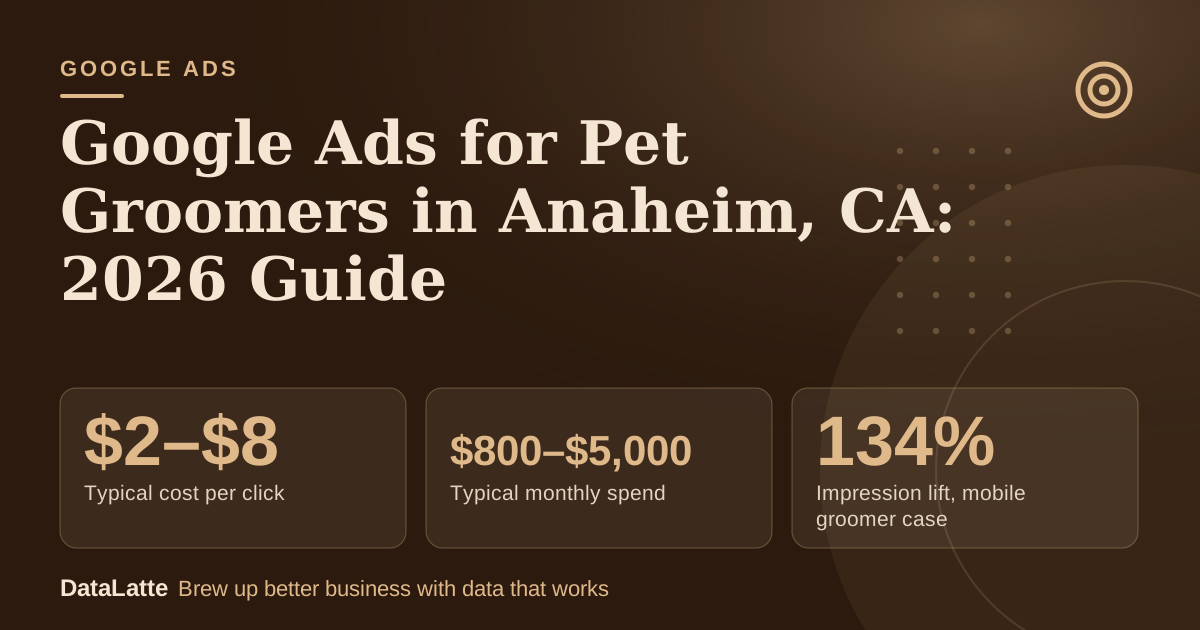
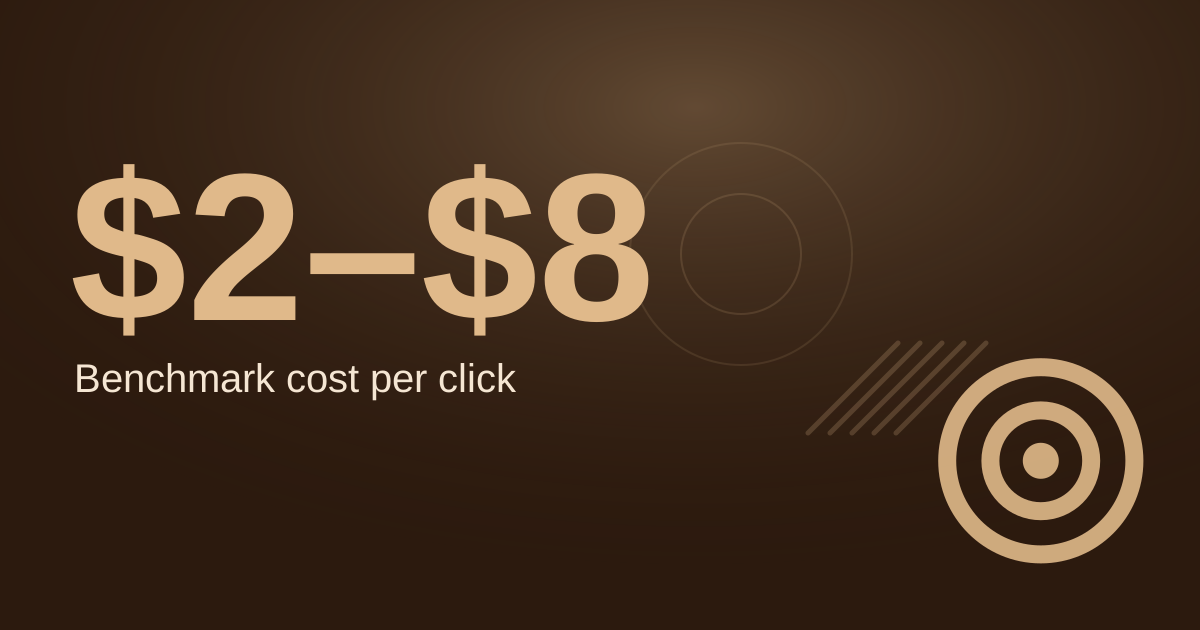
Most dog groomer advertisers spend around $800 to $5,000 a month on Google Ads, according to
AdTurbo, and the benchmark cost per click for dog groomers runs about $2 to $8. For a pet groomer in Anaheim, CA, the practical question is how to keep a modest budget focused on people searching for a grooming appointment nearby. The benchmarks here are national and vendor figures, not Anaheim-specific data, so check them against your own account before committing spend.
→
Typical cost per click
Dog groomer benchmark, AdTurbo
→
Typical monthly spend
Most advertisers, AdTurbo
↑
Impression lift, mobile groomer case
Single 2023 case, Marketing 360
→
Groomer negative keywords
Vendor claim, GroomerGenie
See Sources at the end of the article. Cards marked Assumption are examples, not results.
Which Keywords Should an Anaheim Pet Groomer Bid On?
AdTurbo lists "dog groomer near me", "dog grooming near me", and "puppy grooming near me" as keywords worth bidding on for dog groomers (
AdTurbo). These are "near me" searches, which signal that someone wants a service close to where they are. The same pattern applies to searches that pair a service with a city, such as "pet grooming Anaheim".
Start with a short list of five to ten service and location terms. A tight list is easier to measure than a broad one, and it shows quickly which searches lead to bookings. "Mobile pet groomer" is worth testing if you travel to clients, but treat it as a hypothesis until your own search terms report confirms it.
Review the search terms report weekly during the first month. Move converting terms into exact match and add irrelevant ones to your negative list.
How Much Should an Anaheim Pet Groomer Spend?
A budget of $800 a month sits at the lower end of what AdTurbo reports for most dog groomer advertisers, and $5,000 sits at the top. A single-location shop does not need to match the top of that range to learn what works. Starting modestly and expanding after data arrives is the safer path.
The number to watch is cost per booking, not cost per click. A $4 click that never books costs more than a $6 click that does. Work backwards from what one booking is worth to your business, then decide how much you can pay for it.
Track the budget against your bookings each month. If cost per booking climbs above what a booking is worth, adjust keywords and location settings before adding money.
Worked Example: What a $1,000 Monthly Budget Could Return
These inputs are assumptions for illustration, not sourced figures. Replace them with your own numbers.
| Input or result | Value | Basis |
|---|
| Monthly budget | $1,000 | Assumption |
| Average cost per click | $4 | Assumption, within the $2–$8 benchmark |
| Clicks per month | 250 | $1,000 ÷ $4 |
| Click-to-booking rate | 8% | Assumption |
| Bookings per month | 20 | 250 × 8% |
| Average booking value | $90 | Assumption |
| Revenue from bookings | $1,800 | 20 × $90 |
| Cost per booking | $50 | $1,000 ÷ 20 |
| Revenue per dollar spent | 1.8× | $1,800 ÷ $1,000 |
If your margin per booking is below $50, this budget does not pay off at these assumptions, and the keywords or click-to-booking rate need improvement before you scale. Changing the booking rate to 4% halves the bookings to 10 and doubles the cost per booking to $100, which shows how sensitive the result is to conversion.
Does Timing Change the Budget?
AdWave cites Groomer to Groomer as noting that November and December are traditionally a very busy time for groomers, "sometimes too busy" (
AdWave, secondary). A busy calendar can cap how many new bookings you can take, even if ads generate more demand.
Before raising spend in peak months, check your open appointment slots. Extra clicks have little value if you cannot schedule the people who book. Adjust the budget to match available capacity rather than to the calendar alone.
Which Conversions Should You Track?
GroomerGenie names booking a grooming appointment as the primary conversion to track for dog groomer Google Ads (
GroomerGenie). Set that as the main goal, and treat it as the number that determines whether a campaign is working.
Secondary signals can help you understand behaviour. Phone calls from ads, direction requests from your Google Business Profile, and contact page clicks show interest but are not the same as a booked appointment. Keep them separate in reporting so they do not inflate the results. A
Data Studio reporting setup can combine them into a single monthly view.
Which Negative Keywords Cut Wasted Clicks?
Negative keywords stop your ads from showing for searches that rarely convert. For a pet groomer, the most common waste comes from job-seekers, DIY readers, and people searching for training or certification. Add terms such as "jobs", "hiring", "salary", "how to", "course", and "training" to your negative list from the start.
GroomerGenie states that its proprietary list contains more than 500 groomer negatives (
GroomerGenie). That is a vendor claim rather than an independent measure, so use it as a checklist to compare against your own search terms, not as a guarantee.
Location settings matter too. Barklead suggests targeting users within a 10–15 mile radius for Facebook ads (
Barklead, secondary). Set your Google location targeting to the area you can realistically serve rather than the whole metro.
What Did a Mobile Groomer Case Study Show?
Marketing 360 published a case study of a mobile pet groomer who advertised on Facebook and Google. Compared with the previous six months, the business reported a 134% increase in impressions and a 696% increase in clicks (
Marketing 360). The article is dated June 2023 and does not include cost or booking figures.
Treat the result as one vendor-published example, not a benchmark. It does suggest that a mobile service can be promoted through both platforms, but your own results will depend on your market, offer, and budget. The
Local Services Ads guide for pet groomers covers a different format worth comparing if calls matter more than clicks.
Setup Checklist for a First Campaign
- Set a booking completion as the primary conversion.
- Choose five to ten service-plus-location keywords to start.
- Load a negative keyword list covering job, DIY, and training terms.
- Set location targeting to your realistic service area.
- Set a monthly budget you can sustain for at least 60 days of data.
- Review cost per booking after the first month and expand only keywords that produce bookings.
If you are deciding whether to run this in-house or with outside help,
AI vs human marketing for local business lays out the trade-offs.
FAQ
How much should a pet groomer in Anaheim spend on Google Ads?
AdTurbo reports that most dog groomer advertisers spend around $800 to $5,000 a month (
AdTurbo). Start at a level you can sustain and judge the budget by cost per booking, not by the size of the monthly number.
What is a typical cost per click for dog groomers?
AdTurbo gives a benchmark of about $2 to $8 per click for dog groomer ads (
AdTurbo). Your own cost will vary by keyword, location, and competition, so check the figures in your account.
Should I use broad match keywords?
Start with exact and phrase match on terms that have already converted. Broad match can surface new searches, but without a solid negative keyword list it can spend budget on unrelated queries. Expand it only after you have reviewed search terms for several weeks.
What should I measure to know if the campaign is working?
Measure booking completions as the primary conversion (
GroomerGenie). Compare cost per booking against what one booking is worth to your business. If the gap is negative, adjust keywords, location, or landing page before adding budget.
DataLatte runs
Google Ads management for local service businesses, and a
free audit can review your keywords, negative list, and conversion tracking.
Sources
Free for local businesses
Want this applied to your business?
I'll review your Google presence, local SEO, and ad accounts — and send you a specific action plan within 48 hours. No pitch, no pressure.