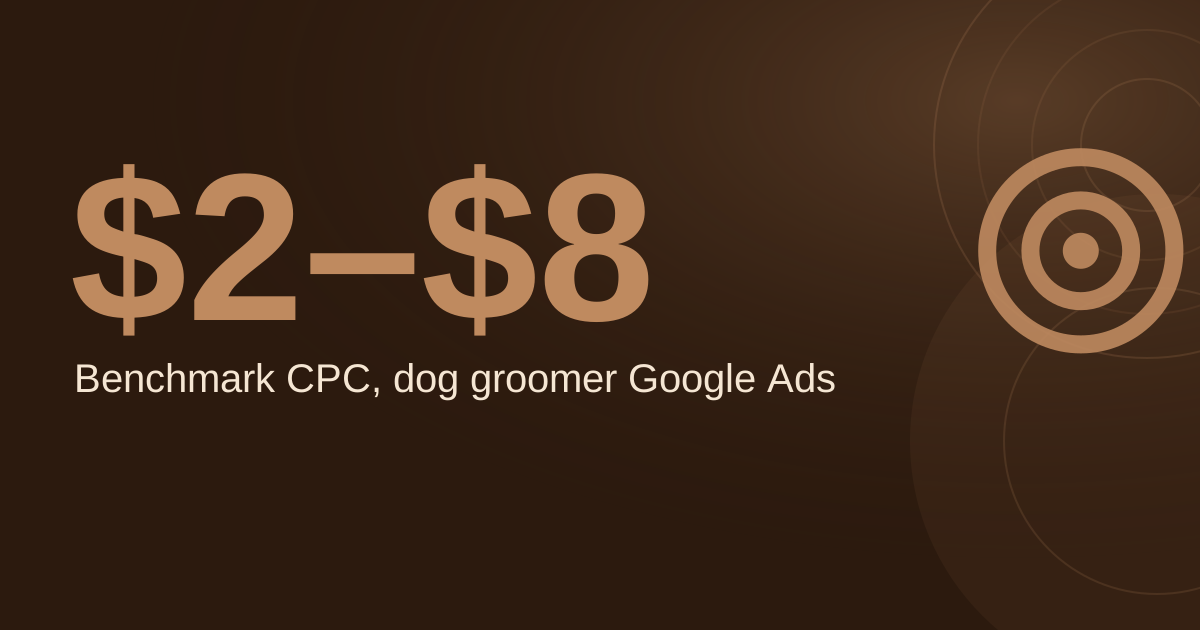
A Google Ads campaign for a Philadelphia pet groomer should target people already searching for a groomer nearby, track booked appointments, and keep spend capped until the numbers justify more. The benchmarks available for this niche are national, not Philadelphia-specific, so treat them as starting points. A dog groomer cost-per-click range of $2–$8 and typical monthly spend of $800–$5,000 anchor the figures below. The worked example uses assumed inputs you should replace with your own.
→
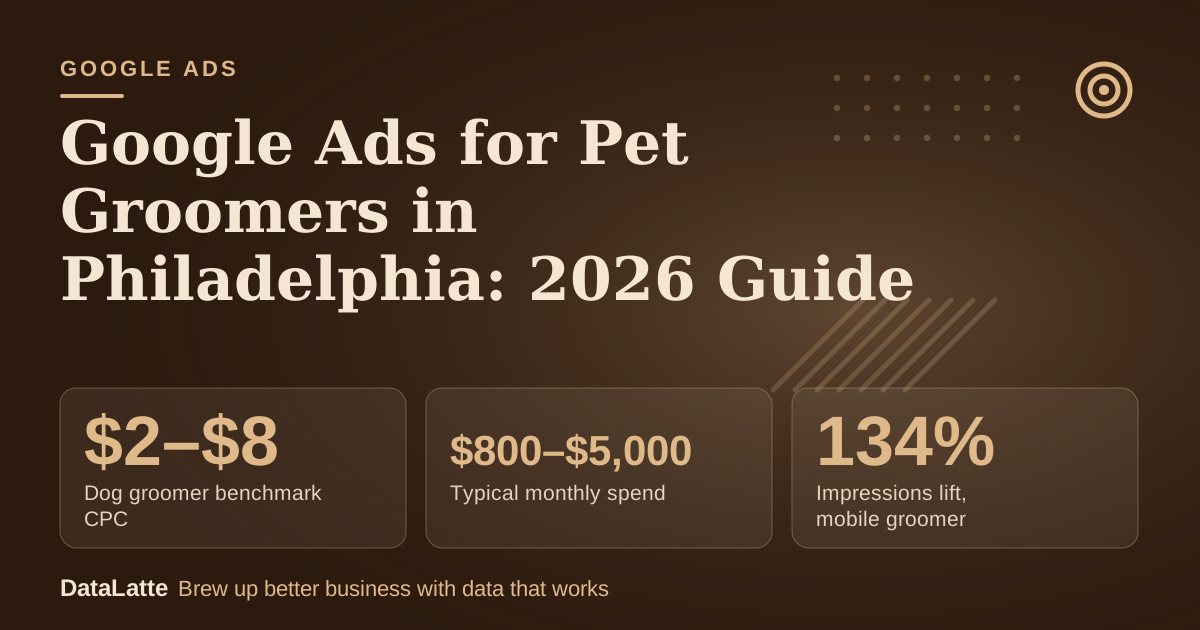
Dog groomer benchmark CPC
Per click, per AdTurbo
→
Typical monthly spend
Most advertisers, per AdTurbo
↑
Impressions lift, mobile groomer
Vs previous 6 months, 2023 case
↑
Clicks lift, same case
Vs previous 6 months, 2023 case
See Sources at the end of the article. Cards marked Assumption are examples, not results.
What does Google Ads cost for a pet groomer?
One vendor benchmark puts dog groomer clicks at about $2–$8 each and warns that a few wasted clicks add up quickly (
AdTurbo). The same page says most dog groomer advertisers spend around $800–$5,000 per month. That spread is wide, and it reflects business size as much as strategy. A mobile groomer working one van has different capacity from a salon with several stylists.
No Philadelphia-only cost-per-click figure is available for this niche, so check the Keyword Planner estimate for your own service area before committing a budget. Start at the lower end of the vendor range and raise spend only after bookings are tracked for at least a month.
If you are also weighing pay-per-lead options, compare them against standard search ads in
this breakdown of Google Local Services Ads for pet groomers.
Which keywords should Philadelphia pet groomers bid on?
AdTurbo lists three keywords worth bidding on for dog groomers: "dog groomer near me," "dog grooming near me," and "puppy grooming near me" (
AdTurbo). These phrases signal that someone wants a service now, which is why they suit a local business with a fixed service area.
Philadelphia-specific terms are a reasonable test, not a sourced recommendation. Add a city-level phrase such as "pet grooming Philadelphia" as a separate ad group and compare its cost per booking with the "near me" group. Keep the ad group that books cheaper, and pause the one that does not.
Avoid broad, generic terms such as "dog" or "pet groomer" early on. They pull in searches from people who will never book a visit.
How wide should the targeting radius be?
Radius is the setting most likely to waste budget for a local groomer. Barklead, a groomer marketing blog, suggests targeting users within a 10–15 mile radius of the business, but that advice is written for Facebook ads, not Google Ads (
Barklead). Treat 10–15 miles as an upper test boundary and not a default.
Set the radius around your address, then run one campaign at a tighter radius and one at a wider radius for the same period. Compare cost per booking, not cost per click. Customers who will drive across a city for a groomer tend to be rare, so a wider radius that adds clicks but no bookings is a clear signal to shrink it.
Which conversions should you track?
AdTurbo names booking a grooming appointment as the primary conversion to track for dog groomer campaigns (
AdTurbo). Everything else is a supporting signal. Clicks and calls show interest, but only a booked appointment shows revenue.
A practical setup:
- Mark a completed online booking as the primary conversion.
- Add phone calls from ads as a secondary conversion, using a tracking number.
- Count direction requests from your Google Business Profile as a secondary signal.
- Each week, reconcile the conversion count against your booking system so the numbers match.
Does Google Ads work for a mobile pet groomer?
One published case study suggests it can. Marketing 360 reports that a mobile pet groomer who advertised on Facebook and Google saw a 134% increase in impressions, a 696% increase in clicks, and a 682% increase in conversions, each compared with the previous six-month period (
Marketing 360). The page was published on June 13, 2023.
Treat this as one case, not a forecast. The report does not establish the starting baseline or spend level in a way that transfers to a Philadelphia business, and the percentage gains are large partly because the earlier period was small. Use it to justify a test budget, not to set expectations.
Worked example: what does a $1,000 month return?
Every input below is an assumption. Replace them with your own figures before making a decision.
Assumptions: monthly budget $1,000, average booking value $120, and three scenarios for cost per click and booking rate. CPC values sit inside the $2–$8 benchmark.
| Scenario (all inputs assumption) | CPC | Booking rate | Clicks | Bookings | Revenue at $120 each |
|---|
| Low | $8 | 3% | 125 | 3.75 | $450 |
| Mid | $5 | 4% | 200 | 8 | $960 |
| High | $2 | 6% | 500 | 30 | $3,600 |
Break-even on $1,000 of spend needs about 8.3 bookings at $120 each. In the mid case, 200 clicks would need a booking rate of about 4.2% to break even. The mid case returns $960, just under spend. These are gross revenue figures, so labour and product costs will reduce what is left. The practical takeaway: a campaign at this budget pays back only if the booking rate or ticket value rises, which is why conversion tracking comes before scaling.
How do seasonal peaks change the budget?
Adwave cites Groomer to Groomer, which notes that November and December are traditionally a very busy time for groomers, sometimes too busy (
Adwave). A full diary means extra ad clicks may not convert into extra revenue, because the appointment slots run out.
Plan around that. Check your booking calendar a few weeks before the peak, and if slots are scarce, lower the budget or narrow the campaign to your highest-converting keywords. Raise spend again in quieter months, when each new booking adds more capacity to use.
Which negative keywords cut wasted spend?
GroomerGenie states that its own proprietary negative keyword list contains more than 500 groomer negatives (
GroomerGenie). That is a vendor claim about its list, so verify any list against your own search terms report before you rely on it.
Build your own list from real searches. Job and pay terms are common waste. A pet-shop marketing guide cites an average annual dog groomer salary of $40,000, which shows how much public interest exists in groomer pay (
PS Print, secondary). Add "salary," "jobs," and "hiring" as negatives. Also exclude "how to," "course," and "training" for DIY searchers, plus any city names outside your service area.
For a broader view of whether to run this in-house or hand it to a specialist, read
AI versus human marketing for local business.
FAQ
How much should a pet groomer in Philadelphia spend on Google Ads?
No Philadelphia-specific figure is available here. Vendor benchmarks put most dog groomer advertisers between $800 and $5,000 per month, and dog groomer clicks cost about $2 to $8 each (
AdTurbo). Start low, track bookings, and scale only if cost per booking holds.
What is the primary conversion to track for dog groomer ads?
Booking a grooming appointment is the primary conversion to track, according to AdTurbo (
AdTurbo). Track phone calls and direction requests as secondary signals.
How wide should my Google Ads radius be?
Test a tighter radius against a wider one and compare cost per booking. Barklead's 10–15 mile suggestion was written for Facebook ads, so use it only as an upper boundary to test (
Barklead).
Do I need a long negative keyword list?
Yes, at least a starter list. Review your search terms report regularly and add terms that bring job seekers, DIY searchers, or out-of-area customers. A vendor's list can help as a starting point, but your own search data is the reliable reference.
Sources
Ready to test a budget without guessing?
Get a free audit or see how DataLatte runs
Google Ads for local service businesses.
Free for local businesses
Want this applied to your business?
I'll review your Google presence, local SEO, and ad accounts — and send you a specific action plan within 48 hours. No pitch, no pressure.