May 16, 2026·Nataliia Rumiantsewa· 10 min read All posts
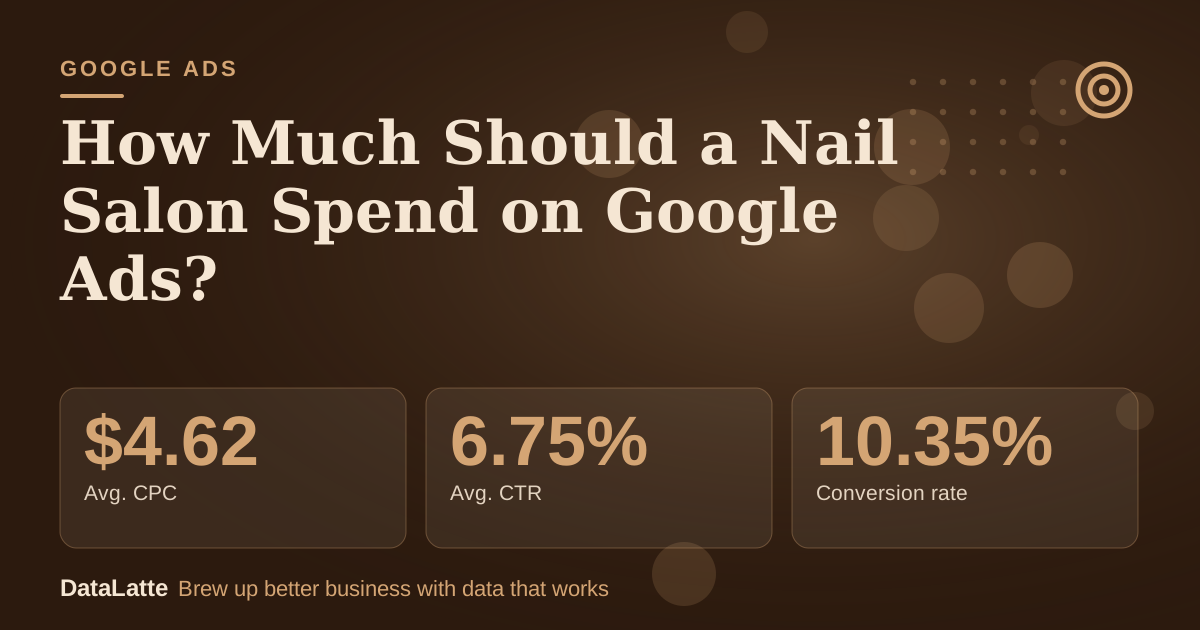
There is no standard nail salon Google Ads budget, and anyone quoting you one without asking about your chairs is guessing. Here is the arithmetic that replaces the guess. LocaliQ's 2026 benchmarks put the average click for Beauty & Personal Care at $4.62.
If 7 in 100 clicks become a booking (my assumption, not a benchmark), a booking costs about $66 in ads. Whether $66 is a good price depends on what a new client is worth to you and how many empty slots you have. That is what sets the budget.
This article is about the number itself. For how to build the campaigns and split the money once you have it, read our Google Ads guide for nail salons; for the term lists, use the nail salon keyword guide. It is written for salon owners in the US, UK, Australia and Canada.
Dollar figures are US-based; in pounds or other dollars, run the same arithmetic with your own click prices, since your Google Ads budget is set in your account currency.
What a Click Might Cost You
Benchmarks for nail salons specifically are scarce, so use the nearest category. LocaliQ (which owns WordStream) lists these 2026 search figures on its search advertising benchmarks page, last updated June 1, 2026:
$4.62→
Avg. CPC
Beauty & Personal Care
6.75%→
Avg. CTR
Beauty & Personal Care
10.35%→
Conversion rate
Beauty & Personal Care
$39.25→
Cost per lead
Beauty & Personal Care
See Sources at the end of the article. Cards marked Assumption are examples, not results.
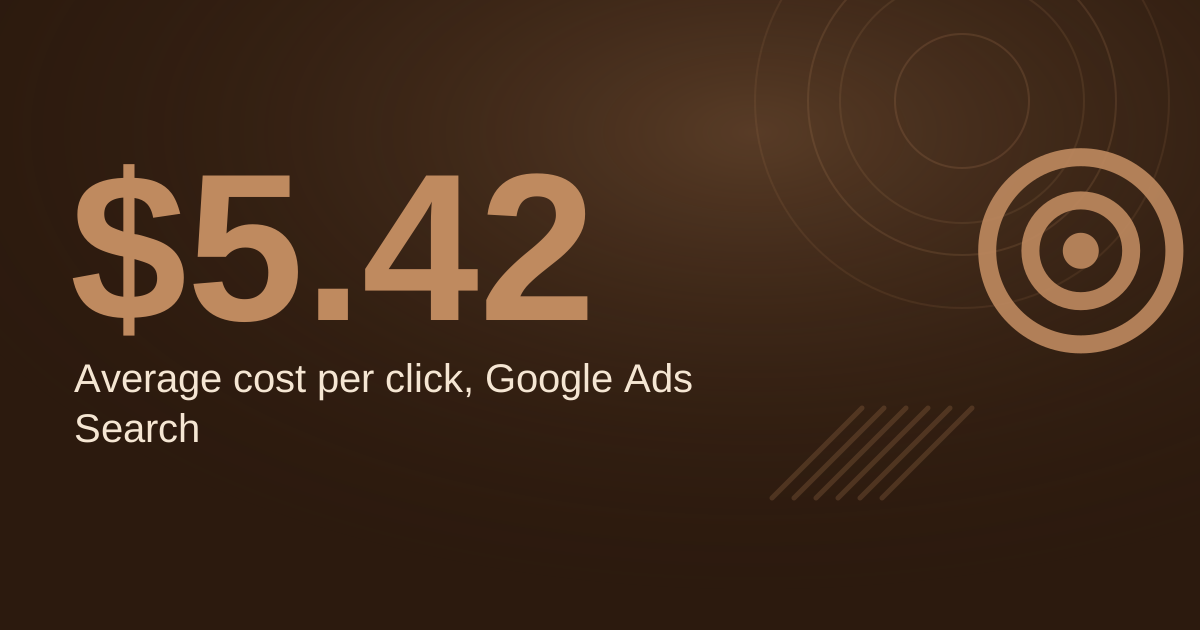
All industries average $5.42 per click and $66.69 per lead on the same page. Two cautions. The page does not publish sample sizes or exact data dates, and "conversion" means whatever each advertiser counted, such as a form fill or call, not a paid manicure.
Treat $4.62 as a sanity check, then swap in your own price after a month. In a big city expect your account to sit above it; in a small town, often below.
Method 1: Start From What a New Client Is Worth
This method gives you a ceiling per booking, not a total. Work through three numbers:
First-visit price. Say $65 for a gel manicure (assumption).
Visits in the first 12 months. Say 3 (assumption). Pull the real figure from your booking system: of the new clients you got last quarter, how many came back within eight weeks?
Share of that revenue you will spend on winning them. Say 40% (assumption; many owners go lower, since revenue is before wages and rent).
Revenue per new client over 12 months is $65 x 3 = $195. Forty percent of that is $78. So the most you would pay for a booking is $78, and your maximum click price is that ceiling multiplied by your click-to-booking rate: $78 x 0.07 = $5.46. At 4% it is $3.12.
That spread is why the booking rate matters so much: the same bid can be profitable or not depending on what happens after the click.
Method 2: Start From Your Empty Slots
A budget should buy something specific: filled chairs. Count how many appointment slots sit empty in a typical month, by looking at your booking calendar for the last eight weeks. Then decide how many of them a new client could realistically fill.
Example (all assumptions): three technicians, 40 empty slots a month, and a goal of filling half with new clients, which is 20 bookings. At the $66 booking cost from above, that is $1,320 a month, about $43 a day once you divide by 30.4.
Google's daily budget help says that is the right conversion for a monthly figure, that for most campaigns spend on one day can reach twice the daily budget, and that a month's total will not exceed 30.4 times it.
If you have no empty slots, you do not need new-client ads at all. You may instead want a rebooking system or higher prices. If your empty slots are all on Tuesday mornings, aim the offer there, not at weekends that already sell out.
Method 3: Check the Market Ceiling
You cannot spend what Google cannot find clicks for. Google's Keyword Planner help says the tool shows estimated monthly searches and the average cost to show an ad for a keyword, and that a plan's forecast shows clicks, impressions or conversions based on your average daily budget, using recent data adjusted for seasonality. Enter your service keywords, set your own area, and read the forecast of clicks at your price.
Suppose the forecast for your area is about 300 clicks a month at roughly $4.62. That is a ceiling of about $1,386 (an assumption for illustration). Spending $3,000 in a market that supplies 300 clicks just raises your bids against yourself.
Once ads are running, Google's impression share report tells you the same thing from live data. Google's impression share help says it shows the share of eligible impressions you received and is a good way to see whether you might reach more people if you raise your bid or budget.
Its help page on budget-related metrics describes "search lost top impression share (budget)" as an estimate of how often your ad did not show among the top ads because of a low budget. If that figure is high and your cost per booking is healthy, budget is the limit. If it is low, adding money will not help.
Putting the Three Methods Together
Method
What it tells you
Worked example (assumptions)
1. Client value
Most you would pay per booking
$78 per booking, or $5.46 per click at 7%
2. Empty slots
Bookings you need, hence spend
20 bookings x $66 = $1,320 a month
3. Market ceiling
Clicks available at your price
300 clicks x $4.62 = about $1,386
Take the smallest total that still meets the goal. Here that is about $1,300 a month, roughly $43 a day. Two checks before you commit: your expected cost per booking ($66) must be below your ceiling ($78), and the budget must not exceed what the market supplies. If you fail the first check, fix the booking page or the offer before adding money.
How Big a Test Budget Do You Need?
A budget that is too small tells you nothing. With few clicks, luck decides whether anyone books, so you may pause a campaign that would have worked. This table uses the $4.62 click and a simple model that treats each click as an independent chance of booking, which is a simplification, not a Google statistic.
Test budget
Clicks at $4.62
Expected bookings at 4%
Expected bookings at 7%
Chance of zero bookings at 4%
$300
65
2.6
4.5
about 7%
$600
130
5.2
9.1
under 1%
$900
195
7.8
13.6
under 1%
So a $300 month can work, but it leaves you with two or three bookings to judge, which is thin. If you are in a high-cost city where a click is $8, the same $300 buys about 37 clicks and the chance of zero bookings at 4% rises to around 22%.
In that case save up for $600 to $900 and run one disciplined test, rather than trickling out $300 and concluding Google Ads does not work.
The Math
Here is the full chain for a $1,300 month, using the Base column as the plan. Every row is an assumption except that the Base click matches the $4.62 benchmark.
Tough
Base
Strong
Monthly budget (assumption)
$1,300
$1,300
$1,300
Cost per click (assumption)
$5.50
$4.62
$3.50
Clicks
236
281
371
Click to booking rate (assumption)
4%
7%
10%
New bookings
9.5
19.7
37
Ad cost per booking
$137
$66
$35
Revenue per new client, 12 months (assumption)
$195
$195
$195
Revenue left after ad cost, per client
$58
$129
$160
Total revenue left after ad cost
$543
$2,541
$5,942
Read it carefully. These are revenue figures, before wages, product and rent, and they hold only if clients return as assumed. In the Tough column you pay $137 to win a $65 first visit, so you only come out ahead if clients stay. The Strong column is better than you should plan on.
The pattern is clear: the same budget produces very different results depending on the booking rate and rebooking, which is why test conditions matter more than the starting number.
Do Not Scale Before You Know Your Rebooking Rate
The Tough column only works if clients come back. Check how many of last quarter's new clients rebooked within eight weeks before you raise the budget. Our guide to Google Ads mistakes nail salons make covers the usual leaks.
When to Raise or Cut the Budget
Raise it when the cost per booking is below your ceiling, empty slots remain, and impression share lost to budget is high. Move in steps of about 20% (my rule of thumb) and wait at least two weeks between changes.
Cut or pause when your calendar is full for the next three weeks. Paying for bookings you cannot serve wastes the money.
Seasonal peaks. If you use Target CPA bidding, Google's seasonality adjustments help says the tool is for short events of one to seven days where you expect a major change in conversion rate, and may work less well past 14 days; Smart Bidding already handles routine seasonal patterns. On manual bidding, simply add budget a few weeks before prom, Mother's Day or the holidays if slots are open.
Slow months. Do not pause just because it is quiet. Check your own data: if cost per booking is steady and slots are open, keep running.
Do This Today
Pull the last eight weeks of your booking calendar and count the empty slots per month.
Work out your first-visit price, visits in the first 12 months, and the share of that revenue you will spend, then compute your ceiling per booking.
Open Keyword Planner, enter your top five services, set your area and note the forecast clicks and average cost.
Pick a test budget of $600 to $900 (or the local equivalent) for six weeks, and divide by 30.4 to set the daily budget.
Set up booking, call and form conversions first using our conversion tracking setup guide, and make a test booking from your own ad.
To run your own numbers, the Marketing Budget Calculator turns your monthly revenue into a budget split by channel, and the Ad Break-Even Calculator shows the most you can pay per click, lead and customer. Both work in USD, GBP, EUR, AUD and CAD.
FAQ
Q: Is $500 a month enough for a nail salon?
A: It can be, in a low-cost market. At a $4.62 click, $500 buys about 108 clicks, which is 4 to 8 bookings at a 4% to 7% rate. That is enough to learn from, but thin; the table above shows how luck can distort a $300 test.
Q: How much is a click for a nail salon?
A: LocaliQ lists $4.62 for Beauty & Personal Care overall, but nail-specific prices vary with city and service. Your Keyword Planner estimate and first month of data are better guides.
Q: Should I pause ads in January?
A: Not automatically. Judge it by cost per booking and open slots in your own account. If both look healthy, keep running.
Q: Google Ads or Instagram?
A: They catch different moments. Search reaches people already looking for a nail salon; Meta can show your nail art to people who were not searching. See our Google Ads versus Facebook Ads comparison.
Q: How long before I should change the budget?
A: Give it four to six weeks, my rule of thumb, unless the account is clearly leaking money.
Local marketing strategist with 10+ years at global agencies — OMD, Dentsu, GroupM, and BBDO. Now helping small businesses get the same data-driven edge. Based in Europe, working with clients in the US, UK, Australia, and beyond.