A local business earns free backlinks when real local organisations list or mention it: suppliers, trade associations, chambers of commerce, charities, event organisers, local press and partner businesses. Each link needs a reason to exist, so the work is asking the right organisations and giving them something worth linking to. No reliable published figure says how many links a local business needs, so aim for relevant local links rather than a target number. This guide covers 11 methods, a request approach, a four-week outreach plan and the practices that carry risk.
→
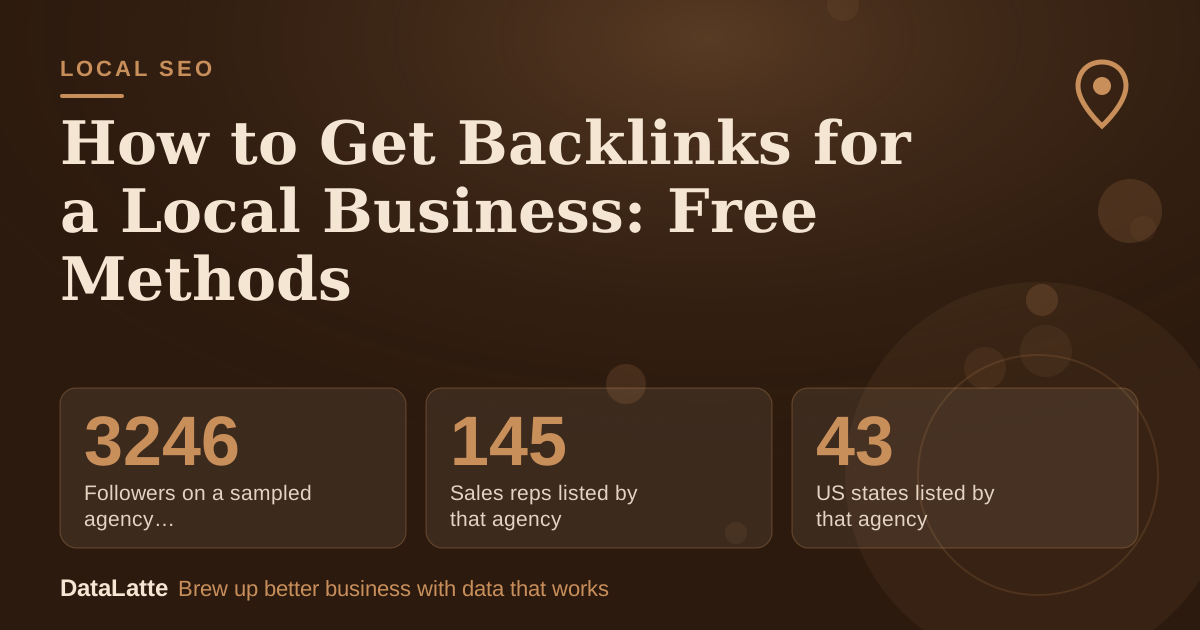
Followers on a sampled agency Instagram profile
Instagram profile, opened 2026-11-09
→
Sales reps listed by that agency
Stated as 145+ in the same profile bio
→
US states listed by that agency
Stated in the same profile bio
→
Agencies in that group
Stated in the same profile bio
See Sources at the end of the article. Cards marked Assumption are examples, not results.
Why Do Backlinks Matter for a Local Business?
A backlink is a link from another website to yours. For a local business, the most useful links come from sites that customers in your area already use: a supplier's stockist page, a trade association directory, a local news story or a community events calendar. These links point search engines and people toward your business from a context that makes sense.
Links are one input among several. Profile details, reviews and website content all matter alongside them. Start with the profiles you control, then build outward. A link from a neighbouring business is only useful if the page it sits on is credible and your own website gives a visitor a clear reason to click.
Treat backlinks as a slow channel. A handful of genuine local links from organisations you already work with will do more for a small business than dozens of links from unrelated directories. Quality and relevance beat volume.
Which Profiles Should Be Checked First?
Before asking anyone for a link, confirm that the profiles you already control point to the correct website. Start with the major platforms where customers look you up. A LinkedIn company page is a useful example. LinkedIn's help guide says the company page URL appears in the browser address bar and follows a pattern such as linkedin.com/company/your-company-name. You find it by searching for the company and selecting the correct result (
LinkedIn Help).
The same help page notes that if a business cannot be found, it may not have a page yet. In that case, create one before asking others to link to it. A link should lead to a destination that matches the name and details the other site shows.
Instagram works the same way. A business profile with a clear website link and a consistent name gives people a reliable place to land. One agency's profile shows the pattern, listing 3,246 followers and a single link in its bio (
Instagram profile). Check that your own links match the page you want to strengthen.
Which Link Tactics Carry Risk?
Some link practices are widely treated as manipulation, and they can damage a site's standing rather than help it. The main ones include paying for links without disclosure, trading links with many unrelated sites, and publishing large batches of guest posts whose main purpose is to insert keyword-rich links. Automated link generation falls into the same group.
Sponsorships and paid placements are not automatically a problem. A local charity sponsorship or a paid directory listing can be legitimate. The safer approach is to ask for a plain, relevant mention, avoid any arrangement where a link is the price of a free product or review, and tag paid links as sponsored where the platform allows it.
A simple test helps: would the link still make sense to a customer reading the page if no search engine existed? If not, the link probably carries more risk than value.
What Are 11 Free Ways to Earn Local Backlinks?
The table below lists each request and the check to run before making it. These are methods, not guaranteed results, because each site owner decides whether to link.
| # | Method | What to ask for | Check before asking |
|---|
| 1 | Your own profiles | Correct website link on every profile | Confirm the URL matches your site |
| 2 | Suppliers and brands | "Where to buy" or stockist mention | Ask only if you genuinely stock or use them |
| 3 | Trade associations | Member directory listing | Free listings are the easiest first step |
| 4 | Chamber of commerce | Business directory page | Check whether it is free or paid |
| 5 | Local charities | Sponsor or partner mention | Tag the link if you paid for the sponsorship |
| 6 | Events you host | Listing on community calendars | Submit a clear event page |
| 7 | Local news and bloggers | Mention in a story you help them with | No free product or payment in return for a link |
| 8 | Partner businesses | Useful cross-referral page for customers | One genuine page, not mass swaps |
| 9 | Schools and clubs | Class, discount or partner page | Offer a real benefit to their members |
| 10 | Local resource pages | Inclusion on a relevant list | Request it only if you truly fit the list |
| 11 | Your own useful content | A guide, price list or local map others cite | Build the resource first, then share it |
Keep a simple log with the site, contact name, date asked and outcome. For most small businesses the practical limit is time, not money, and the log stops you asking the same site twice.
How Should the Request and Link Be Written?
Make the request easy for the other person to fulfil. Suggest a plain description of the business, such as the business name or what it does, and give the exact URL of the most relevant page. That page may be a service page or a local price guide rather than the homepage. A link to the right page helps both visitors and the site owner.
Anchor text, the words the link sits on, should be descriptive and short. Phrases such as "click here" tell readers nothing. A phrase such as "emergency plumbing in Denver" works only if it is accurate and the linked page is genuinely about that service. Stuffing several keywords into one link reads as manipulation and looks unnatural on the page.
Requests also work best when they are specific. A short message that names the organisation and the reason for the contact gets a better response than a generic template sent to many recipients. The
guide to using AI tools in place of a marketing assistant covers how to draft such messages faster without losing that specificity.
What Does a 4-Week Outreach Plan Cost in Time?
The plan below is a planning model. Every input is an assumption, so replace the figures with your own numbers after the first month.
Inputs (all assumptions):
- Contacts across four weeks: 20
- Time per contact, including research and writing: 15 minutes
- Owner time valued at $40 per hour
- Links that go live from the first batch: 2
Calculation:
- Total time: 20 × 15 minutes = 300 minutes, or 5 hours
- Owner cost: 5 hours × $40 = $200
- Owner cost per live link: $200 ÷ 2 = $100
| Week | Task | Count (assumption) |
|---|
| 1 | Check profiles, website and social links | 5 profiles |
| 2 | Ask suppliers and associations | 10 requests |
| 3 | Offer a story or event to local press and blogs | 5 pitches |
| 4 | Follow up and log outcomes | All 20 contacts |
At the end of week four, count how many links went live, which pages they point to and which requests received no reply. Repeat the methods that worked and drop the ones that did not. If nothing worked, the likely gap is something worth linking to, such as a useful local guide or a regular event. Compare the owner cost with paid channels, including the trade-offs in the
Google Local Service Ads guide.
Where Do Directory Listings Fit?
Directories can be a free route to a link, but quality varies widely. Some are established and used by customers. Others are thin pages that exist mainly to sell placements. Before paying for any listing, check whether it is free, whether the page is indexed and useful to customers, and whether it sits in a sensible category for your trade.
Compare the major lead-generation directories before committing money. The
Angi vs Thumbtack comparison for local businesses sets out the trade-offs for home-service firms. A paid listing that generates leads is a different decision from a paid listing bought only for a link, so the reason should be clear before any spending starts.
FAQ
Do backlinks help local SEO?
Links are one input alongside profile details, reviews and website content. Focus on relevant local links from organisations your customers already trust.
Is it okay to pay for a backlink?
Paid arrangements carry risk when the link is the main purpose. Sponsorships and paid listings can be legitimate, and tagging paid links as sponsored is the safer approach.
How many backlinks does a local business need?
No reliable published figure exists. Aim for relevant links from real local organisations rather than a number.
Are link exchanges worth doing?
Mass link swaps with unrelated sites are risky. One genuine partner page that helps customers is a different matter.
What anchor text should be requested?
Ask for a short, accurate description of the business or service, such as the business name or the service offered. Avoid stuffing keywords into the link.
Sources
- LinkedIn Help: Find a company page URL (primary, platform help page, opened 2026-11-09)
- Instagram: The Link Companies profile (primary, platform profile page, opened 2026-11-09)
Want help with local visibility? See the
Local SEO service or
book a free audit.
Free for local businesses
Want this applied to your business?
I'll review your Google presence, local SEO, and ad accounts — and send you a specific action plan within 48 hours. No pitch, no pressure.