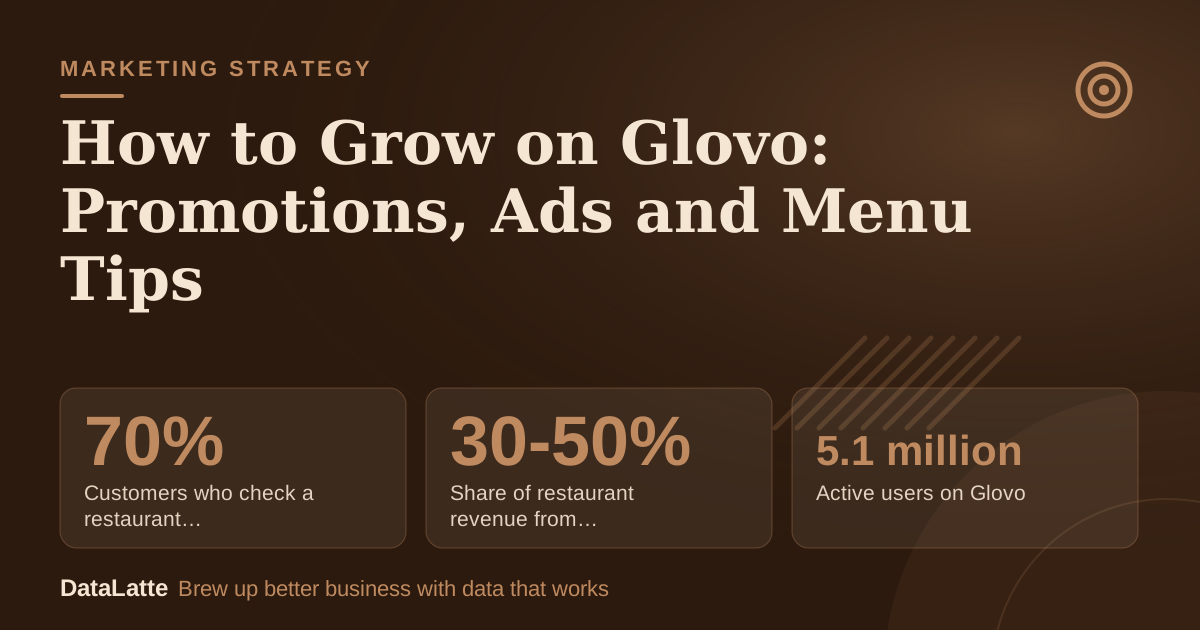
To grow a restaurant on Glovo, fix the basics of your listing, test one promotion with a clear goal, and compare orders and margin each week. Glovo's own restaurant guidance says 70% of customers check a restaurant online before deciding where to order, so an incomplete profile loses orders before any offer runs. The sources here do not publish Glovo's ad rates or commission, so confirm those figures in your partner contract before you set a budget.
→
Customers who check a restaurant online before ordering
Glovo Uganda restaurant sales guide, 2026, primary
↑
Share of restaurant revenue from delivery in most urban markets
Glovo Uganda restaurant sales guide, 2026, primary
→
Active users on Glovo
Deliverect Glovo 101 guide, secondary
↑
Global online food ordering and delivery market value, 2021
Deliverect citing Grand View Research, secondary
See Sources at the end of the article. Cards marked Assumption are examples, not results.
Glovo's restaurant guidance says customers who cannot find your restaurant in a search will not consider it. The fix it recommends costs nothing: list your restaurant with accurate opening hours, a phone number and photos, add the full menu, and respond to reviews.
Customers who want food at home rarely call. They open an app, so being on the platform matters more than any single offer. If your listing shows old photos of dishes you no longer sell, the listing works against you.
Check your listing as a customer would. Search for the restaurant, read the hours, look at the photos and read the most recent reviews. Anything that looks out of date is the first thing to fix.
Glovo's guidance argues that long menus create decision fatigue. Customers end up ordering the safest item, not the most profitable one. A menu of around 40 items is a common problem, so audit yours.
Pick your three to five best-selling, highest-margin dishes, give them clear names and descriptions, and move them to the top. Cut dishes that rarely sell, since a shorter menu is cheaper to run and reduces waste.
Delivery also changes what a dish needs. Glovo suggests choosing items that hold up over about 20 minutes in transit. A dish that goes soggy in a box will get poor ratings regardless of how good it is on the plate.
Food cost matters when you choose which dishes to promote. Glovo's guidance says ingredients above 30 to 35 percent of menu price put margins under pressure. Check that figure on your top sellers before you discount them.
Every promotion comes from your margin, so test the numbers before launch. The worked example below uses assumed inputs for an illustrative restaurant. Replace them with your own figures.
| Input (assumption) | Value |
|---|
| Average delivery basket | $20 |
| Margin before discount (30% of basket) | $6 |
| Discount (20% of basket) | $4 |
| Margin left after discount | $2 |
| Discounted orders needed to equal one full-price order's $6 margin | 3 |
A 20% discount leaves $2 of margin where a full-price order earned $6. If the offer goes to customers who would have ordered anyway, each order costs you $4 compared with the baseline. The promotion pays only if it brings in new customers who return at full price, or if it lifts the basket size.
Glovo's guidance says every promotion needs a clear goal. Use an offer to fill slow hours, launch a new dish or reward repeat customers, and stop it if you cannot state the problem it solves.
What does the delivery share mean for your margins?
Glovo's guidance says delivery now makes up 30 to 50 percent of total restaurant revenue in most urban markets. That share is large enough that fee structures matter as much as menu design. The sources here do not give Glovo's commission rate, so compare the total fees on each app using the same basket size.
The
DoorDash vs Uber Eats restaurant fees guide and the
Grubhub vs DoorDash fee comparison show how to set up that comparison. Use the same test basket on each platform and record the full amount you keep.
Availability also varies. The Deliverect guide describes Glovo as operating in 26 countries with a focus on Europe. Check Glovo's partner page for your city before you plan around it, especially if your restaurant is in the United States, Canada, the United Kingdom or Australia.
How do you keep delivery customers coming back?
Glovo's guidance cites a common benchmark that acquiring a new customer costs five times more than keeping one. Treat that as a general business rule, not a Glovo-specific result. It still points to where effort should go once the listing is working.
The simplest tool is a repeat-customer offer, such as a discount on the next order or a free item after several purchases. The guidance also suggests a personal touch, such as remembering a regular's usual order. Neither needs a large budget.
Write the offer copy carefully. The
ChatGPT prompts for local business marketing article includes drafting prompts that can be adapted for menu descriptions and review replies, which keeps the work quick.
What should you track each week?
Glovo's guidance recommends checking your weekly reports on the platform. Look at which dishes earn the highest ratings, which draw complaints, and where customers drop off before completing an order. These signals show where revenue leaks.
Track three numbers at minimum: weekly revenue, average order value and order count. Compare a promotion week with a normal week on the same measures. A promotion that lifts orders but lowers margin per order may still lose money.
Review the offer after one week and keep it only if the margin holds. If you cannot see the difference in your numbers, pause it and try a different offer.
What do these sources not tell you?
The sources used here do not publish Glovo's ad pricing, minimum spend, cost per click or commission rates. Any figure found on a third-party site should be checked against your own partner agreement. Your account manager can give you the numbers that apply to your contract.
The Glovo guidance is written for restaurants in several markets, so some examples may not match your city. Use the principles on listing, pricing and tracking, and test the specifics in your own market before scaling a budget.
The
Canada local marketing guide for 2026 covers broader local marketing choices if delivery apps are only one part of the plan.
FAQ
How much do Glovo ads cost?
The sources used here do not publish Glovo's ad rates, cost per click or minimum spend. Confirm the figures in your partner agreement or ask your account manager before setting a budget.
What is the first step to growing on Glovo?
Complete the listing with accurate hours, a phone number, current photos and the full menu, then respond to reviews. Glovo's guidance says this costs nothing and can make an immediate difference.
Glovo's guidance says no. Use promotions for a specific problem, such as slow hours or a new dish, and compare each one against a normal week on orders and margin.
How do you know if a discount is worth it?
Work out the margin on one discounted order, then compare it with a full-price order. Use your own basket size and food cost. The worked example in this article shows the method with assumed inputs.
Sources
Planning delivery-app marketing for your restaurant?
Book a free audit to have your listing, offers and fee structure reviewed against your margins.
Free for local businesses
Want this applied to your business?
I'll review your Google presence, local SEO, and ad accounts — and send you a specific action plan within 48 hours. No pitch, no pressure.