May 19, 2026·Nataliia Rumiantsewa· 11 min read All posts
Local Facebook groups can bring pet grooming clients when you join hyper-local communities, engage for weeks before selling, and then use location-based ads with a clear offer. Target a radius that matches how far clients will drive, usually about 10 to 15 miles for a salon. Track which groups produce bookings, and drop the ones that do not. The steps below show how to run that process, plus a worked capacity check so you know how many new clients a mobile or fixed site can actually absorb.
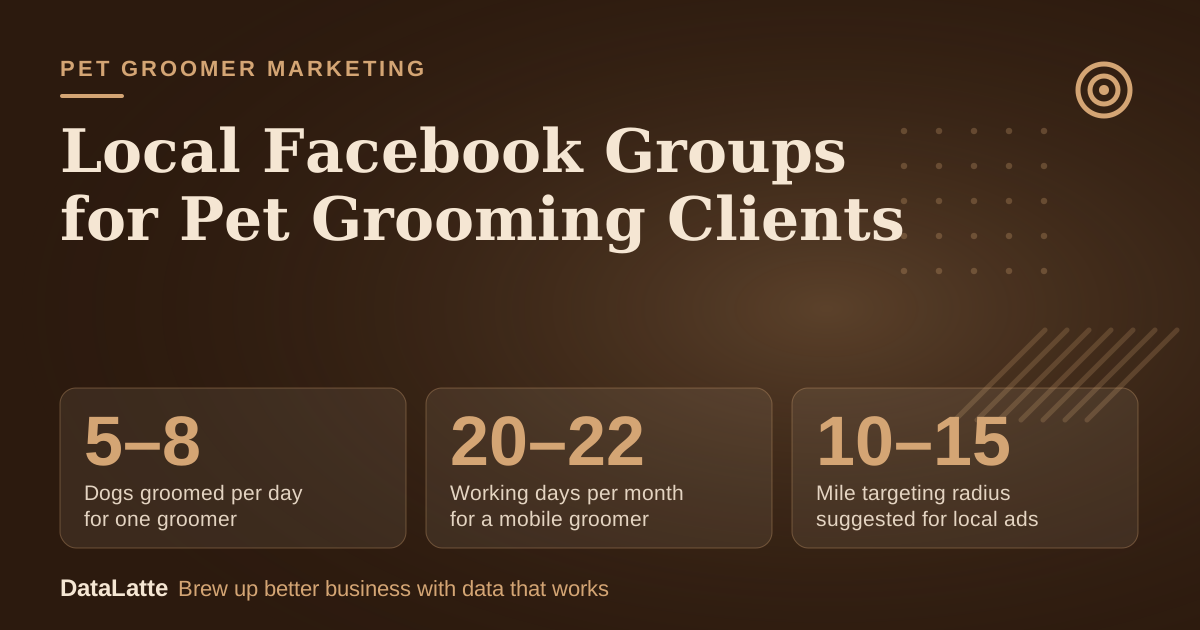
5–8→
Dogs groomed per day for one groomer
industry standard, per Vanspeed PRO
20–22→
Working days per month for a mobile groomer
typical Mon–Fri schedule, per Vanspeed PRO
10–15→
Mile targeting radius suggested for local ads
per Barklead guide
Assumption
10%↑
Discount offered for tagging the business in photos
per GetHookd example, for user-generated content
See Sources at the end of the article. Cards marked Assumption are examples, not results.
Which local Facebook groups are worth joining?
Start with groups tied to a town, zip code, or neighborhood rather than national pet lover communities. Salesforce notes that Facebook may skew toward older users, but certain local communities or niche interest groups can still be highly active on it, so the value sits in the local slice. Salesforce's local marketing guide makes the same point about local communities. A group with fewer members but a high share of nearby residents is usually more useful than a large regional group.
Search Facebook for terms like "dog owners" plus your town name, then check each group's rules and recent posts. Look for active owners asking for groomer, vet, or training recommendations. Those requests are the signal you want. Join three to five groups at first so you can test which ones respond to your posts.
Before you join, read the group rules on promotion. Some groups allow service recommendations only in a pinned thread or on certain days. Following those rules keeps you in the group long enough to earn trust.
How should you engage before promoting your grooming service?
Spend the first stretch of time commenting on other people's posts and answering questions with specific, useful detail. A reply that explains why a long-haired cat needs brushing down to the skin is more valuable than "beautiful cat!" Generic comments read as spam, and group members notice them quickly.
Set a simple rule for yourself. Reply to a handful of posts each day, and avoid promotional posts until you have a track record of helpful replies. The exact waiting period is your call; the principle is that people book with groomers they already recognize as knowledgeable.
Keep your posts short and specific. Describe a problem a local owner has, explain the fix in plain language, and mention your service only if it genuinely solves the problem. This is the same approach that works for local businesses in other categories, as covered in our guide to AI vs human marketing for local business.
Does a discount work better than a plain service post?
A referral-style offer can work when it rewards real customers for sharing. GetHookd suggests asking clients to tag your business in post-grooming photos in exchange for a small incentive such as 10% off their next visit. This is a tactic from a secondary source, so test it on a small group of regulars before rolling it out to a whole client list.
Keep the offer clean. Tie it to a specific action, such as tagging the business, and set an expiry date. Avoid pairing it with a mass promotional message in groups that prohibit ads, because that can get your account removed from the community.
How do you turn group interest into paid reach?
Facebook ads let you target by location and age. Groomer to Groomer notes that Facebook age targeting covers user groups from 13 to 65+, though that screenshot dates from 2016, so confirm current options in Meta Ads Manager before you build an audience. Groomer to Groomer also describes an established client base living within about 12 miles, which matches the radius guidance below.
GroomSoft's illustrative example projects 200 to 300 new clients if 2% of reached users book an appointment. Treat that as a hypothetical model, not a benchmark. Reach and conversion rates vary by market, season, and offer.
What does a capacity check look like for a groomer?
Before you chase more bookings, confirm you have the room to take them. Vanspeed PRO states an industry standard of 5 to 8 dogs per day for one groomer, and a typical mobile groomer working a Monday to Friday schedule for 20 to 22 days per month. Those two figures set a practical ceiling.
Worked example, using the sourced ranges plus assumption-labelled inputs:
Input
Value
Basis
Dogs groomed per day
6
Within the 5–8 range (Vanspeed PRO)
Working days per month
20
Low end of the 20–22 range (Vanspeed PRO)
Monthly dog capacity
120
Calculated: 6 × 20
Average ticket per visit
$80
Assumption
Groups-driven new clients per month
3
Assumption
Visits per client per month
1
Assumption
Added monthly revenue from groups
$240
Calculated: 3 × $80 × 1
If your current bookings already fill 110 of the 120 slots, three new clients per month will push you close to full, so the group strategy only pays off if you can add a second day or groomer. If you are at 60 of 120, the same three clients are easy to absorb. Replace each assumption with your own numbers before deciding how much time to spend in groups.
Time cost matters too. If you spend 20 minutes a day in groups, that is about 7 hours a month (assumption: 20 days of group activity). Compare that to the revenue above, and drop any group that does not produce enquiries after several weeks.
How should you follow up on group enquiries?
Reply to direct messages promptly, and move the conversation to a booking link or phone call rather than leaving it in a long Messenger thread. Keep track of which group each enquiry came from. A simple spreadsheet with columns for group name, date, enquiry type, and booking outcome is enough.
Use this checklist each month:
List every group you posted in, with the number of enquiries and bookings from each.
Drop groups that produce no enquiries after several weeks of helpful participation.
Double down on groups where owners ask for recommendations and reply to your posts.
Check the radius of any ad campaign against where your booked clients actually live.
Compare the month's bookings against your daily capacity before adding new promotions.
For the broader local pipeline behind these steps, AI tools for local marketing cover how to automate reminders and follow-ups without losing the personal touch that group members respond to.
FAQ
How much time do I need to spend in Facebook groups each day?
There is no sourced benchmark for this. A reasonable starting point is 15 to 20 minutes of helpful replies per day, which you can scale up or down based on enquiry data. If the time is not producing enquiries after several weeks, reduce it and focus on fewer groups.
What if a group does not allow business promotion?
Respect the rules. Participate by answering questions and building a reputation, and avoid direct offers in those groups. Owners who discover your business through helpful comments may message you privately, but only do so within the group's stated rules.
Should I use automated comments or bots?
No. Automated engagement is easy to spot, and it can get your account banned from the communities where your customers are. Write specific, relevant replies yourself, even if it takes longer.
Do I need professional photos for group posts?
Not necessarily. Clear, honest photos of a groomed dog in a local setting tend to suit groups better than polished studio shots. Focus on clarity and a short caption that explains what was done and why it mattered to the owner.
Should I use ads or only organic group posts?
Use both if your budget allows, but test them separately. Organic posts build trust over time, while ads let you reach people who are not yet active in the group. Compare booking rates for each before committing a larger budget.
Want More Local Customers?
Nataliia at DataLatte runs data-driven local marketing campaigns for pet groomers, salons, coffee shops, and fitness studios. Get a free audit or explore Google Ads management to see where your next bookings can come from.
Local marketing strategist with 10+ years at global agencies — OMD, Dentsu, GroupM, and BBDO. Now helping small businesses get the same data-driven edge. Based in Europe, working with clients in the US, UK, Australia, and beyond.