The best marketing strategy for a pet groomer keeps the clients you already have before buying new ones. Make sure a new owner can book at any hour, complete your Google Business Profile, collect reviews from every client, and rebook each dog before it leaves the salon. Paid ads come after that. Keeping clients is the cheapest lever: in the worked example below, moving from 40% to 70% routine clients is worth $11,250 a year on assumed prices and visit counts.
→
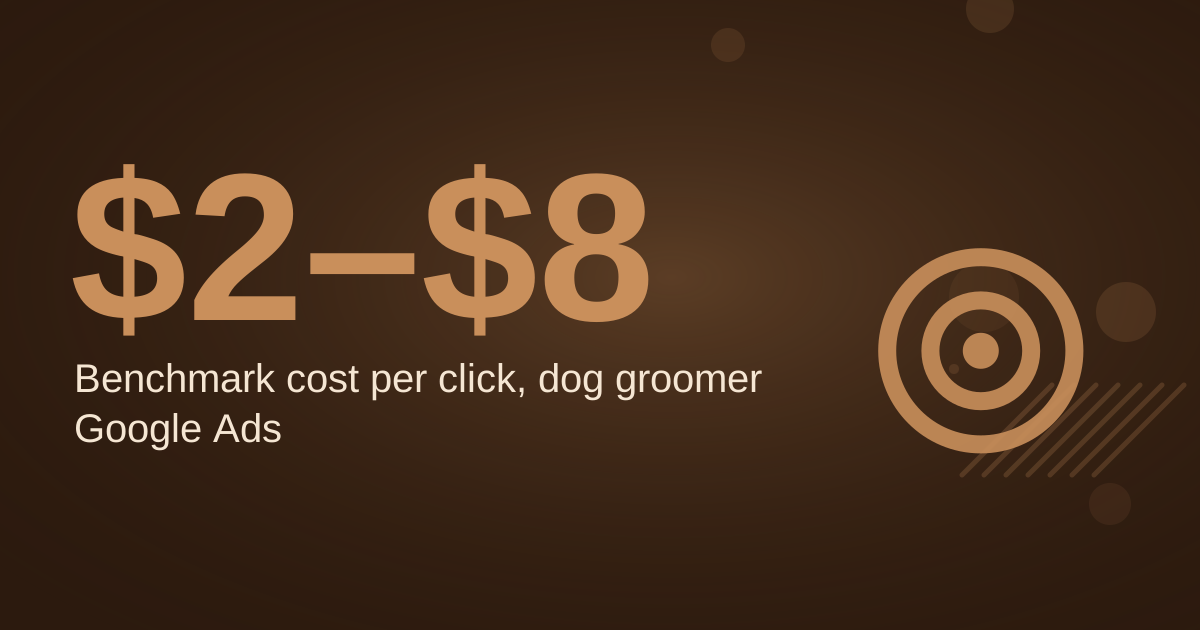
Typical dog groomer cost per click
AdTurbo benchmark
→
Monthly spend of most groomer advertisers
AdTurbo, per month
↑
Impression rise, mobile groomer case study
Marketing 360, as of 2023 vs prior 6 months
↑
Annual growth in mobile grooming
SchedulingKit via Scrap.io (secondary)
See Sources at the end of the article. Cards marked Assumption are examples, not results.
What Should a Pet Groomer Fix First?
Start with the booking path. If a new owner finds your listing at 9pm, they need a phone number or form that works, a way to book, and a reply within hours. Spending on visibility is wasted if the first contact stalls.
Next, complete your Google Business Profile. Choose the right primary category, add each service with a short description, and upload real photos of the salon. With the owner's permission, add before-and-after shots. Keep hours and address accurate, and make your name, address and phone number match everywhere they appear online.
A small website comes third. Six pages cover most needs: home, services and prices, about, contact, a FAQ on vaccination rules and grooming times, and your cancellation policy. For ongoing articles that answer owner questions, the
blog content strategy guide explains how to choose topics.
How Do Pet Owners Choose a Groomer?
Most owners search on a phone for terms such as "dog groomer near me" or "puppy grooming near me", then compare the top few map results on rating, review count, photos and distance. Those terms appear in a
vendor's list of Google Ads keywords for dog groomers, so they are a reasonable starting set for your own research.
Next, owners look for signs that you handle nervous or older pets well. Photos of calm dogs, clear notes on handling and a sentence about your approach all help. Finally, they book with whoever answers first, by phone, message or form. Reply speed is a marketing lever you control completely, and it costs nothing to improve.
How Much Does Google Ads Cost for a Dog Groomer?
AdTurbo, a Google Ads vendor, gives a benchmark of about $2 to $8 per click for dog groomer ads. The same
page says most dog groomer advertisers spend around $800 to $5,000 a month. At those click prices, a few wasted clicks add up quickly, so it matters which action you count as success.
The page names booking a grooming appointment as the primary conversion to track. Count bookings, not clicks, and judge every campaign by the bookings it produces. Barklead's
Facebook ads guide for groomers suggests targeting users within a 10 to 15 mile radius of the groomer's location, which is a useful starting radius to test.
GroomerGenie, a vendor, says its proprietary list contains more than 500 groomer negative keywords. Ask any agency what its negative keyword list covers before you hand over a budget.
Which Paid Channels Have Worked for Mobile Groomers?
Marketing 360 published a
case study of a mobile pet groomer that advertised on Facebook and Google. The case reports a 134% increase in impressions and a 696% increase in clicks compared with the previous six months, with a 682% increase in conversions. These figures date from 2023.
Treat these numbers as one vendor's results for one business, not a forecast for your area. The useful lesson is the method: pick the channels that match where your clients search and scroll, then compare each period against the one before.
For organic posts that show before-and-after work, the
Instagram growth guide covers the basics. Start with one channel, track it for a month, then add another.
Is Mobile Grooming Growing Fast Enough to Matter?
SchedulingKit, as cited on Scrap.io's
pet groomer data page, says mobile grooming is seeing 12 to 15% annual growth. That is a secondary figure from a vendor's citation, so check it against your own local bookings before you plan around it.
The Daily Groomer's podcast listings also describe a mobile operator, Lucky Dog Mobile Grooming, growing to 25 vans in 24 months. That is one company's story, told by a trade publication, so use it as a sign of competition rather than a benchmark.
Growth in a niche is a reason to check what competitors are doing, not a reason to spend more. Compare the profiles, reviews and prices of the mobile groomers nearest you.
Does the Season Change When You Should Push Bookings?
AdWave, summarising Groomer to Groomer, notes that November and December are traditionally a very busy time for groomers, sometimes too busy. Your capacity, not demand, is the constraint in those months, so promotion needs to match the number of open slots you actually have.
Plan promotions with a
holiday marketing strategy for local businesses in mind. Open booking early for the weeks you can fill, and leave the peak weeks for regulars who already rebook. A waiting list is only useful if you can staff it.
How Does a Rebooking Routine Work?
Rebooking is the step most groomers under-invest in, and it costs very little. Four habits do most of the work:
- Suggest the next date at pick-up, based on the coat, and book it before the owner leaves.
- Send a reminder 48 hours before the appointment through your booking software.
- After the usual interval plus a couple of weeks, send one friendly message with a booking link to clients who have not returned.
- Keep a profile for each pet, covering temperament, preferred cut, allergies and health notes.
Your own appointment book shows the typical gap between visits for each breed, which is a better guide than any national figure. Check your local rules for email and text consent before you automate messages, because requirements vary by country and channel.
What Is Rebooking Worth Per 100 New Clients?
Every input in this table is an assumption for illustration. Replace the prices, visit frequency and rebooking rates with figures from your own booking system before you use the result.
| Per 100 new clients | Weak rebooking | Base | Strong |
|---|
| Share who become routine clients (assumption) | 40% | 55% | 70% |
| Routine clients | 40 | 55 | 70 |
| Further visits per routine client in the year (assumption) | 5 | 5 | 5 |
| Average ticket (assumption) | $75 | $75 | $75 |
| Revenue from routine clients over the year | $15,000 | $20,625 | $26,250 |
| Difference vs Weak | n/a | +$5,625 | +$11,250 |
The table counts only revenue after the first visit. It ignores your costs and any pets that leave for reasons you cannot control.
Two readings follow from it. Fifteen extra routine clients are worth about $5,625 a year on these assumptions. Buying 15 new clients at an assumed $50 each would cost $750, but only if those clients also rebook, so ads work only when rebooking works. A reminder message costs far less than a new client.
If your book is nearly full, extra clients become a waiting list rather than extra revenue. Run the same table with your real open slots first, to see whether you need new clients at all or just fewer gaps in the calendar.
How Should AI Fit Into Grooming Marketing?
AI tools suit first drafts and repetitive questions: social captions, email subject lines, review-reply drafts and an after-hours auto-reply with your hours and prices. The
guide to AI tools that can replace a marketing assistant explains which tasks they can take on, and the
ChatGPT prompts for local business marketing article gives starting prompts.
Keep three rules. Never let a tool invent prices, credentials or promises. Never use generated images as stand-ins for real grooming results. Have a person read any message about a pet's health or behaviour before it goes out.
Which Numbers Should You Track Each Month?
Write these six figures in a simple spreadsheet, and review them once a month:
New enquiries, with the source of each one, which you can get by asking every new client.
Bookings and no-shows.
Share of first-time clients who rebook.
Google profile calls, direction requests and website clicks.
Review count and average rating.
Ad spend per new client, if you run ads.
Trends over several months are more useful than any single week, so keep the same definitions each time.
What Should You Do This Week?
- Pull your last 100 first-time clients from your booking system and count how many returned within twice their usual interval. That is your real rebooking rate.
- Test your booking path from a phone at night. Can a stranger find a number, a form and a reply promise within 30 seconds?
- Open your Google profile and fix the three most obviously incomplete items.
- Start naming the next appointment date at every pick-up, and set up a 48-hour reminder in your booking tool.
- Place a QR code for your review link at the counter, and ask every client for a review, not only the happy ones.
If you want a second opinion on the order of these steps, a
free audit can show which gaps cost you the most bookings.
FAQ
What is the best marketing for a pet groomer?
For most groomers the order is a working booking path, a complete Google profile, steady reviews and a rebooking routine, then paid ads. The worked table above shows why keeping clients can matter more than winning new ones.
How much should a pet groomer spend on Google Ads?
Vendor data says most dog groomer advertisers spend around $800 to $5,000 a month, but that describes common spending, not a target. Start with a small test, count booked appointments as the conversion, and scale only what pays.
Can I offer a discount in exchange for Google reviews?
Do not offer one until you have checked Google's current review policy on its help pages. Rules on incentives can change, so use the live policy rather than a summary, including this article.
Can AI answer customer messages for me?
For simple, repeated questions such as hours, prices and cancellation rules, yes. Keep a clear route to a human for anything involving health, safety, behaviour or complaints.
Sources