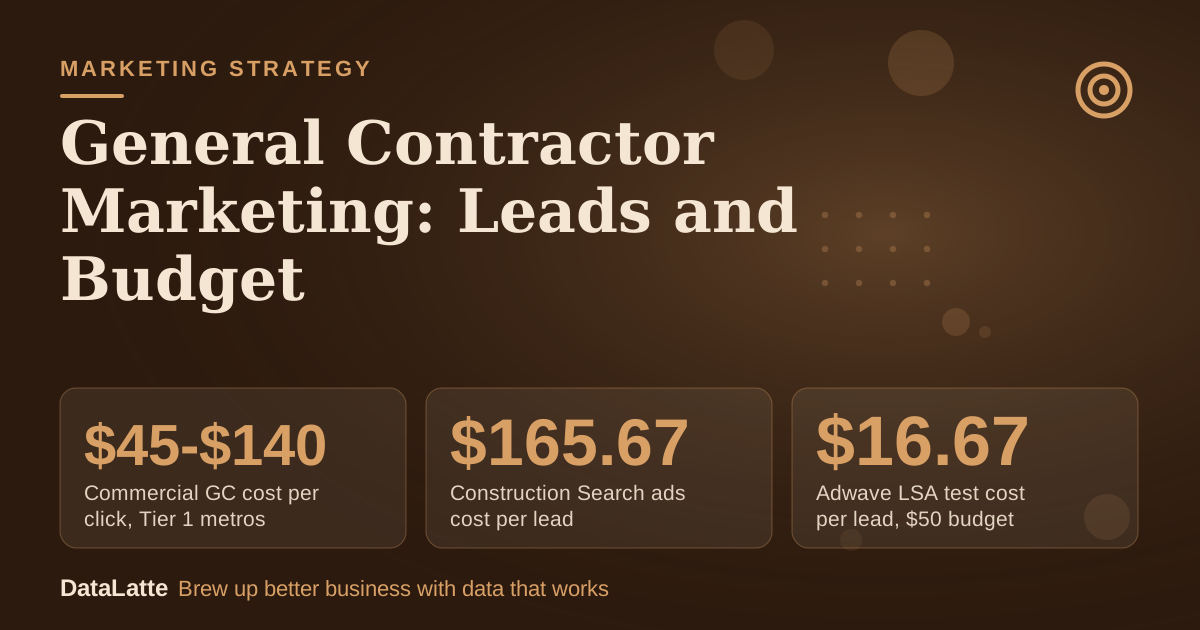
A general contractor's first marketing budget should go to a small, time-limited paid test, with cost per signed job as the target. Commercial general contractors in Tier 1 US metros pay $45 to $140 per click on Google, according to a
Paid Media World guide (secondary). Cost per lead for construction Search ads averages $165.67 in an
Admanage benchmark (secondary). Start with a fixed monthly budget and measure what it returns in signed jobs.
→
Commercial GC cost per click, Tier 1 metros
Paid Media World table (secondary)
→
Construction Search ads cost per lead
Admanage benchmark, updated Feb 23 2026 (secondary)
→
Adwave LSA test cost per lead, $50 budget
Adwave test, 3 leads from 890 impressions (secondary)
→
Referral leads converting into customers
Amplifinity report, cited by Adwave (secondary)
See Sources at the end of the article. Cards marked Assumption are examples, not results.
How Much Does a Google Ad Click Cost a General Contractor?
Clicks are expensive for commercial work. The Paid Media World table lists $45.00 to $140.00 average cost per click for commercial general contractors in Tier 1 metros. Residential and smaller jobs may cost less, but no source in this guide gives a verified residential general contractor figure, so check the live keyword planner for your own cities.
The practical lesson is to avoid broad, expensive terms without a plan.
Best Google Ads keywords for contractors covers which phrases tend to attract buyers rather than researchers. Keep every search term report, and add negative keywords each week for jobs you do not take.
What Does a Lead Cost, and Does a Lead Become a Job?
A lead is a form fill or call, not a signed contract. Admanage's construction benchmark puts Search ad cost per lead at $165.67. A small test in Adwave's Google Local Services Ads example, with a $50 budget, produced 3 leads and a $16.67 cost per lead. Three leads is too small a sample to plan around, so treat that figure as a sign that tests can be cheap, not as a forecast.
Cost per lead is only half the picture. Cost per signed job decides whether the spend pays. Track each lead to an estimate and then to a contract, using a field in your CRM or job software. A tool that connects ad data with job outcomes, such as the approach in
AI-driven local SEO reports, makes this easier to review each month.
How Fast Should You Respond to a Lead?
Speed matters. Pipelineon states that leads contacted within five minutes book at two to three times the rate of leads contacted an hour later. Lead Sync advises calling leads within five minutes and says contractors who wait are wasting ad spend. Both are vendor claims, so test them with your own call log rather than accepting the figures as proof.
Assign one person to own new leads during working hours. Log the time of each first contact. If your average response time is above an hour, fix that before you raise the budget, because a bigger budget will only add more leads that go cold.
Should a Contractor Spend Budget on Referrals?
Referrals are the cheapest channel to test. Adwave's channel comparison lists referral programs at $0 to $500 per month, and cash referral bonuses of $50 to $200 depending on job value are a common structure. For roofing companies, Adwave suggests $100 to $500 depending on project size. Pick a bonus that stays below your average profit on the job.
The Amplifinity report cited by Adwave puts overall conversion of referral leads into customers at 13%. Adwave also claims referral leads often convert better than internet leads, even when they cost less to acquire, but that is a vendor claim. Track referral jobs in their own source field so you can compare them directly with paid leads.
Are Lead Marketplaces Worth the Cost?
Marketplaces sell the same lead to several contractors, which lowers its quality. A 2023 Contractor Magazine survey, cited by Adwave, found that nearly 40% of contractors using lead-gen platforms rated lead quality as poor or very poor. That survey is older than the 2026 data elsewhere in this guide, so check current contractor feedback before committing.
Compare marketplaces against your own paid search results. If a marketplace lead costs more than your Google cost per lead and closes less often, it is a weak use of the same budget. For a side-by-side view of paid platforms, see
Amazon Ads vs Google Ads for local business. Referral partners such as architects and suppliers work like
affiliate-style partnerships, where you pay only for results.
How Should a First Monthly Budget Be Split?
Lead Nurture Close recommends a 30/50/20 split for contractor ads: 30% to Facebook awareness, 50% to Google Display and Search for high-intent clicks, and 20% shared across both platforms for retargeting. Those percentages are a vendor recommendation, not a standard. Adwave's example for a $500 monthly budget gives Google Ads for leads $250 a month, which the page says yields 25 to 50 clicks.
Adwave's guidance for contractors is to start Google Ads at $500 to $1,000 per month. For a $1,000 test, the 30/50/20 split works out as follows.
| Channel | Share (vendor split) | Monthly amount (assumption: $1,000 budget) |
|---|
| Facebook awareness | 30% | $300 |
| Google Search and Display | 50% | $500 |
| Shared retargeting | 20% | $200 |
If Facebook does not produce qualified calls in the first month, shift that money to Google search rather than spreading it thinner.
What Does a Worked Budget Look Like?
The example below uses one assumption set. Replace every input with your own numbers after the first month. The cost per lead is taken from the Admanage benchmark, not from a contractor account.
| Item | Value | Basis |
|---|
| Monthly Google budget | $1,000 | Assumption, within Adwave's $500 to $1,000 range |
| Cost per lead | $165.67 | Admanage construction benchmark |
| Leads per month | about 6 | Calculated: $1,000 divided by $165.67 |
| Lead-to-signed-job rate | 20% | Assumption |
| Signed jobs per month | 1.2 | Calculated: 6 times 20% |
| Average job value | $8,000 | Assumption |
| Gross revenue | $9,600 | Calculated: 1.2 times $8,000 |
| Cost per signed job | $833 | Calculated: $1,000 divided by 1.2 |
Gross revenue is not profit. At an assumed 25% gross margin, the $9,600 becomes $2,400 of gross profit against $1,000 of spend. If your margin is lower or your close rate is 10%, the same budget produces a cost per signed job near $1,667, which may not pay. Set your maximum acceptable cost per signed job first, then work back to the cost per lead that makes sense.
Write down your average job value, your margin and the cost per signed job you can afford. Then set the test budget so that the number of expected jobs covers that cost.
FAQ
How much should a general contractor spend on Google Ads?
Adwave recommends starting Google Ads for contractors at $500 to $1,000 per month. Increase only after you know your cost per signed job, not just your cost per click.
Are Local Services Ads a cheaper option?
Not by default. The Ryze guide notes that contractors without proper tracking can spend $2,000 to $8,000 per month on LSA leads that generate zero revenue. Track every LSA lead to a job before you scale.
Do referral bonuses work for general contractors?
Adwave suggests cash referral bonuses of $50 to $200 depending on job value. The Amplifinity report cited by Adwave shows 13% overall conversion of referral leads into customers, so measure your own referral jobs before setting a permanent bonus.
Should I respond to leads on the weekend?
Ryze reports that HVAC contractors see 40% more leads on Monday to Wednesday, and that landscapers peak on weekends. Those patterns are for other trades, so check your own call and form data by day before changing staffing.
Sources
Want a contractor ad account built around cost per signed job? See the
Google Ads service or
book a free audit.
Free for local businesses
Want this applied to your business?
I'll review your Google presence, local SEO, and ad accounts — and send you a specific action plan within 48 hours. No pitch, no pressure.