Graphic designers find better clients when the portfolio is easy to search and easy to judge, the specialty is stated plainly, and direct outreach targets the buyers you want. Local buyers often need several contacts before they commit; one vendor puts the typical range at 3 to 5 touchpoints. Paid ads can add enquiries, but results vary by industry and budget. Start with a small test, track where every enquiry comes from, and treat vendor claims as starting points rather than promises.
→
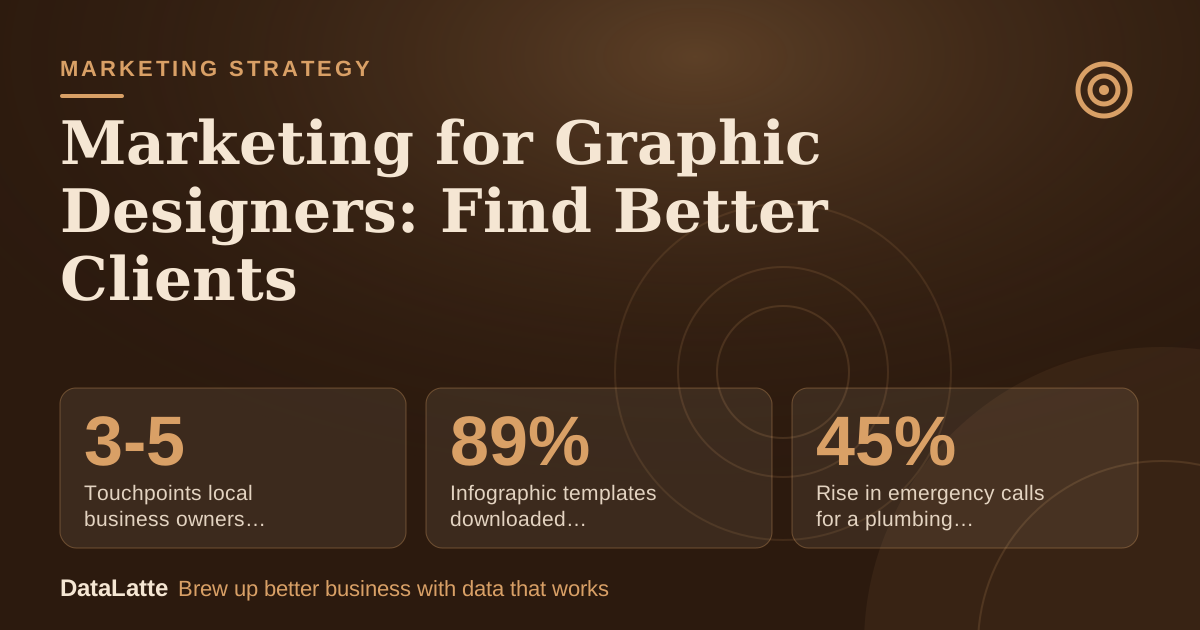
Touchpoints local business owners need before they buy
B2BLeadFinder vendor claim
→
Infographic templates downloaded by non-designers, by 2023
Adwave vendor page, as of 2023
↑
Rise in emergency calls for a plumbing client after targeted search ads
Lead Nurture Close vendor report
↓
Lower cost per acquisition for Meta Advantage+ clients, up to
Sumu Akter author report
See Sources at the end of the article. Cards marked Assumption are examples, not results.
How Many Touchpoints Does a Local Client Need?
A lead-data vendor states that most local business owners need 3 to 5 touchpoints before they buy (
B2BLeadFinder). That figure comes from a vendor, so treat it as a planning range. For a designer, touchpoints might include a portfolio visit, a referral, a follow-up email, a call and a proposal. A single ad click rarely closes a project, so plan the sequence before you spend.
A salon-focused guide cites Main Street ROI for the claim that 72% of potential clients prefer to find information about local businesses through search (
Sunny Storm, secondary). The figure covers local businesses in general, not design studios, but it supports keeping your own site and profiles easy to find.
How Should a Designer Structure the Portfolio?
Give each project its own page. State the client type, the brief, your role and the result, using only facts you can show. Descriptive file names and clear alt text help search engines and screen-reader users understand images, and placing images near the text that describes them makes the page easier to read.
Clients now have cheaper options for simple graphics. Canva, Venngage and Piktochart removed much of the technical setup that used to slow non-designers down (
Adwave). The same Adwave page reports that by 2023, 89% of infographic templates were downloaded by non-designers. Position your pitch on strategy, brand systems and finished work that a template cannot produce.
If you publish an infographic as marketing, keep the attribution line visible. Citations can sit in a footer, final panel or page note, as long as readers can find them easily (
Adwave).
Should a Designer Run Paid Ads?
Sometimes, and only for a narrow service. A vendor reports that a residential plumbing client saw a 45% increase in emergency call volume from highly targeted Google Search Ads (
Lead Nurture Close). That result is from a trade with urgent demand, so it does not predict a design studio's results. Using ads to reach a specific buyer type, such as packaging clients for food brands, is a more realistic test.
Other channels show mixed evidence. A UK restaurant-marketing guide says its authors often see Performance Max give better results than their search campaigns (
Taller Digital). An author reports that clients using Meta Advantage+ saw lower cost per acquisition, up to 20 to 30% better, especially with a mix of creatives (
Sumu Akter). Both are practitioner reports, not controlled tests.
Keep the audience in mind. A 2016 pet-grooming blog found that a narrow audience of 150,000 people within 20 miles, on a limited budget, meant users saw the ad typically less than 1.5 times (
Groomer to Groomer). Tight targeting with a small budget can mean very few repeat impressions.
Ads also do not change your local listing. Google says there is no way to request or pay for a better local position (
Rozhair). A paid campaign buys visibility for that campaign only.
How Much Social Posting Is Realistic?
A salon-marketing guide says most salon owners find three to four Instagram posts a week and one to two Facebook posts a week sustainable (
Bookeo). That cadence is for a different business type, so use it as a rough ceiling for a solo designer, not a target. A steady schedule of case-study posts beats an irregular burst.
Direct outreach often works better than posting for a designer with a clear niche. Local neighbourhood groups can help you find buyers, as described in the
hyperlocal marketing guide for Nextdoor. If you draft outreach emails or post captions with software, compare options in the
AI marketing tools guide and check any output before you send it.
What Does a $500 Ad Budget Return?
The table below uses assumptions for every input except the stated figure. None of these numbers is a published benchmark for design work; replace them with your own.
| Step | Input | Result |
|---|
| Monthly ad budget | $500 (assumption) | $500 |
| Cost per click | $3.00 (assumption) | about 167 clicks |
| Enquiry rate | 2% of clicks (assumption) | about 3.3 enquiries |
| Enquiries who hire you | 1 in 3 (assumption) | about 1.1 clients |
| Average project fee | $1,500 (assumption) | about $1,670 revenue |
| Ad cost per client | $500 divided by 1.1 | about $450 |
With 3 to 5 touchpoints typical before a purchase (
B2BLeadFinder), an enquiry that arrives at the first click may need follow-up before it becomes a project. Run the test for at least three months, because one extra client changes the result a great deal at this volume. A
budget guide for small businesses can help you plan the spend, and a simple
marketing dashboard lets you record each enquiry's source.
How Should You Handle Testimonials?
Use testimonials that clients have actually given, and ask permission before you publish them. Do not write reviews for clients, and do not offer incentives that depend on a positive review. These are basic ethical limits, and the rules on reviews and endorsements differ by country, so check the current guidance for the US, UK, Australia or Canada before you set up a review request process.
Short, specific quotes that describe the brief and the result are more useful than general praise. Pair each one with the matching project page so a prospect can see the work behind it.
FAQ
How do graphic designers get clients?
A findable portfolio, a clearly stated specialty, real testimonials and direct outreach to specific buyers form the core of the approach. Each channel's results depend on the niche, so test them one at a time.
How many touchpoints does a local client need?
A vendor reports that most local business owners need 3 to 5 touchpoints before they buy (
B2BLeadFinder). Plan follow-up instead of relying on a single contact.
Can a designer get a better local listing by paying Google?
No. Google says there is no way to request or pay for a better local position (
Rozhair).
Should I write my own testimonials to fill my portfolio?
No. Use only testimonials clients have given and approved, and check the current review rules in your country.
Sources
Want help getting your portfolio found? See the
Local SEO service or
book a free audit.
Free for local businesses
Want this applied to your business?
I'll review your Google presence, local SEO, and ad accounts — and send you a specific action plan within 48 hours. No pitch, no pressure.