The cheapest way to fill pool routes is to win homeowners already searching nearby, keep weekly customers on the route, and use paid ads only to fill open slots. Pool service is recurring work, so marketing pays back over months rather than on a single visit. Pool-specific benchmarks are scarce, so this guide uses adjacent service data, clearly labelled, and a worked example with assumed inputs you can replace.
→
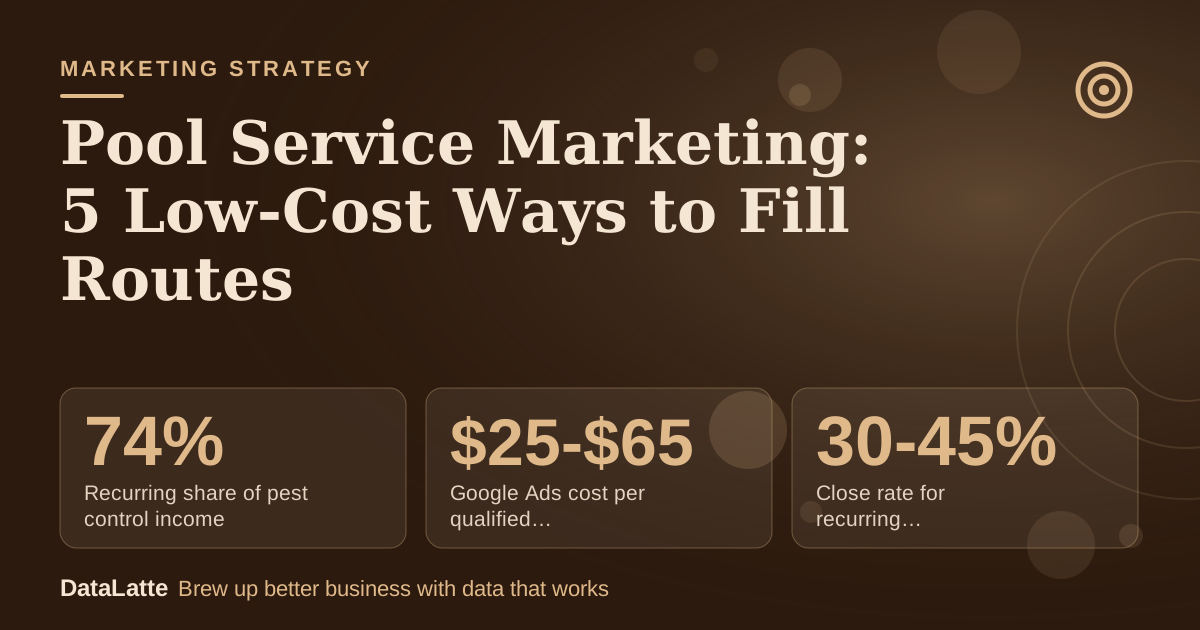
Recurring share of pest control income
PipelineOn summary of a 2025 cost study (secondary)
→
Google Ads cost per qualified lead, landscaping
AdWave expectation (vendor claim)
↑
Close rate for recurring landscaping service
AdWave expectation (vendor claim)
→
Minimum daily budget on one ad platform
AdWave, no contract (vendor)
See Sources at the end of the article. Cards marked Assumption are examples, not results.
What are the five low-cost levers for a pool service company?
| Lever | Typical cost | Time to first leads | Best for |
|---|
| Google Business Profile and reviews | Your time | Slow, then steady | Homeowners searching nearby |
| Referral offer to current customers | Cost of one credit per referral | Quick | Filling a tight service area |
| Property managers, HOAs and agents | Your time | Slow | Bulk and commercial accounts |
| Seasonal offers (openings, green-pool rescues) | Low | Seasonal | One-off jobs that turn into weekly service |
| Paid search | Per click or per daily budget | Days | Open slots you need filled now |
Start with the first two, since they cost the least. Add the others once you know how many new customers each channel brings in. Keep a simple log of lead sources so you can tell which lever actually produced each signed route.
Why does keeping a weekly customer beat finding a new one?
Every route customer is worth more over time than any single visit. The numbers below are assumptions, not industry data. Replace them with your own route figures before you rely on them.
- Assumed monthly price per customer: $160.
- Assumed gross margin after chemicals, labour and fuel: 40%, so $64 a month.
- Assumed average stay: 24 months, so lifetime gross profit is $64 x 24 = $1,536.
- Assumed loss at month 6: the customer leaves with 18 months left, costing $64 x 18 = $1,152 of gross profit.
That gap is why retention work pays. On-time visits, a short text after each service, and fast fixes to cloudy water protect the route. A simple
email retention plan can keep customers informed between visits, and
marketing automation for small business can send those messages without manual work.
How should review and service data guide retention?
A reputation dashboard should track review velocity, response timing, recurring sentiment themes, and where those themes appear by location or service line. AdWave recommends this for service businesses, and it works for routes too. If one neighborhood keeps raising the same complaint, you can fix that route before customers leave. A
marketing dashboard for a small business can hold these figures in one place.
AdWave also suggests reviewing one recurring service scenario each week and asking which avoidable step created work for the customer or staff. For a pool company, that could be a missed gate code, a late chemical top-up, or a repeated call about a broken pump. Each fix removes friction that would otherwise show up as a cancellation or a poor review.
When should a pool company time its marketing?
AdWave's summer TV guide states that demand for pool installation, lawn care and related outdoor home services peaks from May through July. It also says heat-driven services such as HVAC, AC and pool should start summer campaigns in mid-May to capture early planners. Work backwards from that date: have offers, booking pages and review requests ready before the first warm week.
Neighbourhood channels can run alongside those dates. For ideas on reaching households in a small radius, see
hyperlocal marketing with Nextdoor. Keep the spring push tied to open slots on the calendar, not to a general awareness goal.
How much should a pool company spend on paid ads?
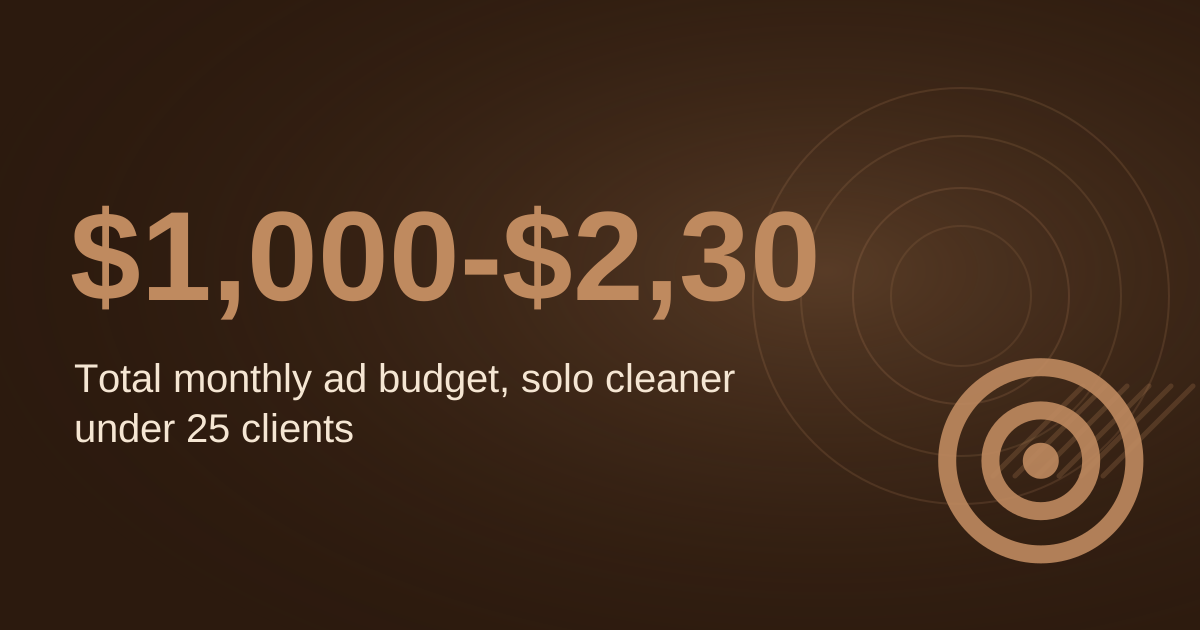
A LocaliQ survey of more than 300 small business owners from February 2026 found 52% had a monthly marketing budget under $1,000, as cited by Zoca (secondary). AdWave's pool-service page shows how far a small budget goes: a $30 daily budget equals $900 over 30 active days, a $35 daily budget equals $1,050 once Reddit is added, and $75 a day equals $2,250. Its daily budget runs from $30 to $10,000 with no subscription or contract.
Those are platform figures, not targets. A rule of thumb for salons puts advertising at 5 to 15% of revenue, with no derivation given. Use your own customer value to set the limit. For more low-cost options, see
affordable marketing help for small business.
Worked example: cost per customer from a $900 budget
Inputs (assumptions): $900 monthly ad spend, $64 monthly gross profit per customer, and new customers from ads per month as shown.
| Scenario | New customers per month (assumption) | Cost per customer | Months to repay from $64 monthly profit |
|---|
| Strong month | 5 | $180 | 2.8 |
| Weak month | 3 | $300 | 4.7 |
| Landscaping benchmark high end ($65 lead, 30% close) | Not pool data | $217 | 3.4 |
The landscaping row uses AdWave's cost per qualified lead and close rate for a different trade, so treat it only as a comparison point. A pool company that keeps cost per customer below its lifetime gross profit of $1,536 is still profitable on paper, but a shorter payback protects cash flow during a slow month.
Is TV worth it for a small pool company?
AdWave's pool example shows the reach math. Reaching 12,000 households five times a month requires 60,000 impressions, or $1,500 at a $25 CPM, which exceeds a $1,000 budget. Run the same check before booking airtime: households times frequency, divided by a thousand, times the CPM your provider quotes.
For most single-van operators, search and local listings will deliver more predictable results per dollar than TV. Consider TV only when the area is large enough that the math works and you can measure calls in the same period.
FAQ
How much should a pool service company spend on marketing?
No pool-specific benchmark is available from these sources. Start from customer value, set a ceiling per new customer, and check it against the cost per customer in the worked example above. A daily budget from $30 is a platform minimum, not a recommended spend.
Are paid ads worth it for a small route?
They can be, if you test with a fixed daily budget for a set period. Compare cost per customer with lifetime gross profit using your own inputs. If the payback period is longer than a customer typically stays, cut spend or change the offer.
When should I start seasonal marketing?
Start before demand peaks. AdWave reports that pool-related outdoor demand peaks May through July and suggests heat-driven services start in mid-May. Have bookings ready before the first warm week.
How should I respond to a bad review?
Reply promptly and specifically, referring to the actual job. Track response timing on your dashboard so slow replies do not go unnoticed. Use the same weekly review to fix the step that caused the complaint.
Do I need a dashboard to track this?
It helps. Record lead source, review volume, response timing and cancellations in one place. A
simple dashboard guide shows the setup. If you want an outside check of your current setup, request a
free audit, or review
Google Ads services for paid search.
Sources
Free for local businesses
Want this applied to your business?
I'll review your Google presence, local SEO, and ad accounts — and send you a specific action plan within 48 hours. No pitch, no pressure.