A taxi or private car company should market where riders search when they need a car now or want to book one ahead: Google Maps and search, backed by a profile that shows your phone number, hours and service area. Ride-hailing apps win on convenience, so compete on what they cannot easily promise: pre-booked airport transfers, fixed quotes and a dispatcher who answers. Paid ads can reach high-intent searches, but no published source gives a taxi-specific price per click or per lead. The ranges below come from other local service categories, so test with a capped budget.
→
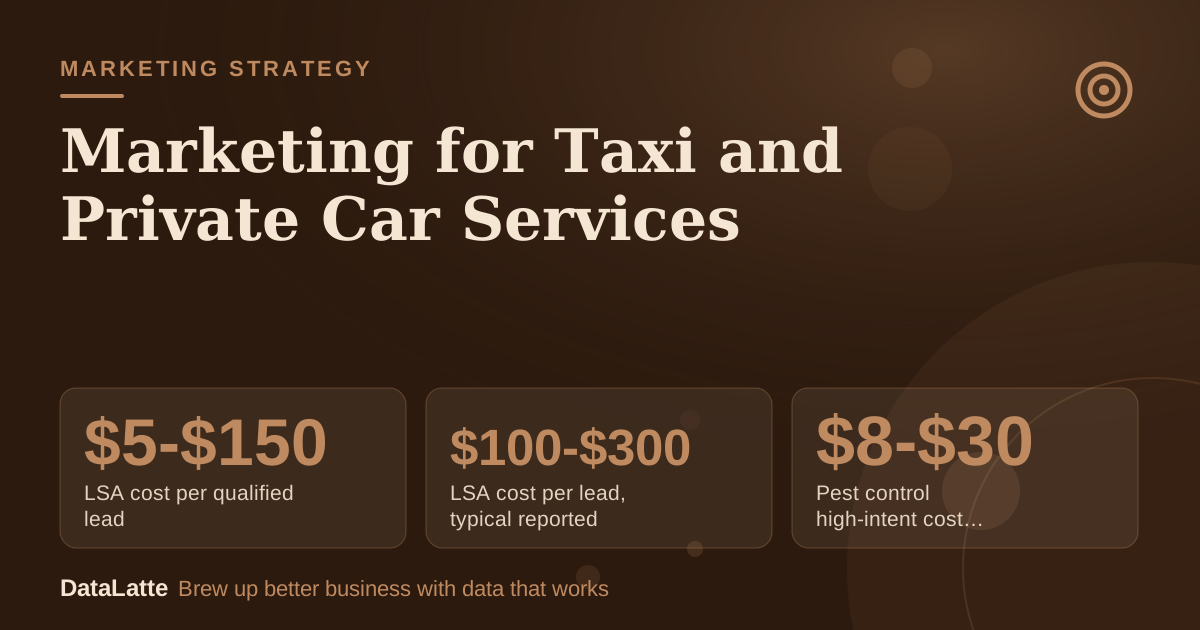
LSA cost per qualified lead
Ryze 2026 guide (vendor)
→
LSA cost per lead, typical reported
RuBanKT (vendor)
→
Pest control high-intent cost per click
INSIDEA, as of 2025-07-11 (vendor)
→
Contractor cost per lead
Contractor Marketing Pros (vendor)
See Sources at the end of the article. Cards marked Assumption are examples, not results.
Each card is a different service category, not a taxi benchmark. Read them as a sense of range, then measure your own numbers.
What Does a Local Lead Cost?
Ryze describes Local Services Ads as a pay-per-lead model, with businesses charged $5 to $150 per qualified lead depending on service category and market competition (
Ryze, 2026 guide, vendor). RuBanKT reports that businesses with Local Services Ads often see $100 to $300 per lead, depending on competition (
RuBanKT, vendor). Contractor Marketing Pros puts cost per lead for most contractor industries at $25 to $150 (
Contractor Marketing Pros, vendor).
These are trade figures, not taxi figures. A firm in a dense city with many competitors could sit near the top of a range, while a firm in a quieter area could sit lower. The only reliable way to know is a small test. Track cost per call and cost per paid trip, not only cost per click.
Should a Taxi Company Join an App Instead of Competing?
Ride-hailing apps set the convenience standard, so a direct fight on speed and ease is hard to win. Compete on what they cannot easily promise: confirmed pre-booked pickups, fixed prices, a named dispatcher and a human who picks up the phone.
Joining an app can still add trips. Before signing, ask four things: the commission on each trip, whether you keep your customers' details, whether your own phone and web bookings continue, and how the price is shown to drivers and riders. An app can fill slow hours, but it also moves part of the customer relationship to someone else. Keep building direct bookings either way. For a broader view of app-based promotion, read
app marketing for local business.
How Should You Show Up on Google?
Start with your Business Profile. Use your real company name, a phone number that someone answers, accurate opening hours, the areas you cover and photos of your vehicles. Choose categories that match what you actually sell, such as airport transfers, so the listing does not promise services you do not run.
Ask passengers for reviews after good trips, and reply to every review, including the poor ones, with a calm and factual answer. Drafting replies can be routine work. The
ChatGPT prompts for local business marketing guide has wording ideas. Check any AI draft against what really happened on the trip before you post it.
Do Local Services Ads Suit a Taxi Firm?
Local Services Ads are built around pay-per-lead, which fits a firm that wants calls rather than website visits. Confirm in Google Ads whether your area and category are eligible, because availability can change. Standard search ads are the other route. They can show for "taxi near me" style searches, and you control the location and keywords. For search ads, INSIDEA puts high-intent pest control clicks at $8 to $30 as of July 2025 (
INSIDEA, vendor), which shows how much local competition can move the price.
A lead is not a paid trip. A caller may price-shop, book with an app or never confirm. Set a call-handling rule before you spend: who answers, how fast, and what counts as a booked trip. Without that rule, a cheap lead can still cost more than it earns.
What Does a Test Budget Return?
All inputs in the table are assumptions, chosen inside the lead-cost ranges above. The assumed monthly budget is $500. Assumed: 40% of leads become a paid first trip. Assumed: the average fare is $60.
| Item | Scenario A (assumption) | Scenario B (assumption) |
|---|
| Monthly budget | $500 | $500 |
| Cost per lead | $25 | $100 |
| Leads | 20 | 5 |
| Paid first trips (40% of leads) | 8 | 2 |
| Cost per first trip | $62.50 | $250 |
| Revenue from first trips at $60 | $480 | $120 |
| Net after first trips | -$20 | -$380 |
| Revenue if each customer books 3 trips | $1,440 | $360 |
| Net with 3 trips each | +$940 | -$140 |
At $25 per lead, the first trip roughly breaks even, and repeat bookings decide the result. At $100 per lead, even three trips per customer do not cover the spend. Set a maximum cost per lead before the test starts, and pause the campaign when it is passed. Adwave's channel framework starts with four inputs: ticket size, repeat business, urgency and competition density (
Adwave, vendor). For a taxi firm, repeat corporate and airport customers are the inputs to watch.
How Can AI Help With After-Hours Requests?
Many booking questions arrive when the office is closed: fares, availability and airport pickup times. An AI agent can answer those from approved information and capture the name, pickup point, destination and time, so a person can confirm the booking in the morning. The
AI agent for customer service guide explains the setup. A
custom GPT for customer service is a lighter option for a firm with a small team.
Keep a human in the loop for live dispatch and for any price quote. Do not let the tool invent fares or promise a pickup time that no driver can meet. Test it with real calls before you rely on it, and review a sample of transcripts each week.
FAQ
How can a taxi company compete with ride-hailing apps?
Compete on pre-booked trips, fixed prices, reliability and a human dispatcher, and make those promises visible on your Google profile and in your ads. Join an app only if its terms keep your direct customers.
Are Local Services Ads worth it for a taxi firm?
They can be, for calls from high-intent searches. Ryze lists $5 to $150 per qualified lead across categories, but no taxi-specific figure exists in the sources here. Test with a capped budget and measure paid trips, not only leads.
What should a taxi Google profile include?
Your real name, a phone number someone answers, accurate hours, the areas you cover and photos of your vehicles. Keep categories accurate, and reply to reviews.
Should I build my own app?
Not necessarily. Phone, web booking and a simple confirmation message cover many small firms. An app costs money to build and maintain, and the sources here do not show that it pays off for small fleets.
Sources
Want help setting up Google ads and a call-ready profile? See the
Google Ads service or
book a free audit.
Free for local businesses
Want this applied to your business?
I'll review your Google presence, local SEO, and ad accounts — and send you a specific action plan within 48 hours. No pitch, no pressure.