Marketing for Kids Activities Businesses
Part of the guide: Local Marketing Strategy
What Benchmarks Exist (and Which Ones Do Not)
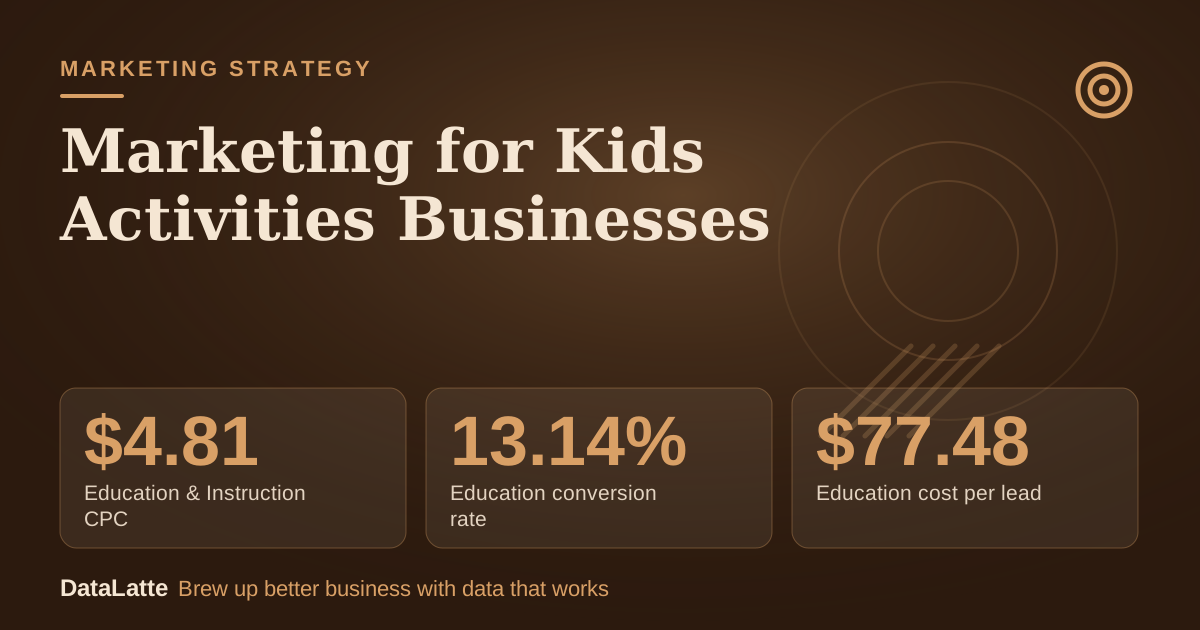
Education & Instruction CPC
LocaliQ 2026
Education conversion rate
LocaliQ 2026
Education cost per lead
LocaliQ 2026
Sports & Recreation CPC
LocaliQ 2026
See Sources at the end of the article. Cards marked Assumption are examples, not results.
How Parents Decide
- A trigger: a child asks for a hobby, a term is about to start, a friend recommends something.
- A search ("kids swimming lessons near me") or a question in a local parents' group.
- A shortlist of two or three, compared on reviews, photos, timetable, location and price.
- A trial or enquiry, often outside working hours.
- A decision after the first class, based on how the child felt and how staff handled it.
Get Found: Google Business Profile First
- Name: exclude taglines, hours, phone numbers, URLs and "service or location details". Your profile name should be the name on your sign, not "Little Stars Dance Classes Best Kids Ballet Austin".
- Categories: use as few as possible to describe your core business, and pick ones that say what you are, not everything you offer.
- Hours: the guidelines say certain businesses shouldn't provide hours, including those with varied schedules, "like schedules for different types of activities, including showtimes, worship services, or classes", and they list schools among the examples. Whether a class studio falls under that is a judgment call. My reading is that if your hours genuinely vary by class, check what the guidelines say for your situation before listing front-desk hours that do not match what a parent will find, and put the timetable on your website.
Pages Per Class, Not One Page for Everything
Paid Search: A Small, Timed Campaign
- Location: a radius drawn from where your current families live. Pull your last 50 enrolments and look at the zip or postcodes.
- Keywords: group by what the parent wants, such as "kids swimming lessons [town]", "ballet classes for 4 year olds", "beginner karate for children", all in phrase or exact match. Add negatives:
jobs,teacher training,course online,free,adult,worksheet,app. Our negative keywords guide explains how to apply them. - Ads: put the age and the offer in the headline ("Kids Swim Lessons Ages 3-12. Free Trial Class"). Say only what is true.
- Landing page: the class page above, not your home page. See landing page best practices.
- Tracking: count form submissions and calls, not clicks. Our conversion tracking guide has the steps.
Show Safety Plainly
- Staff checks. In England and Wales, the government's guidance on regulated activity with children lists "teaching, training, or instruction, care for, or supervision of children" as a specified activity, counted when it happens on more than 3 days in a 30-day period, and says employers and organisations request the Enhanced DBS check with a Children's Barred List check. Australia's Working With Children Checks and US state requirements differ by state or territory and are not covered here, so check your own state's screening body.
- First aid training, class sizes and child-to-staff ratios.
- A written safeguarding policy, insurance and your sickness and pick-up rules.
- A "Meet the team" page with names, short bios and photos.
Photos and Video of Children
Offer a Low-Risk First Step
Reviews and Referrals
Where Else Parents Look
- Local parent groups, following each group's rules on promotion
- School and nursery newsletters (ask first)
- Libraries, cafes and community centre boards
- Partnerships: a dance school with a shoe shop, a swim school with a children's physio
Keep Families Across Terms
The Math
| Tough | Base | Strong | |
|---|---|---|---|
| Budget (assumption) | $500 | $500 | $500 |
| Cost per click | $6.50 (assumption) | $4.81 (LocaliQ Education) | $2.77 (LocaliQ Sports & Rec) |
| Clicks | 77 | 104 | 180 |
| Click to trial booking (assumption) | 4% | 8% | 10% |
| Trial bookings | 3.1 | 8.3 | 18.0 |
| Booking to attended (assumption) | 65% | 75% | 85% |
| Attended to enrolled (assumption) | 35% | 50% | 60% |
| New enrolments | 0.7 | 3.1 | 9.2 |
| Ad cost per enrolment | $714 | $160 | $54 |
- Your ceiling click price. Max CPC = most you will pay per enrolled child x booking rate x attendance rate x enrolment rate. In the Base column the three rates multiply to 0.03, so if you will pay $150 per child, the ceiling is $150 x 0.03 = $4.50 a click.
- What a child is worth. Multiply the term fee by the number of terms a child typically stays. A child who pays $180 a term and stays three terms is $540 in revenue (assumed numbers). Use your own enrolment records, not a guess.
Do This Today
- Pull your last 50 enrolments and note each family's town or zip code. Draw your ad radius from them.
- Work out the most you will pay for one enrolled child: term fee x average terms stayed x the share you can spend on acquisition.
- Check your Google Business Profile name, categories and hours against the Google guidelines above, and add a "Meet the team" and safeguarding section to your site.
- Build a trial-class page for your biggest age group with one booking button, then run a small Search campaign starting four weeks before term.
- Set up a day-before reminder for every trial and a written photo-consent form before posting any images.
FAQ
Sources
- LocaliQ: Search advertising benchmarks (2026)
- Webtonic: Education and coaching Google Ads statistics (second-hand roundup)
- Google Business Profile Help: Guidelines for representing your business
- Google Advertising Policies: Personalized advertising
- Google Maps User Contributed Content Policy: Fake engagement and incentives
- GOV.UK: Regulated activity with children in England and Wales
- NSPCC Learning: Photography and sharing images
Related guides
- Small Business Marketing in Arkansas: 2026 Guide
- Small Business Marketing in Rhode Island: 2026 Guide
- Small Business Marketing in Iowa: 2026 Guide
- Customer Lifetime Value for Small Business: CLV Guide
- Salon Brand Building: Steps to Attract More Clients
- Marketing for Electricians: Leads, Reviews, Budget
- Telegram Marketing for Local Business: Channel Setup
Free for local businesses
Want this applied to your business?
I'll review your Google presence, local SEO, and ad accounts — and send you a specific action plan within 48 hours. No pitch, no pressure.
Want hands-on help?
See how DataLatte handles Analytics & Reporting for local businesses.

Local marketing strategist with 10+ years at global agencies — OMD, Dentsu, GroupM, and BBDO. Now helping small businesses get the same data-driven edge. Based in Europe, working with clients in the US, UK, Australia, and beyond.
Related articles

Marketing for Escape Rooms: Fill Off-Peak Slots
8 min read
Marketing for Electricians: Leads, Reviews, Budget
8 min read
Lead Generation for Local Business: Channels and Costs
8 min read
Customer Lifetime Value for Small Business: CLV Guide
8 min readWant this applied to your business?
Let's review your current marketing setup together — free, no obligations.
Get Your Free Marketing Audit