May 20, 2026·Nataliia Rumiantsewa· 10 min read All posts
A click on a Meta traffic ad for a restaurant or food business averages $0.45, according to LocaliQ's 2026 benchmarks. That sounds like a bargain until you do the arithmetic a café has to do. Say $450 buys 750 clicks, 45 people claim your offer and 18 walk in.
That is $25 of advertising per new customer. On a $7 drink with a 65% margin, you earn $4.55 per visit, so that customer has to come back about six times before the ad has paid for itself.
Coffee is a frequency business, which makes Meta ads good for it, but only if you plan for the second and third visit, not just the first.
This is the in-depth setup guide. If you want a shorter overview of campaign types and creative, start with Facebook and Instagram ads for coffee shops, then come back here for the settings, the offer design and the math. It is written for café owners in the US, UK, Australia and Canada. Benchmarks are US-based; use your own prices in pounds or other dollars.
What the Benchmarks Say
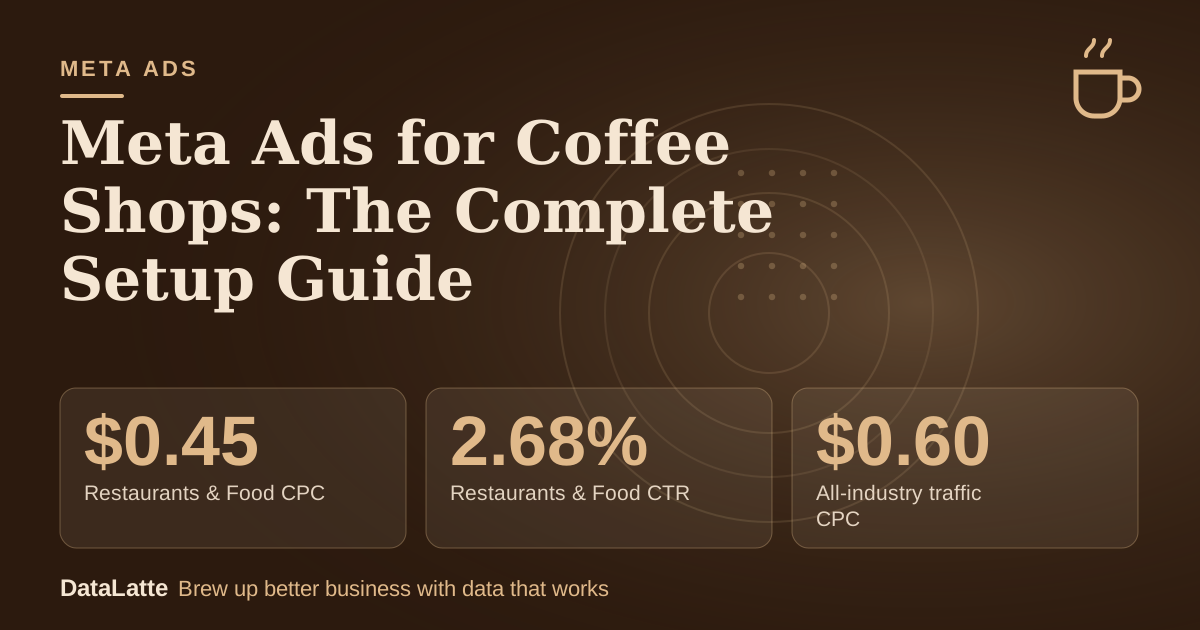
LocaliQ publishes yearly advertiser benchmarks. Its 2026 Facebook benchmarks list the following for traffic campaigns (optimised for clicks to a link):
$0.45→
Restaurants & Food CPC
LocaliQ 2026
2.68%→
Restaurants & Food CTR
LocaliQ 2026
$0.60→
All-industry traffic CPC
LocaliQ 2026
1.93%→
All-industry traffic CTR
LocaliQ 2026
See Sources at the end of the article. Cards marked Assumption are examples, not results.
Three cautions before you plan around those figures. The page does not describe its methodology or sample size. It has no lead-campaign data for Restaurants & Food. And a click is not a coffee: it measures curiosity, not a visit.
Another roundup, Stackmatix, puts Meta at $12 to $18 CPM and $0.80 to $3.50 CPC across advertisers, so a range of roughly $0.45 to $1.00 per click for a local café is a sensible thing to test against. Check live estimates in Ads Manager, which reflect your radius and season.
Step 1: Pick the Right Objective (the Old Names Are Gone)
Older guides tell you to choose "Store traffic" or "Local awareness". Those are legacy objectives. Flighted's explainer of Meta's objectives says Meta now organises campaigns into six: Awareness, Traffic, Engagement, Leads, App Promotion and Sales, and that the 11 legacy objectives, including Store Traffic, are no longer available when creating new campaigns. That article does not say which new objective replaces Store Traffic. Check what your Ads Manager offers.
For a single café with no online ordering, a sensible default is:
Traffic, sending people to a one-page offer with a claim button. This is the easiest to measure.
Awareness only for a launch or a re-opening, where being seen matters more than a measurable claim.
I would avoid Sales unless you take online or app orders and have the Meta pixel installed, because that objective optimises for purchase events your café probably does not generate often enough to learn from. That is a judgement, not a Meta rule.
Step 2: Account Foundations
Before spending a cent:
A Facebook Page and a linked Instagram professional account.
A Meta Business account that you own, not a freelancer's.
Payment method and a spending limit you are comfortable with.
Location. Meta's location targeting help page covers radius, city and zip-code options and the choice between people living in an area and people recently there (only its headings loaded for this article, so check the options and the minimum radius in your own account). For a café, draw a radius around the door based on where regulars live and work. Pull postcodes from your loyalty app or last 50 card transactions, and look at the map.
Audience. Start broad: location plus a wide age range, and let delivery find buyers. Stacking five interests (coffee, specialty coffee, brunch, baking, local food) tends to shrink the audience, though I treat that as a working assumption to test, not a proven rule.
Lookalikes. A third-party guide from Flighted says Meta requires at least 100 people in a source audience and cites Meta's Business Help Center for a recommended 1,000 to 5,000 (the Meta page itself would not load, so this is second-hand). Most single cafés do not have a list that size, so skip lookalikes at first and use the list for exclusions: exclude existing customers so you pay to reach new ones.
Placements. Use automatic placements to start and make sure each ad has a vertical 9:16 version for Stories and Reels, plus a square for feed. Check the placement breakdown after two weeks and trim if one clearly wastes money.
Step 4: The Offer Is Half the Campaign
An ad without an offer gets a like. An ad with a specific, low-friction, time-limited offer gets a visitor. Design the offer around the economics of a cup of coffee:
Offer
Cost to you (assumption)
Why it works
Free pastry with any first drink
about $1.20
Low cost, the drink pays for it
Buy one, get one, weekdays before 10am
about $2.00
Fills a slow shoulder period
Free upgrade to a large
about $0.40
Cheap, feels generous
10-visit card, first stamp done
about $0.50
Starts the habit immediately
Those costs are examples. Use your real cost of goods. The best-fitting offer tends to be the one that starts a routine, because your profit is in visit number five, not visit number one.
Step 5: Creative Briefs You Can Shoot on a Phone
Shoot three short pieces in one morning:
The pour or the pull (8 to 12 seconds). Vertical video, no talking, the offer as text on screen in the first 3 seconds, address at the end.
The person. A barista or regular saying one honest line: "It's the corner shop with the cardamom bun." Real faces tend to beat stock photos for local businesses, which is a practical observation rather than a statistic.
The proof. A screenshot of a real review plus a photo of the space.
Write copy that fits in two lines: what it is, where it is, what the offer is, how to claim it. "New on Mill Street: filter coffee and cardamom buns. Show this ad for a free bun with your first coffee, Mon to Fri until 10am."
Meta can also test text and image variants automatically, but with a small budget, test one variable at a time: offer first, then video versus photo.
Count the redemption, not the click
Give each ad a different phrase for staff to hear ("the bun offer", "morning pour") and keep a tally by the till. A paper tally beats guessing.
Step 6: Tracking Without a Pixel
Cafés rarely have enough online purchases for pixel optimisation, so track what walks in:
Unique phrase or code per ad (as above).
A QR on the landing page that the barista scans or that the customer shows. A different QR per ad if you can.
Loyalty card stamps with a different card colour or sticker for ad-sourced customers.
A simple question at the till for the first month: "How did you hear about us?"
At the end of each week, write down claims, redemptions, spend. Cost per redemption is the metric; clicks are only a diagnostic.
Step 7: Budget and Schedule
Our local marketing budget guide covers how much of revenue to allocate. For a test, a common pattern is $15 a day (about $450 a month) for 30 days, one campaign with two ad sets: one audience around the shop, one for the office block or campus nearby. That is my suggestion, not a Meta requirement.
Do not edit budgets or creative in the first 3 to 4 days. Review weekly. If an ad set spends $60 with no redemptions, change the offer before the audience.
The Math
This is the table that decides whether to keep going. Every row is an assumption for illustration, except that the $0.45 Base click matches the LocaliQ restaurant average for traffic campaigns. Replace the numbers with your own after 30 days.
Tough
Base
Strong
Monthly budget (assumption)
$450
$450
$450
Cost per click (assumption)
$0.90
$0.60
$0.45
Clicks
500
750
1,000
Click to offer claim (assumption)
3%
6%
10%
Claim to redemption (assumption)
30%
40%
50%
New customers in the door
4.5
18
50
Ad cost per new customer
$100
$25
$9
Margin per visit at a $7 ticket, 65% (assumption)
$4.55
$4.55
$4.55
Cost of the free item (assumption)
$1.20
$1.20
$1.20
Visits in the next 90 days per new customer (assumption)
1.5
3
4
Net result after 90 days
-$425
-$226
+$400
Visits needed to break even
22
6
2.2
How to read it: break-even visits equal (ad cost per customer + cost of the free item) divided by margin per visit.
The Base case loses money at 90 days and breaks even at about 6 visits, so it works if a typical regular comes in a couple of times a week for a few weeks. The Tough case never will. The Strong case is better than you should plan on.
Two conclusions:
Your break-even click price = (margin per visit x expected visits - free item) x claim rate x redemption rate. For Base-case behaviour over 6 visits, ($4.55 x 6 - $1.20) x 0.06 x 0.40 = $0.63. Click prices above that lose money on average.
The biggest lever is not the click price, it is repeat visits. A loyalty card, an email follow-up and a decent product move the visit number far more than shaving 10 cents off a click.
Do This Today
Work out your margin per visit and how many visits a typical new regular makes in 90 days. Write down your break-even visits.
Pull the postcodes of your last 50 loyalty customers and draw your ad radius around the shop.
Build a one-page offer with a claim button and a different phrase for each ad.
Shoot three 10-second vertical clips in one morning before opening.
Launch one Traffic or Leads campaign at about $15 a day and set a weekly 20-minute slot to log claims, redemptions and spend.
FAQ
Q: How much do Meta ads cost for a coffee shop?
A: LocaliQ's 2026 benchmarks put a Restaurants & Food traffic click at $0.45, versus $0.60 across all industries. Your own cost depends on radius and competition. At that price, $450 a month buys about 1,000 clicks, though conversion from click to coffee is the number that matters.
Q: Which objective should a café choose?
A: The legacy Store Traffic and Local Awareness objectives are no longer offered for new campaigns, per Flighted's explainer. Traffic or Leads is the usual starting point for a shop with no online sales, and Awareness for a launch.
Q: Do I need the Meta pixel?
A: Not for an offer-claim test. A unique phrase, a QR code or a loyalty stamp is enough. A pixel starts to matter if you take online orders.
Q: Facebook or Instagram?
A: Run both through automatic placements, then check the breakdown. See the shorter Meta ads for coffee shops overview for placement and creative detail.
Q: Will ads bring regulars or one-time freebie hunters?
A: Some of each. That is why the math counts visits, and why you capture an email or a loyalty stamp on visit one. Offers tied to a routine (weekday mornings) tend to attract more habitual customers than blanket discounts, in my judgement rather than from a study.
Local marketing strategist with 10+ years at global agencies — OMD, Dentsu, GroupM, and BBDO. Now helping small businesses get the same data-driven edge. Based in Europe, working with clients in the US, UK, Australia, and beyond.