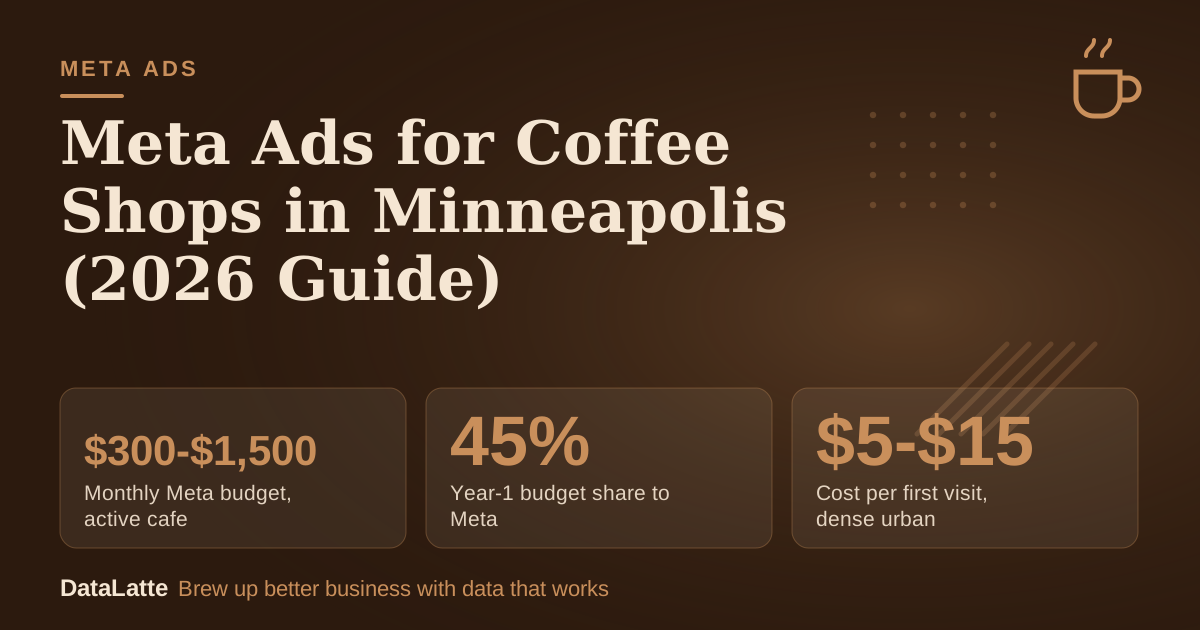
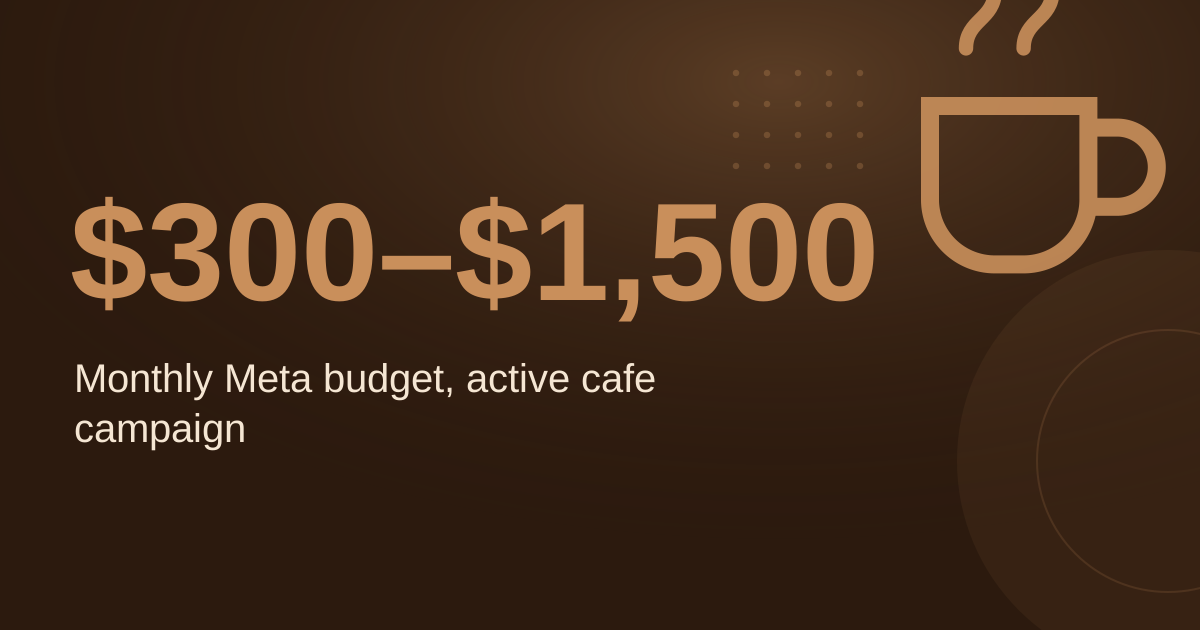
Meta ads on Facebook and Instagram can bring steady local traffic to a coffee shop in Minneapolis, MN, but only when the budget, radius and creative are set for one neighborhood rather than a broad audience. AdWave's 2026 comparison puts an active cafe campaign on Meta at
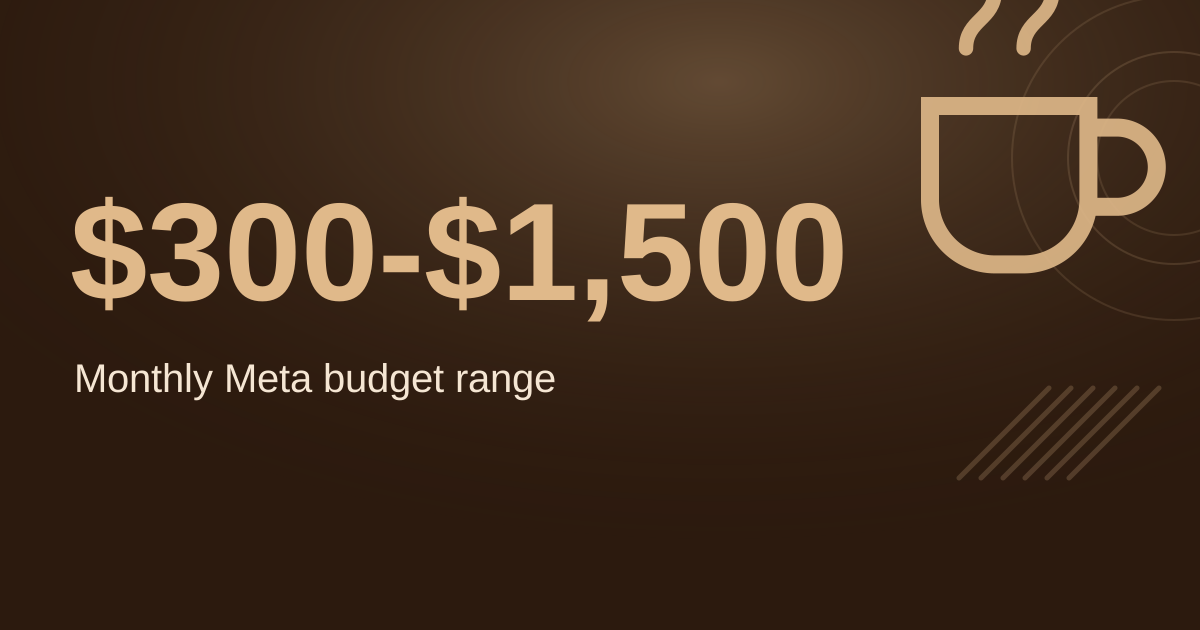
$300-$1,500 per month. This guide covers how to split that budget, which formats to use and how to measure results. Local cost data for Minneapolis varies, so treat the figures below as national planning bands and check live numbers in Ads Manager.
→
Monthly Meta budget, active cafe
AdWave 2026 planning band
→
Year-1 budget share to Meta
Pre-launch and year-1 mix
→
Cost per first visit, dense urban
Suburban range is $10-$25
→
Typical cost per click
Typical Meta ad cost
See Sources at the end of the article. Cards marked Assumption are examples, not results.
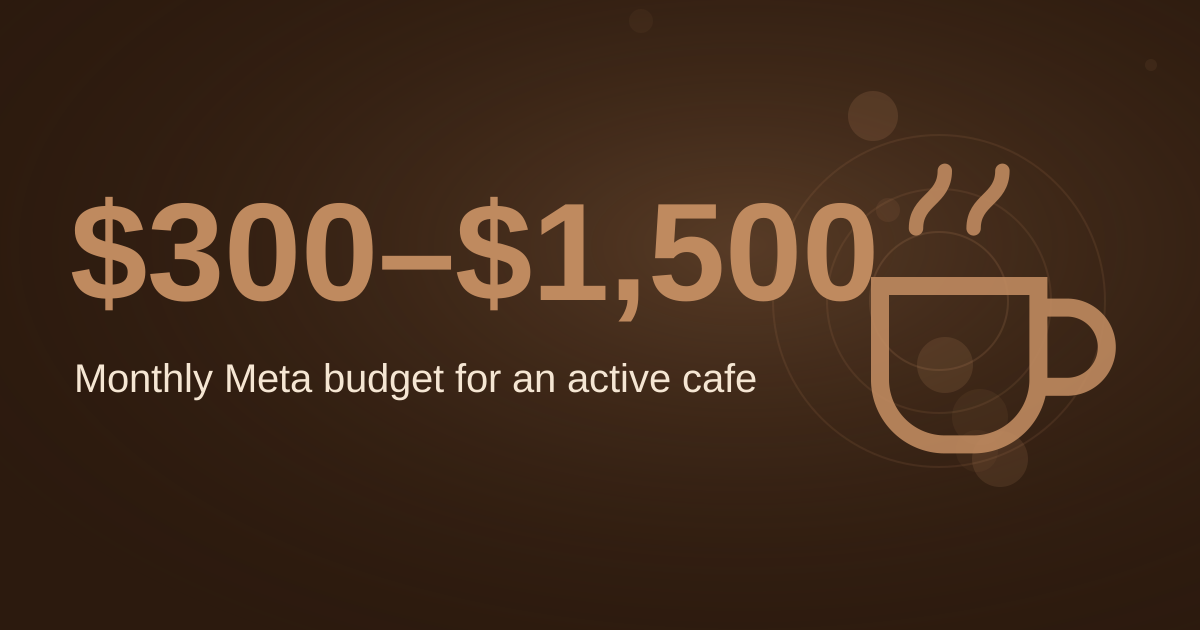
AdWave recommends planning
$300-$1,500 per month on Meta for an active cafe campaign. Its general channel comparison lists a standalone Meta buy at
often $300-$1,000 per month. A restaurant guide gives a similar band of
$300-$1,500+ monthly, with results in weeks rather than days.
These are planning bands, not guarantees. A coffee shop that has never run paid social should expect a test period before cost per visit settles.
The share of budget matters too. AdWave's pre-launch and year-1 mix allocates
45% of budget to Instagram and Meta ads, dropping to 30% in years two to four. A shop running its first paid campaign should expect Meta to take the largest share early, then share budget with email and search as repeat customers build up.
This worked example uses assumption-labelled inputs, so you can swap in your own numbers.
Inputs:
- Daily budget: $30 (assumption, the low end of the $30 to $50 per day Reels range AdWave suggests)
- Days running per month: 30 (assumption)
- Monthly spend: $900 (calculated)
- Average ticket for a first visit: $6 (assumption)
AdWave puts cost per first visit at
$5-$15 in dense urban markets and $10-$25 in suburban areas. Dividing $900 by those costs gives the following.
| Scenario | Cost per first visit | Estimated first visits per month |
|---|
| Dense urban, low cost | $5 | 180 |
| Dense urban, high cost | $15 | 60 |
| Suburban, low cost | $10 | 90 |
| Suburban, high cost | $25 | 36 |
The table counts first visits, not repeat buyers. At the dense-urban high-cost case, 60 visits at a $6 ticket (assumption) produce $360 in first-visit revenue, which does not cover the $900 spend. Repeat visits are what make the numbers work, so the first month is best treated as a test of which ad and audience bring people back.
Short-form video is the format to start with. Meta's 2025 Creative Best Practices report, as cited by AdWave, says
short-form video generates 2.5 times more engagement than static images on Facebook and Instagram (secondary). AdWave's coffee shop example uses latte art video, a morning atmosphere and customer photos for its Reels ads.
Keep the offer simple. AdWave suggests a "first drink on us" offer for a Reels launch,
running at $30-$50 per day. For a seasonal product, the same logic applies. AdWave's multi-channel guide gives the example of a coffee shop promoting
a new fall latte to everyone within five miles of the store.
Use real footage of your space, drinks and staff. Stock imagery makes a neighborhood shop look like a chain. For a deeper walkthrough of short vertical clips, see
Instagram Reels for coffee shops.
How should you target people near your shop?
Start with a tight radius. AdWave's Reels suggestion uses
1-3 mile radius targeting, while its fall latte example uses five miles. For a single location, begin at the tighter end and widen only when the first audience stops responding. Avoid national interest targeting such as "coffee" with no location limit, because it spends budget on people who will never walk in.
Meta's platforms share one system.
Instagram ads run through the same Meta Ads Manager as Facebook ads, and one campaign can run on Instagram, Facebook or both. Meta also
owns both platforms, which lets advertisers identify detailed customer profiles and set a budget for each ad (secondary).
Age and interest audiences should be tested in your own account. No sourced benchmark sets an age range for coffee shops, so let your first campaign's results decide which groups to keep. The step-by-step approach is covered in
Instagram ads for coffee shops, step by step.
What should a coffee shop ad say in Minneapolis?
Keep the copy local and specific. A broad national slogan gives the viewer no reason to choose your shop over the one on the next block. Examples of hook structures, which should be tested rather than assumed to work, include a line about morning coffee near the viewer, a line that contrasts a local independent shop with a chain, and a line aimed at newcomers asking where locals start their day.
Make sure the ad's promise matches what someone finds when they tap. The Google Business Profile is often the next stop. One guide recommends that coffee shops
answer common questions proactively in the profile's Q&A, such as whether you offer free Wi-Fi, dairy-free options or dogs on the patio (secondary).
A clear call to action beats a vague one. Name the action a viewer should take, such as visiting the shop, claiming the first-drink offer or checking the menu. For local search work that supports paid ads, see
local SEO for coffee shops in Minneapolis.
The most common waste is targeting by broad interest instead of radius. A campaign aimed at everyone who likes coffee, anywhere, will pull clicks from people who cannot reach the shop. Tie every campaign to a radius around the location instead.
The second mistake is running the same ad at the same level all day. Check your own sales data to find the hours your shop is busiest, and concentrate spend there rather than spreading it evenly across quiet hours.
The third is stock imagery. Genuine footage of the space, the baristas and the drinks is the format AdWave's examples rely on, and it matches what a passerby will actually see. The fourth is judging the campaign by reach alone. Reach shows how many people saw an ad, not how many walked in.
Set up tracking before spending on a campaign. Without it, the only numbers available are impressions and clicks, which do not show whether the shop sold a single extra drink.
- Install the Meta Pixel on the website and confirm it fires on the contact or booking page.
- Set a conversion event, such as a Lead event when someone submits a form.
- Add UTM parameters to every ad URL so Google Analytics records Meta-sourced traffic.
- Compare Ads Manager results each week against actual first visits and repeat orders, not just reach.
Meta Ads Manager is the central place to run ads across Instagram and Facebook, as
Adobe Express describes it (secondary). Meta's own training is also free:
Meta Blueprint offers free Facebook and Instagram advertising courses with certification on completion (secondary).
Plan the budget in phases. Year one carries the heaviest Meta share, at 45% of the budget, and later years settle at 30%, according to
AdWave's mix. Use the early months to find the ad, audience and radius that bring repeat visits, then lower the share as the mix stabilizes.
Organic posting supports the paid work. One guide recommends that coffee shops
post on social media at least once per week, ideally one to two times per day (secondary). The same content can feed ads, so one good video can serve both. For a broader content plan, see
coffee shop Instagram marketing strategy.
Automation can reduce the work of following up with customers who have already visited. The tools and setup are covered in
marketing automation for local coffee shops.
FAQ
AdWave suggests planning
$300-$1,500 per month on Meta for an active cafe campaign. Start where you can test and measure results for a few weeks before increasing spend.
Do Instagram and Facebook ads need separate accounts?
AdWave puts it at
$5-$15 in dense urban markets and $10-$25 in suburban areas. Your own cost will depend on creative quality, radius and offer.
Sources
Ready to check where your Meta budget is going?
Get a free audit of your current setup.
Free for local businesses
Want this applied to your business?
I'll review your Google presence, local SEO, and ad accounts — and send you a specific action plan within 48 hours. No pitch, no pressure.