May 21, 2026·Nataliia Rumiantsewa· 7 min read All posts
A restaurant can use programmatic ads for retargeting, which shows ads to people who already visited its website or searched for it. Whether this is worth the money depends on traffic and cost per booking. Adwave reports that 88% of diners search online before choosing a restaurant, so a restaurant with few site visits has a small pool to retarget. Check your platform's current audience requirements on its live help page before building a list. Then run a capped test with one clear offer and compare its cost per booking with search.
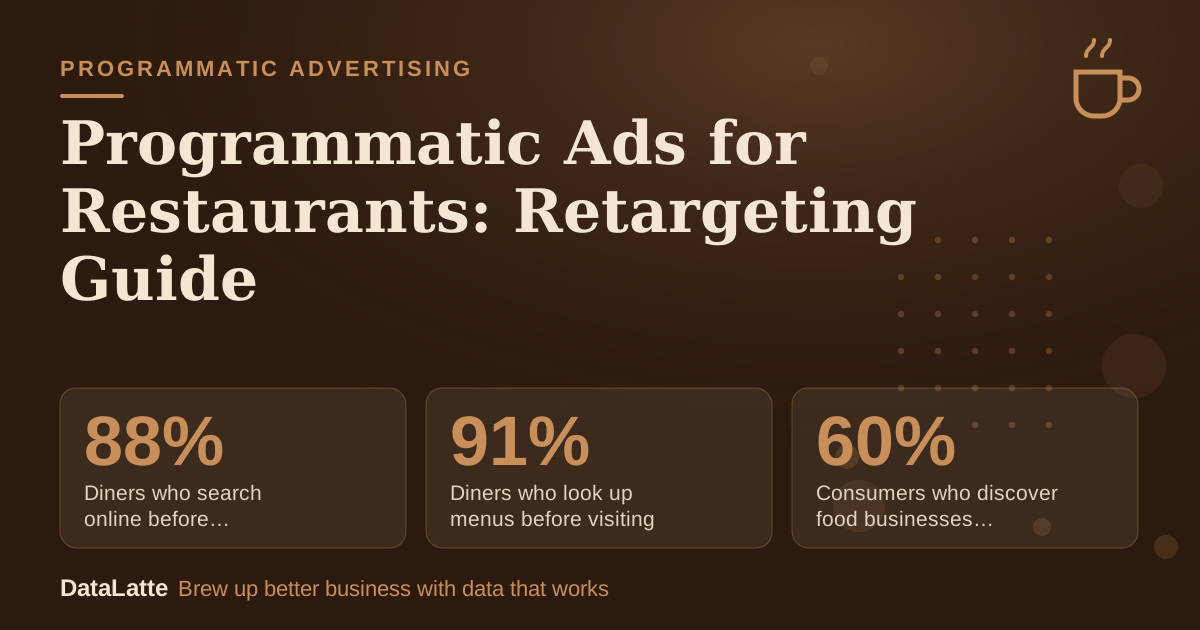
88%→
Diners who search online before choosing a restaurant
Marketing LTB, via Adwave (secondary)
91%→
Diners who look up menus before visiting
Marketing LTB, via Adwave (secondary)
60%→
Consumers who discover food businesses online or on social media
National Restaurant Association 2024, via Adwave (secondary)
6-12%→
Restaurant PPC clicks that convert to reservations or orders
Marketing LTB, via Adwave (secondary)
See Sources at the end of the article. Cards marked Assumption are examples, not results.
What Does Retargeting Mean for a Restaurant?
Retargeting shows ads to people who have already shown interest, such as someone who viewed your menu or booking page and left. Adwave also describes search retargeting, which targets people based on keywords they recently searched online rather than on prior website visits. For a restaurant, that could mean reaching someone who searched for a dinner spot nearby and never booked.
The National Restaurant Association's 2024 State of the Industry report, as cited by Adwave, says 60% of consumers discover new food businesses through online searches and social media rather than by driving past them. Retargeting sits in that part of the journey, after a person has already found you once.
The evidence available is vendor-led. StackAdapt states that retargeting website visitors can boost engagement by 25-40% over manual buys, a figure reported on Adwave's programmatic video page. Custom Market Insights states that retargeting often delivers 10x better performance, a third-party claim as reported on the same page. Neither figure comes from a restaurant.
Engagement is not the same as bookings. Adwave also says it targets only households that have already shown interest in a brand online, but this is a vendor claim, not a measured result. Treat these numbers as reasons to test, not as forecasts for your dining room.
What Must Be in Place Before You Start?
Retargeting needs an audience, so your website has to receive visits first. Grubhub recommends that restaurants include as much information as possible in their Google Business Profile, including an address, phone number, website URL, operating hours and photos. Those details help people reach your site in the first place.
Mobile matters too. Grubhub notes that Google switched to mobile-first indexing in late 2020, so it evaluates the mobile version of a website when ranking it, and cites RestaurantEngine saying more than 80% of consumers look for restaurants using their smartphones. Your menu and booking pages should load well on a phone. The online menu and website setup guide covers this.
Respond to reviews too. Adwave advises restaurants to respond to every review on Google and Yelp within 24 to 48 hours. Reviews do not feed a retargeting list directly, but they shape whether a visitor books once they arrive.
Which Offers and Ad Messages Should Retargeting Use?
Keep one job per ad: book a table, order, or enquire about a private event. Adwave's illustrative example for website visitors who did not book is 10% off a first online order. It is an example of a retargeting offer, not a benchmark, so test it against your own margins before using it.
Creative matters. Marketing LTB analysis, as reported by Adwave, says video ads achieve 1.8x higher click-through rates than image-based restaurant campaigns. Because 91% of diners look up menus before visiting, a strong option is an ad that shows the dish or menu section the visitor already viewed, plus your address and one button.
Adwave's cost guide estimates that Google Ads for restaurants costs $300 to $1,500 per month, and Meta ads cost $500 to $2,000 per month for most single-location restaurants. It also cites industry benchmarks of 3% to 6% of revenue on advertising for established restaurants and 8% to 12% for new locations. Adwave advises planning to increase total ad spend by 30% to 50% during peak months.
For a restaurant doing $800,000 a year, Adwave calculates a marketing budget of $24,000 to $48,000 per year, or roughly $2,000 to $4,000 per month across all channels. These are vendor estimates, so use them as a range to test within, not a target. For how programmatic pricing works, see the programmatic advertising cost guide.
Worked Example: Is an $800 Test Worth It?
The budget and margin are assumptions. The cost per click and conversion range come from sourced figures, but they describe search campaigns, so applying them to retargeting is also an assumption.
Item
Input or calculation
Low case
High case
Monthly test budget
Assumption
$800
$800
Average cost per click
WordStream average, cited by Adwave
$1.84
$1.84
Clicks
$800 / $1.84
about 435
about 435
Conversion rate
Marketing LTB range, cited by Adwave
6%
12%
Bookings or orders
Clicks x conversion rate
about 26
about 52
Cost per booking
$800 / bookings
about $31
about $15
Margin per booking
Assumption
$25
$25
Margin returned
Bookings x $25
about $653
about $1,305
At the low case, the test returns less margin than it spends. At the high case, it returns about 1.6 times the spend. The gap between these outcomes is the reason to measure your own conversion rate before scaling. If your margin per booking is lower than $25, the break-even conversion rate rises.
How Do You Set Up and Judge a Test?
Pick one offer and one action, such as a booking or a first online order.
Map the campaign 6 to 8 weeks ahead if it is tied to a promotion, as Adwave advises for key campaigns.
Set the retargeting window to match the decision. Short windows suit same-week dinner visits; longer windows suit private dining and catering.
Cap how often one person sees the ad and exclude people who already booked or ordered, if your platform allows it.
Check that the most popular search keywords are the most expensive, as The Fork Manager notes, so compare retargeting cost per booking against search before deciding where the next dollar goes.
Judge the test at the end of a fixed period set in advance, using cost per booking and margin returned, not clicks.
Delivery apps are a separate channel. In one Adwave example about an Austin Thai restaurant, adding DoorDash Storefront reduced commission costs on direct orders from 30% to 6%, which is worth weighing against paid retargeting when you plan your mix.
FAQ
Do programmatic retargeting ads work for a single restaurant?
They can, if enough people visit your website and your offer is clear. The available evidence is mostly vendor-led, so run a capped test and track cost per booking.
How much should a restaurant spend on a test?
Adwave's estimate for Google Ads is $300 to $1,500 per month for restaurants. Start near the low end and increase only if cost per booking beats your search campaigns.
Can retargeting feel intrusive?
It can, if the same ad repeats too often. Cap frequency, keep the message relevant to what the visitor viewed, and stop showing ads to people who have already booked.
What if my website gets little traffic?
Build visits first through search, your Google Business Profile and reviews. Retargeting needs an audience, so most of the early work is getting found.
Local marketing strategist with 10+ years at global agencies — OMD, Dentsu, GroupM, and BBDO. Now helping small businesses get the same data-driven edge. Based in Europe, working with clients in the US, UK, Australia, and beyond.