StackAdapt Review: Pricing and Fit for Local Business
Part of the guide: Programmatic & Audio Advertising
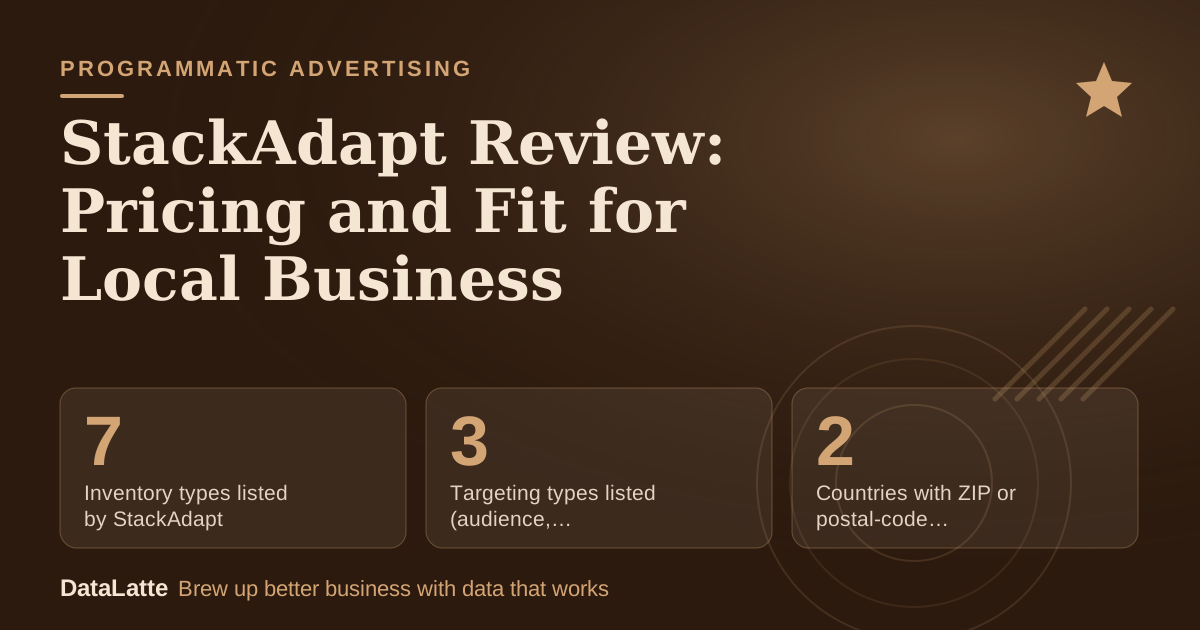
Inventory types listed by StackAdapt
StackAdapt platform page
Targeting types listed (audience, context, location)
StackAdapt platform page
Countries with ZIP or postal-code list uploads (US, Canada)
StackAdapt geotargeting guide
Published CPMs or fees
None published
Source: StackAdapt platform page and geotargeting guide, checked Oct 2026
What StackAdapt Is
Pros and Cons for Local Businesses
- Native, display, video and CTV in one platform.
- Contextual and audience targeting, plus retargeting of site visitors.
- First-party list uploads such as email subscribers, where you have consent.
- Useful for awareness before a high-consideration purchase.
- More complex than Google Ads or Meta Ads, with a steeper learning curve.
- Local targeting is mostly country, state, city or DMA level. In the US and Canada you can upload a list of ZIP or postal codes, and radius targeting around addresses or coordinates exists but is described for mobile in-app environments (StackAdapt geotargeting guide, checked Oct 2026). Expect less precision than Google Ads location targeting.
- Needs enough budget and time for the algorithm to learn. Minimums vary, so confirm with the vendor.
- Awareness-style clicks are less likely to convert than search clicks, because nobody was looking for you.
What Does StackAdapt Cost?
The Math: What $1,000 Buys
| Step | Programmatic (example) | Google search (example) |
|---|---|---|
| Monthly budget | $1,000 | $1,000 |
| Assumed price | $8 CPM | $3 per click |
| Impressions / clicks | 125,000 impressions | 333 clicks |
| Assumed click rate | 0.1% | n/a |
| Clicks | 125 | 333 |
| Assumed enquiry rate | 3% | 5% |
| Enquiries | 3.75 | 16.7 |
| Assumed close rate | 40% | 40% |
| New customers | 1.5 | 6.7 |
| Cost per new customer | about $667 | about $150 |
Do This Before You Spend (20 Minutes)
- Write down what one new customer is worth to you over 12 months. One number.
- Ask StackAdapt or your agency for the CPM, platform fee and monthly minimum in writing.
- Run the table above with your numbers. If cost per customer is higher than the value in step 1, stop.
- Confirm that you can see conversions (calls, bookings, forms) before any money moves.
How to Structure a First Campaign
- Set a single goal. Calls, bookings or a lead form, not "awareness" in general.
- Layer audiences carefully. For a coffee shop, you might combine interest in specialty coffee with a tight local geography. For a salon, combine beauty interests with ZIP-code targeting.
- Schedule by time of day if your setup allows it. Run ads when your audience is likely to act, such as mornings for a cafe or evenings for a fitness studio.
- Retarget your site visitors. Retargeting is usually the most efficient programmatic use for small businesses. Make sure your tracking is installed first; see Facebook Pixel vs Google Tag.
- Send traffic to a focused landing page with a single call to action.
- Test for at least a few weeks before deciding. Programmatic campaigns need time to learn. Set the stop date on day one.
Who Should and Should Not Use It
| Business | Fit |
|---|---|
| High-ticket local services (hair colour, bridal, fitness memberships) | Possible, especially for retargeting |
| Pet groomers with repeat customers | Possible for local awareness if tracking is in place |
| Coffee shops with low ticket sizes | Usually hard to justify on cost alone |
| Appointment businesses with weak tracking | Fix tracking first |
StackAdapt vs Other Options
- Google Ads captures existing demand and is usually the better first investment for local services. See our Google Ads service.
- Meta Ads are strong for local awareness and offers with simpler setup. See our Meta Ads service.
- Other programmatic platforms differ in minimums and support. Compare them in our programmatic platforms guide.
Pre-Launch Checklist
- Tracking works. Conversions are recorded for calls, bookings or form submissions.
- A landing page matches the ad. The offer on the page should match what the ad promised.
- A frequency cap is set, if the campaign type supports one, so the same person is not shown your ad too many times in a short period.
- Brand-safety and fraud settings are reviewed. Ask what viewability and invalid-traffic tools are available and whether they add cost.
- You know your target cost per lead, based on what a customer is worth over time.
- You have a review date. Pick a point at which you will pause, adjust or scale.
Our Take
FAQ
Sources
Next Step
Related Articles
- Amazon Prime Video Ads for Small Business
- AppLovin Ads for Local Business
- Best Programmatic Advertising Platforms for Small Business in 2026
- Introduction to Programmatic Advertising for Coffee Shops
Related guides
Free for local businesses
Want this applied to your business?
I'll review your Google presence, local SEO, and ad accounts — and send you a specific action plan within 48 hours. No pitch, no pressure.
Want hands-on help?
See how DataLatte handles CTV Advertising for local businesses.

Local marketing strategist with 10+ years at global agencies — OMD, Dentsu, GroupM, and BBDO. Now helping small businesses get the same data-driven edge. Based in Europe, working with clients in the US, UK, Australia, and beyond.
Related articles
Spotify Ads for Local Business: Complete Guide
9 min read
Google Display vs Programmatic: What Differs (2026)
9 min read
Programmatic Advertising for Pet Groomers: A Guide
8 min read
Programmatic Ads for Restaurants: Retargeting Guide
7 min readWant this applied to your business?
Let's review your current marketing setup together — free, no obligations.
Get Your Free Marketing Audit