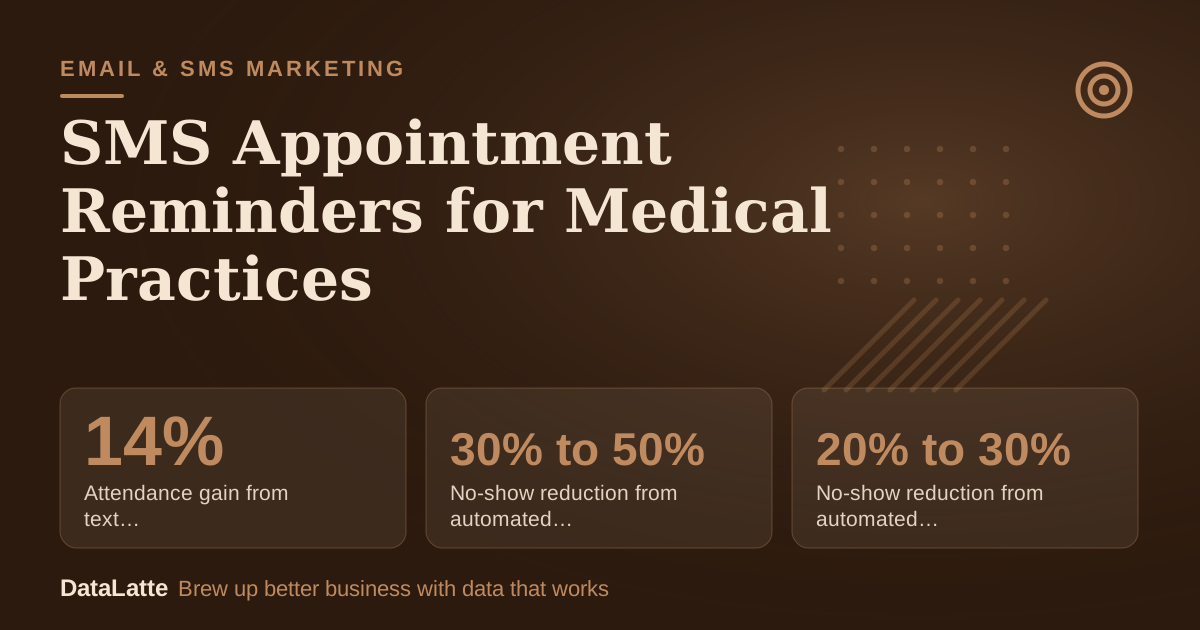
Automated SMS reminders reduce missed medical appointments, but the size of the effect depends on the source. Research cited on a salon rebooking blog puts the attendance gain from text reminders at 14%, while vendor pages claim no-show cuts of 20% to 30% and 30% to 50%. The most consistent timing advice is a reminder 24 to 48 hours before the visit, with short wording and a clear way to reply.
This guide is for small medical, dental and allied-health practices in the US, UK, Australia and Canada. Vendor claims are labelled as such, and the worked example uses labelled assumptions. Nothing here is legal advice. Consent and message rules vary by country and state, so check them with a compliance adviser before you automate.
↓
Attendance gain from text reminders (Permanente Journal, as cited)
secondary, cited by Lutily
↓
No-show reduction from automated reminders (dental page)
vendor claim, Adwave
↓
No-show reduction from automated reminders (med spa page)
vendor claim, Adwave, as of 2026
→
Recommended reminder lead time
vendor guidance, Adwave
See Sources at the end of the article. Cards marked Assumption are examples, not results.
How Much Do SMS Reminders Reduce No-Shows?
The most specific figure here is a 14% improvement in attendance from text reminders, attributed to research published in The Permanente Journal and cited by
Lutily's salon rebooking article. It is cited second-hand, so check the original before quoting it in patient materials.
Vendor pages give bigger numbers. Adwave states that
automated appointment reminders reduce no-shows by 30% to 50%, and separately gives 20 to 30% for med spas,
as of 2026. These are marketing claims, not controlled results, so plan around the low end. Two other figures, up to 40% from BonusQR and 60% to 70% from GoConverso, name no source and are left out of the calculations below.
Your starting no-show rate matters. A practice with few missed visits has less room to improve than one losing a fifth of its bookings. For the wider toolkit, see
how to reduce no-shows in appointment businesses.
When Should the Reminder Go Out?
The most cited window is 24 to 48 hours ahead. Adwave recommends
sending reminders 24-48 hours in advance, and a pet grooming software guide gives the same window for
automated SMS and email reminders, with an option to confirm or reschedule.
A salon marketing checklist is more specific:
48 hours beforehand works best, and texting the day before is too late. That is one practitioner's view rather than a study, so treat it as a hypothesis. A two-step pattern, one text at 48 hours and one at 24 hours, sits inside the cited window and is a sensible starting test.
Text, Email or a Phone Call?
Reminder systems can send
reminders via SMS, email, or automated calls days or hours before an appointment. The same guide cites veterinary research on client communication but gives no figures from it and notes it is not specific to grooming, so it does not settle which channel works best.
For a medical practice, the practical question is who actually reads texts. Offer a call or voice reminder to patients who do not reply to the first message, and record each patient's preferred channel at booking. This keeps staff calls focused on non-responders rather than phoning the whole list.
What Should the Message Say?
Keep it short and plain: practice name, date, time, and one action such as replying to confirm or calling to change. Templates for appointment texts exist as inspiration;
SimpleTexting's examples cover appointment reminders among other uses, though they are written for accounting firms.
Offer an alternative for patients who cannot attend. Adwave's illustrative dental example
sends two proactive reminders and offers a same-day rebooking option, and the page notes such examples are not verified performance studies. Keep health details out of the text itself, and send any promotional content separately.
What Happens to a Slot That Opens Up?
A reminder only helps if the freed slot refills. Adwave summarises a
2024 peer-reviewed study of online booking in a medical practice, which recorded 1,080 online interactions from 880 patients over 12 weeks. In that study, 47.7% of online appointments were scheduled within seven days. The study covers online booking rather than reminders, so it shows how quickly patients book, not whether reminders work.
Another cited figure is from a
medical practice and hospital study, where unused appointments fell from 22.7% to 10.3% after online scheduling. For practical methods to refill gaps, see
how to fill empty appointment slots fast. For patients who never came back after a missed visit, the
win-back email guide covers follow-up.
Worked Example: What Could Reminders Save?
All inputs below are assumptions for an illustrative clinic. Replace them with your own numbers.
| Input | Value | Basis |
|---|
| Appointments per month | 800 | assumption |
| Current no-show rate | 15% (120 missed visits) | assumption |
| Average revenue per visit | $140 | assumption |
| Relative reduction, base case | 14% | cited figure, applied to assumption |
| Relative reduction, high case | 20% | low end of vendor range, applied |
| Messages per appointment | 2 | assumption |
| Cost per message | $0.02 | assumption, not from a source |
Base case: 120 x 14% = 16.8 visits recovered, about 17. At $140 each, that is about $2,350 in revenue if every freed slot refills. Messaging costs 800 x 2 x $0.02 = $32, leaving roughly $2,320 before software and staff time.
High case: 120 x 20% = 24 visits, or $3,360 in revenue, about $3,330 after messaging. If only half the freed slots refill, the base case falls to roughly $1,140 after messaging. Treat these as ceilings, then measure your own no-show rate for 8 to 12 weeks, by visit type, and replace the assumptions with those results.
How Do You Set Up Reminders Step by Step?
- Collect a mobile number and preferred contact method at booking.
- Schedule one reminder about 48 hours ahead, with an optional second at 24 hours.
- Write a short text: practice name, date, time and one action.
- Offer a same-day rebooking option when a patient cannot attend.
- Call or voice-remind patients who do not reply.
- Track the no-show rate by visit type for 8 to 12 weeks before and after.
Automation logic is covered in the
appointment reminder script guide, and the
AI agent for appointment booking guide covers booking flows. Teams without in-house development can start with the manual steps above.
If you want a second look at your reminder and booking setup,
book a free audit.
FAQ
Do SMS reminders cut no-shows by 40%?
Not on the evidence here. The cited figures range from 14% to 50% depending on the source, and the one claim of up to 40% names no source. Expect a range and measure your own results.
What time should reminders be sent?
The most cited window is 24 to 48 hours before the appointment. One practitioner advises 48 hours and says a text the day before is too late. That is an opinion, so test it against your own data.
Is a phone call better than a text?
The sources here do not compare channels with figures. Automated systems can use SMS, email or calls, so offer a call to patients who do not reply to texts.
Do reminders need patient consent?
Consent and message rules differ by country and state, and this article does not cover them. Check with a compliance adviser before you automate texts.
Can a reminder include a rebooking option?
Yes. Adwave's illustrative example pairs two proactive reminders with a same-day rebooking option, though the page says such examples are not verified performance studies.
Sources
Want reminders set up without guesswork?
Book a free audit and we will review your current no-show process.
Free for local businesses
Want this applied to your business?
I'll review your Google presence, local SEO, and ad accounts — and send you a specific action plan within 48 hours. No pitch, no pressure.