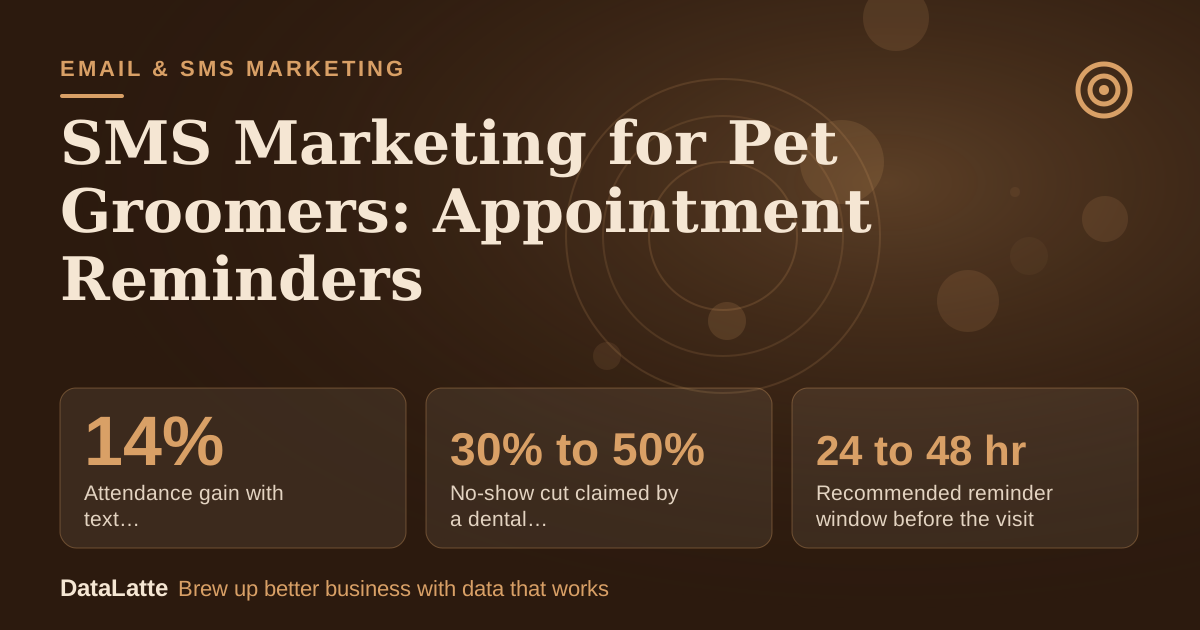
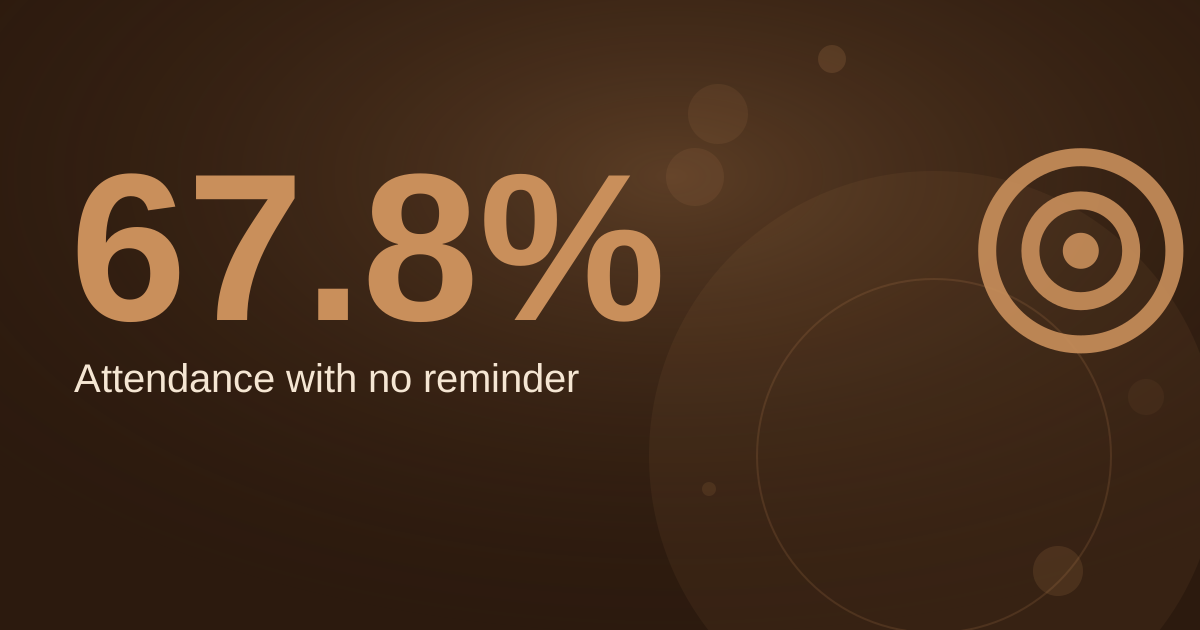
Pet groomers should start with one automatic text reminder sent 24 to 48 hours before each appointment, then add promotional texts only for clients who opted in. No grooming-specific study of text reminders was found. A healthcare study cited by
Lutily reports that text reminders improve appointment attendance by 14%. Vendor marketing pages claim larger no-show cuts, but those figures are not from trials. Test the reminder on your own bookings.
This guide covers the evidence, reminder timing, software options, consent basics and a worked cost example. Vendor claims are labelled as claims, and every worked-example input is marked as an assumption.
↑
Attendance gain with text reminders (healthcare, secondary)
Permanente Journal, cited by Lutily
↑
No-show cut claimed by a dental marketing vendor
Vendor claim, not a trial
→
Recommended reminder window before the visit
Most sources agree on this window
→
Free trial length for Pawfectly Booked, no card needed
Vendor offer
See Sources at the end of the article. Cards marked Assumption are examples, not results.
Do text reminders reduce grooming no-shows?
No grooming-specific figure was found. The closest evidence is from healthcare.
Lutily cites research in The Permanente Journal finding that text reminders improve appointment attendance by 14%. That is a secondary retelling of the study, so check the original before quoting it in marketing material.
Vendor pages go further.
ADWave's dental page says automated reminders reduce no-shows by 30% to 50%, and its
med spa guide gives 20 to 30%.
BonusQR says up to 40% for salons, without a source.
Remind1 claims up to 90% fewer no-shows, which it says is not independently verified. Treat all of these as sales claims. Your own no-show count before and after is the only figure that will hold for your shop.
When should the reminder go out?
Most sources point to 24 to 48 hours ahead.
Pawfectly Booked calls 24 to 48 hours before the appointment the sweet spot, and notes that many salons send an email 48 hours out and an SMS 24 hours out. Its automated timing can be set anywhere from 1 to 72 hours before.
ADWave's dental strategy page also recommends 24 to 48 hours.
One author disagrees. A salon marketing piece on
Lockhart-Meyer says 48 hours works best and that texting the day before is too late. That is one opinion, not a test. Mobile groomers may prefer a
morning-of text, a vendor suggestion. Timing matters because a slot is expensive: Remind1 notes that a full groom can block a table for two hours or more. Send a confirmation at booking and a reminder one day before, then compare no-show counts across several weeks.
What should a reminder say?
Keep it short and include the facts a client needs: the business name, the pet's name, the date and time, and a way to confirm or reschedule. Example text, written for this guide:
"Hi Sam, this is Paws Grooming. Biscuit is booked for Sat 14 Nov at 10:00. Reply C to confirm or call us to change. Reply STOP to opt out."
Reminders can also carry a rebooking offer. A sample card from
Uprinting's pet groomer guide offers a free nail trim upgrade for booking within 6 weeks. That offer works as text too, but send it at the appointment, not in the reminder, so the reminder stays focused on the visit itself. For help drafting variations, see
ChatGPT prompts for local business marketing.
Which software sends reminders automatically?
Automatic reminders tied to the booking calendar are the simplest start, because the message updates when the appointment moves. Two vendors show the range of offers.
| Tool | Automatic reminders | Trial or cost detail |
|---|
| Pawfectly Booked | Personalises and sends every reminder automatically on the Gold plan; email booking confirmations on every plan | 14-day free trial, no card required |
| Remind1 | Recommended schedule includes a booking confirmation and a reminder 1 day before; setup takes 2 minutes | First 10 reminders free, then pay only for reminders created; prices vary by country |
Neither page gives a single monthly price that applies everywhere, so check each vendor's live pricing page before you commit. Ask whether the plan includes two-way replies, because a reply to confirm or reschedule saves a call. For a broader look at automating booking, read
an AI agent for appointment booking for local business.
What are the consent and opt-out basics?
Consent rules are not covered in detail here, and they differ across the US, UK, Australia and Canada. The safe working rule is to send promotional texts only to clients who opted in, and to keep a record of when they did. Appointment reminders are usually handled differently from promotions, but confirm that split for your country with a local adviser before you launch a campaign.
Put an opt-out instruction in every promotional text, such as "Reply STOP to opt out." Process each opt-out request promptly and remove that number from promotional lists straight away. Avoid sending promotional texts to clients who only gave a phone number for appointments.
Should groomers send promotional texts too?
Only after reminders run smoothly, and only to opted-in clients. Two uses fit grooming well: a rebooking nudge when a client's usual interval has passed, and a short note when a slot opens after a cancellation. Keep the frequency low enough that you can answer replies.
Cadence matters more than volume. In a welcome sequence described by
Main Street AI Automation, the second email goes out 3 days after the first appointment and the third 5 weeks after it. That is an email example, but the same spacing can guide texts. Deciding which parts to automate and which to keep personal is covered in
AI vs human marketing for local business.
What does a reminder save? A worked example
All inputs below are assumptions. A grooming shop books 120 appointments a month (assumption) at an average ticket of $75 (assumption). Without reminders, 10% of bookings are no-shows, or 12 appointments (assumption). A reminder cuts no-shows by 20% relative, the low end of the vendor range cited above (assumption). Reminder software costs $50 a month (assumption; check the live price).
| Line | Amount |
|---|
| Appointments booked per month (assumption) | 120 |
| No-shows before reminders (assumption) | 12 |
| No-shows after a 20% relative cut (assumption) | 9.6 |
| Appointments recovered | 2.4 |
| Value recovered at $75 each | $180 |
| Reminder software (assumption) | $50 |
| Net gain per month | $130 |
The reminder pays for itself once it saves about two-thirds of one appointment a month, since $50 divided by $75 is 0.67. If the reminder saves nothing, the loss is the $50. Replace the assumptions with your own no-show count and ticket value before deciding. Count the no-shows for a month before you turn reminders on.
FAQ
Do text reminders reduce grooming no-shows?
No grooming-specific study was found. In healthcare,
Lutily cites research showing a 14% attendance gain with text reminders. Count your own no-shows for a month before and after you start.
When should a groomer send the reminder?
Most sources recommend 24 to 48 hours before the appointment.
Pawfectly Booked says its timing can be set from 1 to 72 hours. Test two windows and keep the one with fewer no-shows.
Do I need consent before texting clients?
Promotional texts should only go to clients who opted in. Consent rules differ by country and change over time, so confirm the rule for your location with a local adviser before launching a campaign.
Pawfectly Booked sends reminders automatically on its Gold plan and offers a 14-day free trial with no card.
Remind1 lists the first 10 reminders as free, then charges for each reminder created. Check live pricing on each vendor's site.
Sources
Want reminder timing and rebooking texts set up around your grooming calendar?
Book a free audit.
Free for local businesses
Want this applied to your business?
I'll review your Google presence, local SEO, and ad accounts — and send you a specific action plan within 48 hours. No pitch, no pressure.