A TikTok Spark Ad is an ad built from an organic post that already exists on your account or on a creator's account. A local shop can boost a post that already earned replies from nearby customers, then judge the result against a clear test. Pew Research found that 37% of U.S. adults use TikTok, so the audience is large enough to test. The sources behind this guide do not publish TikTok's own budget minimums or authorization rules, so those details are left out and should be checked in TikTok's Business Help Center before any money is spent.
→
YouTube use
Pew 2026, U.S. adults
↓
Facebook use
Pew 2026, U.S. adults
↑
Instagram use
Pew 2026, U.S. adults
→
TikTok use
Pew 2026, U.S. adults
See Sources at the end of the article. Cards marked Assumption are examples, not results.
Who Are You Reaching With a TikTok Spark Ad?
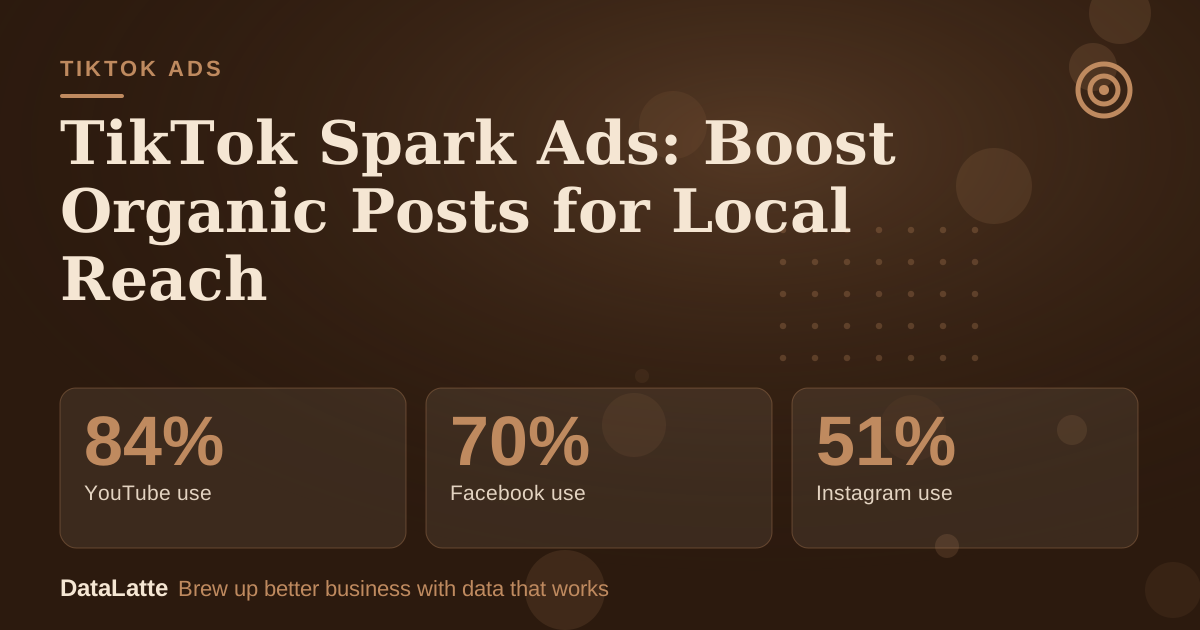
Pew's 2026 fact sheet surveyed 5,511 U.S. adults between January 30 and June 18, 2026, with a margin of error of plus or minus 1.8 percentage points. Pew states that the survey represents the views of all U.S. adults. In that survey, 37% said they ever use TikTok, the same share as in the 2025 survey. YouTube (84%) and Facebook (70%) reach more people, while Instagram rose from 50% to 51%. Facebook dipped from 71%.
The figures describe the United States only. Pew does not publish comparable data for the United Kingdom, Australia or Canada in these sources, so a shop in those countries should check local usage data before assuming the same reach.
Reach is not the same as local reach. A post reaches people who use TikTok in general. The real task is making sure the people who see the boosted post can actually walk into the shop, so the post should show a real street, a real product and real opening hours.
Which Posts Are Worth Boosting?
Start with the organic posts already on the account. Sort them by replies, saves and direct messages from customers who live nearby, not by total views alone. A post with a dozen comments from regulars tells more about local interest than a post that went viral among people several states away.
Avoid posts that depend on a moment that has passed, such as an event that ended last week or a seasonal joke that will look strange in a month. A boosted post runs for as long as it stays live, so it should still make sense on its last day.
Check the caption before boosting. Spelling errors, outdated prices and wrong hours will run on every impression. If the caption needs to change, publish a corrected post and boost that version instead of the old one. Pick posts that show the same offer a customer would find in store, so the ad does not promise something the counter cannot deliver.
How Do You Set Up a Fair Test?
Meta's guidance on A/B testing is useful here, even though it covers Meta ads rather than TikTok. Meta says A/B testing should be used instead of informal testing, such as turning ad sets on and off by hand, because informal testing can create overlapping audiences and unreliable results. Meta also says to use the same budget for both versions so the comparison is fair. (
Meta Business Help Center, About A/B testing for Meta Ads)
Apply the same logic to TikTok. Pick one variable to change, such as the post or the call to action, and keep the budget equal for each version. If the audience cannot be split evenly, run the two versions in sequence over the same days of the week and note that the comparison is weaker.
Write a hypothesis before starting. For example, a salon might guess that a before-and-after video will bring more booked appointments than a product demo. A clear guess tells the owner which number to read at the end, and it stops the test from turning into a search for any result that looks good.
What Does a Budget Check Look Like?
No TikTok cost per view or cost per click is published in the sources for this guide, so the numbers must come from the business itself. Start with the margin on what a customer spends, then work out how many extra customers the boost must bring to pay for itself.
The table below uses assumed inputs. Replace them with real figures before making a decision.
| Input | Example value (assumption) | How it is used |
|---|
| Spend on the boost | $280 over 14 days | Total test budget |
| Average order | $12 | Revenue per customer |
| Gross margin | 65% | $12 × 0.65 = $7.80 profit per order |
| Break-even orders | 36 | $280 ÷ $7.80, rounded up |
| Orders needed per day | About 2.6 | 36 ÷ 14 days |
If the shop cannot tell which orders came from the boost, the break-even test cannot be measured. Use a discount code that appears only in the ad, or ask customers to mention the video when they order.
For context on paid search costs, WordStream's industry benchmarks put the average Google Ads cost per click across all industries at $2.69 for search and $0.63 for display. Those figures date from an older benchmark update and cover Google, not TikTok, so use them only as a rough reference for how paid clicks usually compare. (
WordStream, Google Ads Benchmarks for YOUR Industry)
What Steps Should a Local Shop Follow?
Use this checklist before and after each boost. It turns the points above into an order that can be repeated each month.
- Pick two organic posts with real replies from nearby customers.
- Check the caption, hours, address and any price for accuracy.
- Write one hypothesis and name the single variable to change.
- Set the same budget and the same run length for both versions.
- Set a discount code or a trackable action, such as a booking call or a map tap.
- Record orders or bookings each day for the test period.
- Compare the result to the break-even number from the budget check.
- Keep the winner, drop the loser, and write down what was learned.
Run the test long enough to see a pattern, but not so long that spend continues on a post that is not working. A two-week test on a small budget is easier to judge than a month-long run where the post fades.
How Do You Measure Whether It Worked?
Measure the action that matters to the business, not just views. For a café, that may be a coupon redeemed. For a studio, a booked class. For a salon, a phone call or an online booking that names the ad. Views and likes can show whether a post is interesting, but they do not show whether it sold anything.
Google's Display network documentation describes reach across "35 million websites and apps," but reach figures on any platform are a claim about exposure, not sales. The same discipline applies across channels: decide the result before launch, then compare it to spend. (
Google Ads Help, About Display ads and the Google Display Network)
If the boost did not beat the break-even number, TikTok has not necessarily failed. Check whether the post matched a local audience, whether the offer was clear, and whether the caption contained an error. Then test again with one change.
Where Should You Go Next?
If other paid channels are already in use, compare results rather than picking a platform because it is popular. The guide to
Bing Ads for local business covers another paid option for local search.
Drafting captions and test notes takes time.
These ChatGPT prompts for local business marketing can produce variations for review.
Which AI tools can replace a marketing assistant for a local business explains where automation helps. A person still needs to check the result.
For shops in Canada, the
local business marketing guide for Canada covers channel choices for that market.
FAQ
Does a Spark Ad show the same reach as a standard TikTok ad?
The sources here do not compare reach between Spark Ads and standard ads. Pew's figures show how many U.S. adults use TikTok, not how a particular ad format performs. Test both formats with the same budget before deciding.
Can I use a post from another account?
The sources do not confirm the rules for boosting a creator's post. Check TikTok's Business Help Center for current authorization steps before asking a creator to join a campaign.
How big should a test budget be?
There is no single answer. Use the break-even method in the table above, with the business's own average order and margin. A budget that cannot produce enough extra orders to cover its cost is too small to judge the post.
How long should a boosted post run?
Run the test long enough to collect several days of results, but stop if spend has passed the break-even limit without any sign of return. Two weeks is a practical test length for many small shops, provided the budget stays fixed.
Does Pew's data apply to the UK, Australia or Canada?
No. Pew's fact sheet covers U.S. adults only. Check local usage studies for the relevant country before assuming the same audience size.
Sources
- Pew Research Center, Americans' Use of Social Media in 2026 (primary; survey of 5,511 U.S. adults, January 30 to June 18, 2026; platform use shares)
- Meta Business Help Center, About A/B testing for Meta Ads (primary; testing method, equal budgets, avoiding informal tests)
- Google Ads Help, About Display ads and the Google Display Network (primary; "35 million websites and apps" reach claim)
- WordStream, Google Ads Benchmarks for YOUR Industry (secondary; dated 2016 benchmark averages for search and display cost per click)
Want help choosing which posts to boost and how to track them?
Book a free audit to have current organic posts and the paid setup reviewed.
Free for local businesses
Want this applied to your business?
I'll review your Google presence, local SEO, and ad accounts — and send you a specific action plan within 48 hours. No pitch, no pressure.