The best Google Ads keywords for a caterer name the event and the place: "wedding caterers" plus your city, "corporate caterers" plus your city, and "lunch catering near me". Public keyword data for catering is thin and mostly global, so the figures below are a starting point. Confirm local search volume in Keyword Planner before setting a budget. Then use a simple cost-per-booking calculation to decide whether a keyword group is worth paying for.
Which Keywords Should a Caterer Start With?
Group keywords by who is buying. A couple planning a wedding and an office manager ordering lunch ask different questions, so each group needs its own ad copy and landing page. Sending both to one generic page usually lowers click-through and makes the enquiry form harder to complete.
The table uses global monthly search volumes and cost-per-click estimates from AdTargeting, a third-party keyword tool. These are worldwide figures, not your city, so treat them as a guide to relative demand.
| Intent group | Example keyword | Global monthly searches | Global CPC |
|---|
| Near me | caterer near me | 135,000 | $2.60 |
| Weddings | wedding caterers | 22,200 | $2.45 |
| Corporate | corporate caterers | 6,600 | $5.51 |
| Office lunch | lunch catering near me | 6,500 | $12.13 |
| Private parties | birthday party catering | 1,900 | $1.53 |
Source:
AdTargeting catering keyword lists (secondary, global data).
The biggest volume sits in broad "caterer" terms, but those searches are often students, job seekers or people far outside the delivery area. Event-plus-place phrases are narrower and usually cheaper to test. Build each group around a city or suburb the business actually serves, such as "wedding caterers [city]".
What Do Caterer Keywords Cost Per Click?
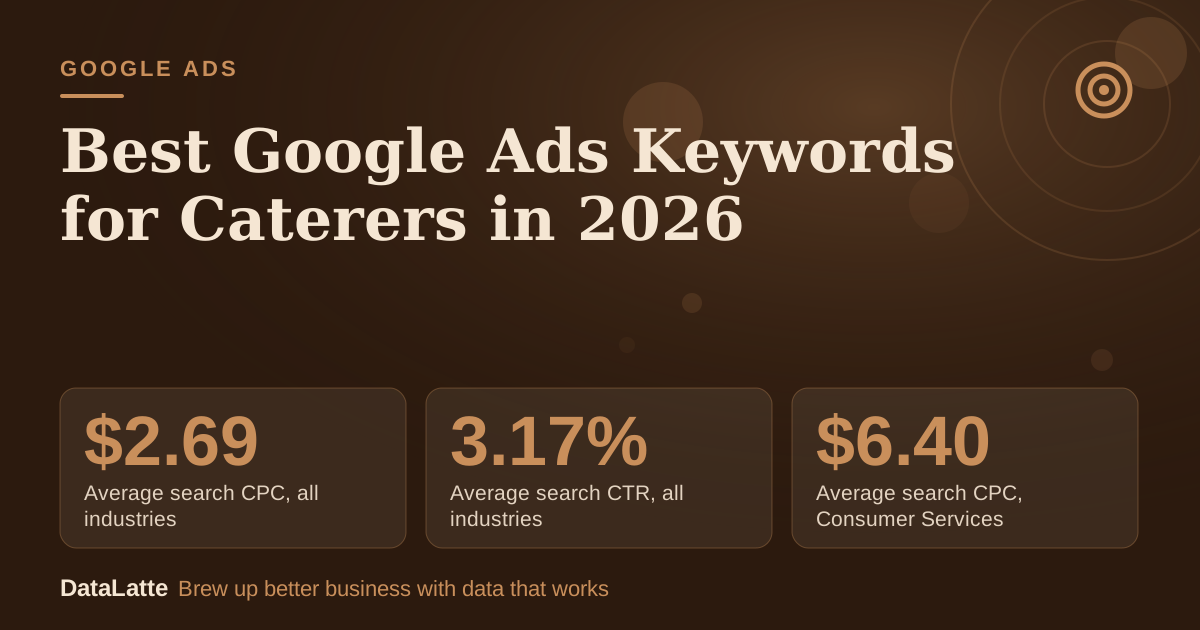
Public benchmarks do not name catering as its own category. The closest broad measures come from WordStream's industry averages, which cover search and display for twenty sectors. The search figures below are for all industries and for Consumer Services, a category that includes services bought by consumers.
→
Average search CPC, all industries
WordStream all-industry average
→
Average search CTR, all industries
WordStream all-industry average
↑
Average search CPC, Consumer Services
WordStream, consumer services
↓
Average search CTR, Consumer Services
WordStream, consumer services
See Sources at the end of the article. Cards marked Assumption are examples, not results.
Source:
WordStream Google Ads benchmarks by industry (primary, vendor data). The page's averages date from an earlier period, so check current numbers in your own account before relying on them.
Consumer Services has a higher average cost per click and a lower click-through rate than the all-industry average. Each click is likely to cost more, so the ad and landing page need to earn the click. Clear service area, menu range and a visible price guide tend to filter out unqualified clicks before they cost money.
How Should a Caterer Match Keywords to Capacity?
Pick keywords the business can actually fulfil. A two-person catering team cannot take a 200-guest corporate contract, so an ad for that order brings enquiries that have to be turned down. BatLinks, an SEO agency, makes the same point for organic search: target phrases you can realistically deliver on rather than competing with larger caterers for generic terms (
BatLinks, catering keywords, secondary).
Match the group to the size of the order. Small teams can run "birthday party catering" and "office lunch catering" with a clear menu and price. Large weddings need a longer sales conversation, so a call or quote form works better than a raw click. If the business also sells desserts or flowers, compare the intent groups with
keywords for bakeries and
keywords for florists, since wedding searches overlap.
What Does $750 a Month Buy a Caterer?
No source gives a standard catering budget, so this example works backwards from one booking. Every input labelled assumption is a placeholder to replace with real figures from the business.
| Line | Value | Basis |
|---|
| Monthly budget | $750 | Assumption |
| Average CPC | $2.69 | WordStream all-industry search average |
| Clicks | about 279 | $750 divided by $2.69 |
| Conversion rate to enquiry | 5% | Assumption |
| Enquiries (calls and quote forms) | about 14 | 279 times 5% |
| Enquiries that book | 25% | Assumption |
| Booked events | about 3.5 | 14 times 25% |
| Cost per booked event | about $214 | $750 divided by 3.5 |
| Average event value | $900 | Assumption |
| Revenue from booked events | about $3,150 | 3.5 times $900 |
Now run the same budget on a corporate keyword. At the $5.51 global CPC for "corporate caterers", clicks fall to about 136, enquiries to about 7, and bookings to about 1.7. Cost per booked event rises to about $441. That can still pay if corporate orders are larger, but only if the booking rate holds.
The lesson is to test one group at a time and track cost per booked event, not cost per click. Confirming the booking rate matters more than raising the budget, because a higher budget only multiplies whatever the booking rate turns out to be.
Which Negative Terms Should Caterers Exclude?
Negative keywords stop ads from showing on searches that will never turn into a sale. Caterers usually waste spend on job searches, do-it-yourself recipes and suppliers.
Start with these groups and add terms from the search terms report each week:
- Jobs and training: jobs, hiring, salary, course, school
- Do it yourself: recipe, how to, diy, at home
- Suppliers: wholesale, catering supply, equipment, for sale
- Free: free, template, sample menu
Coffee and food-service advertisers face similar waste, so the same review habit applies to
keywords for coffee shops. Plural and singular forms can need separate entries, so check the report rather than assuming one form covers both.
How Should a Caterer Measure Results?
Count booked events and the cost of each one. A click that becomes a call is worth more than ten clicks that leave the page, and an enquiry that never books is not a sale.
Set up call tracking and quote-form submissions as conversions. Review results monthly against the sales log, so it is clear which intent group produces bookings at a cost the business can afford. Ask each enquiry where it came from, because a caller who found the business through a search ad may not say so unless asked directly.
For a second opinion on account structure,
request a free audit, or review the
Google Ads service page for service businesses.
FAQ
What are the best Google Ads keywords for caterers?
Event-plus-place phrases usually fit best, such as "wedding caterers [city]" and "corporate caterers [city]". Check local search volume in Keyword Planner, because the figures in this guide are global.
How much does a click cost for a caterer?
No public benchmark lists catering as its own category. The AdTargeting global CPCs range from $1.53 for birthday party catering to $12.13 for lunch catering near me. WordStream's all-industry search average is $2.69.
Which match type should a caterer start with?
Phrase and exact match give tighter control for a small budget. Broaden only when the search terms report is reviewed weekly and a negative list is kept up to date.
Which negative keywords matter most?
Job, recipe, free and supplier terms usually drain budget first. Review the search terms report each week and add new ones as they appear.
How do I know if the budget is working?
Compare cost per booked event with the profit a booking brings in. In the worked example, $750 a month gives about 3.5 bookings at about $214 each, but only if the assumed rates hold.
Sources
- AdTargeting: Catering Keywords, Top Google Ads Keywords (secondary, global monthly search volume and CPC)
- BatLinks: Catering Keywords that Will Get You Clients (secondary, SEO vendor guidance on keyword realism)
- WordStream: Google Ads Benchmarks for Your Industry (primary, vendor benchmark data; check for newer editions)
Free for local businesses
Want this applied to your business?
I'll review your Google presence, local SEO, and ad accounts — and send you a specific action plan within 48 hours. No pitch, no pressure.