The best Google Ads keywords for a veterinary clinic are local and urgent: "vet near me", "emergency vet [town]", "vet open Saturday [town]" and "new puppy vet [town]". Start with 10 to 20 of these in phrase or exact match, split them into three ad groups, and block job, training and home-remedy searches from the first day. Google Ads charges per click, so each irrelevant search adds cost.
GrowDVM describes the same approach for vet practices: local searches, search-term reviews and negative keywords.
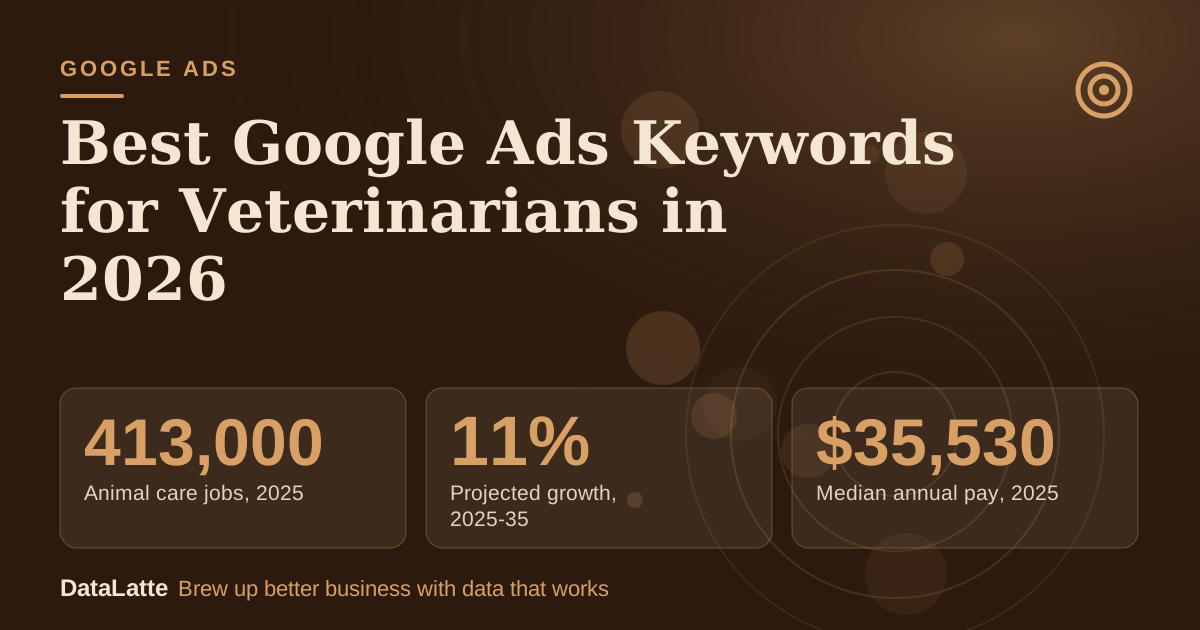
The sourced figures below describe the animal care job market rather than ad costs. No source here publishes veterinary click or conversion benchmarks, so the budget example later uses labelled assumptions.
→
Animal care jobs, 2025
BLS, primary
↑
Projected growth, 2025-35
BLS, much faster than average
→
Median annual pay, 2025
BLS, $17.08 per hour
→
Projected openings per year
BLS, many from replacing workers
See Sources at the end of the article. Cards marked Assumption are examples, not results.
Which Keyword Groups Should a Vet Build First?
Group searches by urgency and service rather than keeping one long list. Each group needs its own ad copy and landing page, because an emergency searcher and a new-puppy owner want different things.
| Group | Example searches | Intent |
|---|
| Urgent | emergency vet [town], vet open now | Very high: needs a call now |
| Find a vet | vet near me, veterinarian [town] | High |
| New pet | puppy vaccinations [town], kitten check-up | High, planned |
| Service | dog dental cleaning [town], spay neuter [town] | Medium to high |
| Brand | your practice name | Defends your own name |
These phrasings are examples to test, not measured search volumes. Check actual volume in Keyword Planner for your town before committing budget. A pet groomer runs a different mix of terms, so compare with the
pet groomer keyword guide if you share a town with one.
Should Urgent Keywords Run Around the Clock?
Only when someone can answer the phone. GrowDVM states that campaign priorities and ad schedules should reflect opening hours, front-desk coverage and available appointments, and that urgent-care ads should run only for services the team can provide. A call to a closed clinic is a wasted click.
Set the ad schedule to match staffing, not the clinic's wish list. If the front desk closes at 5 pm, stop emergency ads at 5 pm. Put the phone number and opening hours in the ad itself, so the searcher knows whether to call now or wait.
Which Negative Keywords Stop Wasted Clicks?
Negative keywords tell Google which searches should not trigger an ad. GrowDVM lists job searches, training courses and services a clinic does not offer as common exclusions. For a vet, add these groups from the start:
- Careers: vet tech jobs, veterinary assistant, salary
- Training: vet school, degree, course
- Home advice: home remedy, how to treat at home, DIY
- Products: pet food, supplements, for sale
- Services not offered, such as boarding or grooming
Add both singular and plural forms of each term, since the list only works for the exact wording entered. Review the search terms report weekly for at least the first month, because new irrelevant searches tend to appear as the campaign learns.
What Does a Test Budget Produce?
The table below uses assumptions, not sourced benchmarks. Replace each assumption with real figures after two weeks of data.
| Input | Value | Basis |
|---|
| Monthly budget | $600 | Assumption |
| Average cost per click | $4.00 | Assumption |
| Clicks | 150 | $600 / $4.00 |
| Calls and booking requests | 18 | 150 x 12% (assumption) |
| Share of requests that book | 50% | Assumption |
| New clients | 9 | 18 x 50% |
| Cost per new client | about $67 | $600 / 9 |
| First-year value of a client | $350 | Assumption |
| First-year value from new clients | $3,150 | 9 x $350 |
On these inputs, each new client costs about $67 and returns about $350 in first-year value. If the booking share falls to 25%, new clients drop to about 4.5 and the cost per client rises to about $133. The cost per call alone hides this result, so track which calls became booked visits.
How Do You Know Which Calls Become Patients?
Track calls and form requests by campaign, then check bookings against the appointment book. GrowDVM describes this approach: call recordings help review lead quality, and a call is not automatically a new patient. Ask the front desk to tag each inquiry with its source, and keep a simple weekly sheet.
For every inquiry, record three things: whether the caller is a new client, whether the campaign brought them in, and whether they booked. Separate wrong numbers, existing clients and unrelated questions, so the cost per qualified inquiry reflects real demand.
What Should You Do Before Launching?
- Confirm the Google Business Profile address, phone number and hours match the website.
- Build three ad groups: urgent, find a vet and new pet.
- Load the negative keyword list before the campaign goes live.
- Set the ad schedule to match front-desk staffing.
- Set up call tracking and a front-desk booking tag.
- Review search terms weekly and adjust the budget after two weeks of data.
Acupuncture and chiropractic practices, which also sell appointment-based care, can use the same grouping. See the
acupuncture keyword guide and the
chiropractor keyword guide for comparison.
FAQ
What are the best Google Ads keywords for veterinarians?
Urgent and local terms work best: "emergency vet [town]", "vet near me" and "vet open Saturday [town]". Put new-pet and service searches in separate ad groups so each has its own message.
Should a vet use broad match keywords?
Phrase and exact match give more control while a campaign is new. Expand to broader terms only after the search terms report shows which related searches bring in real inquiries.
Do vets need negative keywords?
Yes. Job searches, training courses and home-remedy questions are common sources of wasted clicks. Add them before launch and review the search terms report every week.
How do I know if the ads are working?
Track calls and booking requests by campaign, then check which ones became booked appointments. Cost per click alone does not show whether a clinic gained new clients.
Sources
Want a veterinary campaign built and tracked? See the
Google Ads service or
book a free audit.
Free for local businesses
Want this applied to your business?
I'll review your Google presence, local SEO, and ad accounts — and send you a specific action plan within 48 hours. No pitch, no pressure.