The best Google Ads keywords for a real estate agent are local, intent-led phrases: your city or neighbourhood plus "real estate agent", "realtor", "buyer's agent", "sell my house" or "home valuation". Start with searches from people who want to hire an agent or sell a home. Treat broad listing searches such as "homes for sale" as a test rather than a core group, because they can attract clicks from people who are browsing, not choosing an agent.
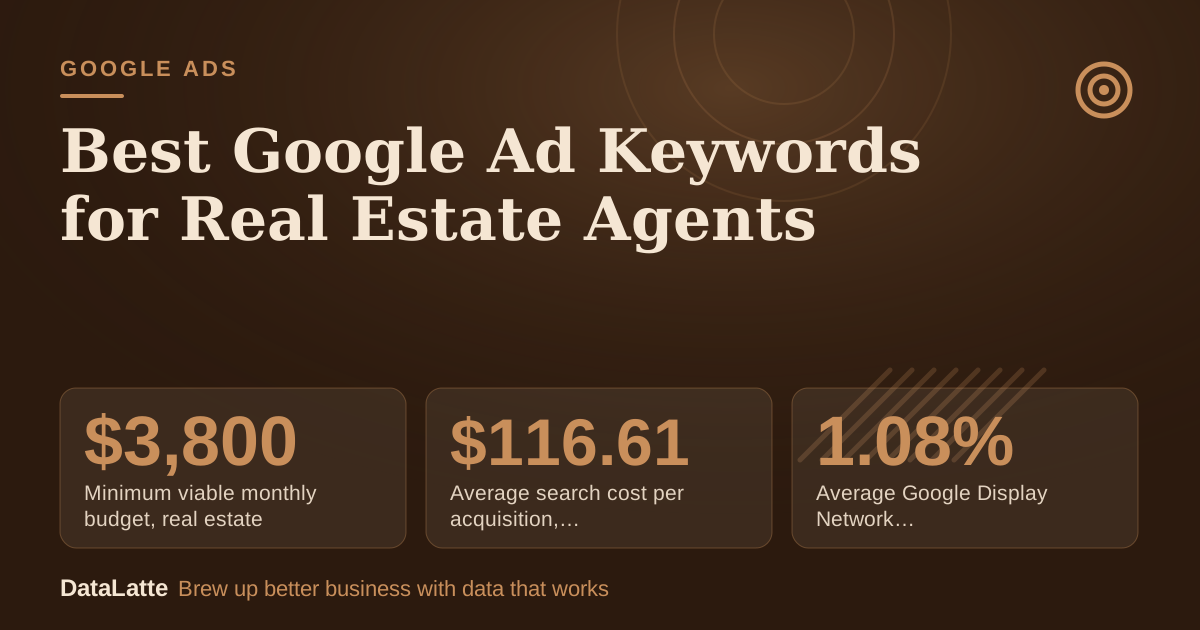
Costs vary by market. The real estate figures in the benchmark table below are older, so use them as historical reference points. WordStream's search table lists an average cost per acquisition of $116.61 for real estate, covering August 2017 to January 2018.
→
Minimum viable monthly budget, real estate
Focus Digital, 2025, secondary
→
Average search cost per acquisition, real estate
WordStream, Aug 2017 to Jan 2018, dated
→
Average Google Display Network click-through rate, real estate
WordStream benchmark table, 2016, dated
→
Growth of local searches without near me, versus those with it
Google data cited by Geotargetly, secondary
See Sources at the end of the article. Cards marked Assumption are examples, not results.
Which Keyword Groups Should a Real Estate Agent Test First?
Group keywords by what the searcher wants to do, then add your city or area to each group. Test each group separately so you can see which one produces enquiries rather than clicks.
| Intent group | Example keyword patterns (add your city) | Who searches |
|---|
| Hire an agent | real estate agent, realtor, buyer's agent, listing agent | Buyers and sellers choosing an agent |
| Sell a home | sell my house, list my home, how much is my home worth, home valuation | Sellers, often at an early stage |
| Buy a home | first time home buyer agent, buyer's agent for condos | Buyers ready to talk |
| Property type | condos for sale, townhouses for sale, homes for sale | Mostly browsing; test carefully |
| Area expertise | neighbourhood name plus real estate agent | Local searchers |
Put most of your early budget behind the "hire an agent" and "sell a home" groups. Listing-style searches can be useful later, once you have data showing which ones convert for your area. The same intent-and-area structure works for other local service businesses, as shown in the guide for
contractors.
None of these patterns has a volume or cost figure in this guide. Check each one in Google Keyword Planner, which shows estimated monthly searches and the average cost to show on a keyword for your own location.
How Much Budget Does a Real Estate Test Need?
Google Ads location-targeted pay-per-click campaigns can start at $10 to $50 per day, but competitive industries may need higher budgets, according to
Geotargetly's guide to hyperlocal marketing. Focus Digital's 2025 analysis puts the minimum viable monthly budget for real estate at $3,800, citing dense regional competition.
Those two figures sit far apart, and that gap is the point. A $10-a-day test can show you which keyword groups get any response at all. It will rarely produce enough data to judge a full agent business, so set the test budget against the number of leads you need to learn anything.
Should Real Estate Keywords Include "Near Me"?
Sometimes. "Realtor near me" and "real estate agent near me" fit the hire-an-agent group. Geotargetly cites Google data showing that local searches without the phrase "near me" are growing 150% faster than those that include it. That tells you about search trends, not about which phrasing converts for a particular agent.
Test both forms in separate ad groups and compare cost per lead over at least a few weeks. Keep the location in your keyword or in your campaign targeting, and check the search terms report for areas you do not serve.
Which Match Type Should You Start With?
Match types control how closely a search must match your keyword before your ad can show. Google's keyword matching help page describes each type, and it is worth reading before you choose. As a suggestion rather than a rule, a small budget often works best with narrower matching on core terms such as "real estate agent" and "sell my house", then widening once you have conversion data and a negative keyword list. The same caution applies to
accountants, where a few high-value terms can carry most of the budget.
What Negative Keywords Should Agents Add?
Negative keywords stop your ad showing on searches you do not want. Review your search terms report every week and add terms that show intent you do not serve. Common candidates for an agent account include:
- Job seekers: "jobs", "salary", "courses", "exam"
- Rentals, if you do not handle them: "apartments for rent", "rent"
- Property types you do not sell
- Agent-side searches: "become a realtor", "realtor license"
- Locations outside your service area
Add plurals and close variations separately, because a negative keyword does not automatically cover every variant. Some searches that look irrelevant, such as "cleaning" after a move-out, can still be useful for a related business. The guide to
cleaning services shows how those terms differ by trade.
Does Google Treat Real Estate Ads Differently?
Google's Local Service Ads page lists real estate agents among the business services eligible for a Google Verified badge, so the badge is worth checking if it is available in your area. Google's business representation guidelines also list real estate agents as individual practitioners. Read those guidelines before you create or edit your Business Profile, so the listing describes you accurately.
For targeting, Geotargetly suggests a slightly wider radius of 1 to 5 miles for services such as real estate. Treat that as a starting point and adjust it using your own enquiry data. Build campaigns around the cities and radii you actually serve.
What Does a Month Look Like? A Worked Example
Every input below is an assumption, built to show the arithmetic. Replace them with your own numbers.
| Input or result | Value |
|---|
| Monthly budget (assumption) | $1,000 |
| Average cost per click (assumption) | $4.00 |
| Clicks | 250 |
| Conversion rate to enquiry (assumption) | 4% |
| Enquiries | 10 |
| Cost per enquiry | $100 |
| Enquiry-to-client rate (assumption) | 10% |
| New clients | 1 |
| Commission per client (assumption) | $9,000 |
| Gross commission versus ad spend | about 9 to 1, before your time and other costs |
The $100 cost per enquiry is close to the dated WordStream average of $116.61, but the example is not a forecast. A single month with one client is noise, and a $1,000 budget sits well below Focus Digital's $3,800 minimum viable figure. The lever that matters most is the enquiry-to-client rate, since one more closed deal changes the result more than a cheaper click. Record every enquiry's source in your CRM from the first day so you can calculate that rate yourself.
Paid search works best alongside a complete Business Profile and steady follow-up with enquiries. If you want help setting up the account or checking the numbers, see the
Google Ads service or
book a free audit.
FAQ
What are the best Google Ads keywords for real estate agents?
Local, high-intent phrases that pair your city or neighbourhood with "real estate agent", "realtor", "buyer's agent", "sell my house" or "home valuation". Test each intent group separately and keep the ones that produce enquiries.
How much does a click cost for real estate?
Costs depend heavily on your market. WordStream's real estate benchmark for average search cost per acquisition is $116.61, from August 2017 to January 2018, so check Keyword Planner for current estimates in your area.
How much should I spend on Google Ads as a real estate agent?
Google Ads location campaigns can start at $10 to $50 per day, according to Geotargetly, but Focus Digital's 2025 analysis gives $3,800 per month as the minimum viable budget for real estate. Choose a figure that gives you enough enquiries to judge results.
Should I use "near me" keywords?
Test them. Google data cited by Geotargetly shows that local searches without "near me" are growing faster, but that does not show which phrasing converts for your business. Compare cost per enquiry in separate ad groups before deciding.
Sources
Free for local businesses
Want this applied to your business?
I'll review your Google presence, local SEO, and ad accounts — and send you a specific action plan within 48 hours. No pitch, no pressure.