DataLatte☕
Google Ads

Best Google Ads Keywords for Cleaning Services
Infographic: Best Google Ads Keywords for Cleaning Services

Part of the guide: Google Ads

June 30, 2026·Nataliia Rumiantsewa· 9 min read All posts
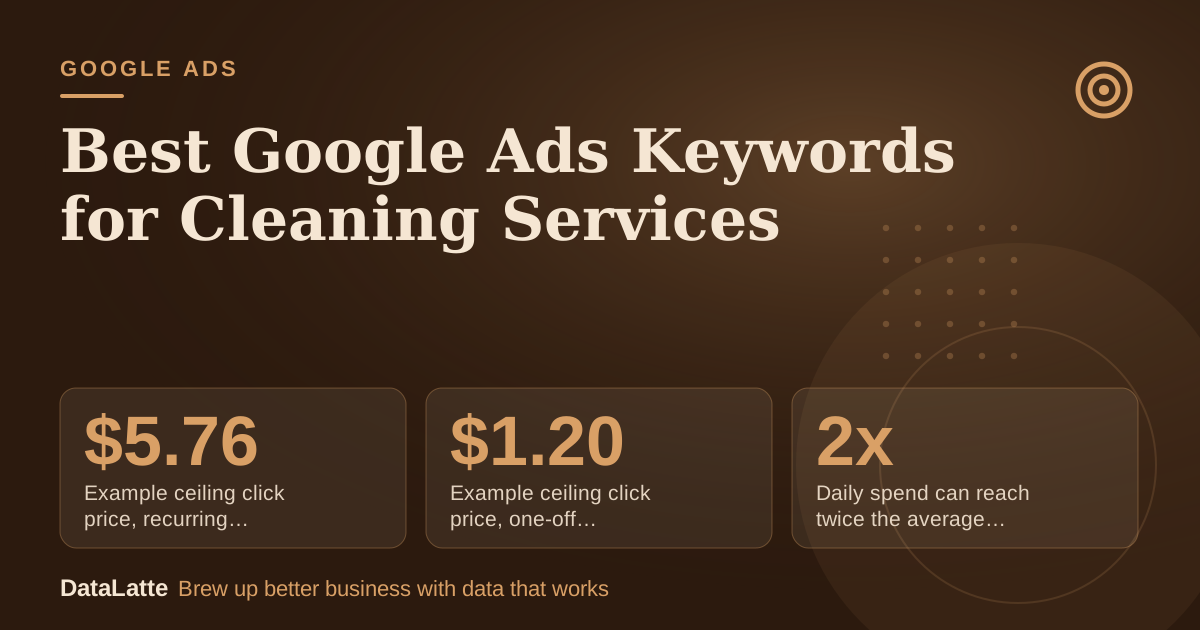
Suppose a recurring cleaning client is worth $1,200 in revenue over six months, and you are happy to spend 20% of that, $240, to win one. If 8 in 100 clicks become a quote request and 3 in 10 quote requests book, the most you can pay for a click is $5.76.
For a one-off $250 deep clean on the same assumptions, the ceiling drops to $1.20. Same industry, same city, a nearly fivefold gap in what a click is worth. That gap is why a flat "top 10 cleaning keywords" list misleads, and why this article groups keywords by the job behind them.
Every input in that example is an assumption for illustration, not a benchmark. This guide also does not print search volumes or click prices per keyword. They differ by city and change month to month, and this guide did not use Google Keyword Planner, so any per-keyword figure here would be invented.
You will pull your own numbers in ten minutes (see "Do This Today"). It is written for cleaners in the US, UK, Australia and Canada, so read "zip code" as "postcode" and swap "move-out" for "end of tenancy" or "bond clean" where that is what your customers type.
Assumption
$5.76→

Example ceiling click price, recurring client (assumption)

Assumed inputs: $240 spend, 8% quote rate, 30% booking rate

Assumption
$1.20→

Example ceiling click price, one-off deep clean (assumption)

Assumed inputs: $50 spend, 8% quote rate, 30% booking rate

2x→

Daily spend can reach twice the average daily budget

Google Ads Help

30.4x→

Monthly spend cap as a multiple of the daily budget

Google Ads Help

Source: Google Ads Help: About average daily budgets; ceiling prices are worked examples, not benchmarks

Group Keywords by the Job, Not the Search Volume

"House cleaning" can mean a weekly client worth thousands a year or a single $120 visit. Give each job type its own ad group and landing page, so the ad and page repeat what the person typed.
IntentExample keywords (replace [city])Match typeLanding page
Recurring home cleaning"house cleaning [city]", "maid service [city]", "weekly house cleaning [city]", "biweekly cleaning service"Phrase + exactRecurring plans page with a quote form
"Near me" home cleaning"house cleaning near me", "maid service near me"PhraseSame as above, tested as its own ad group
Deep and one-time"deep cleaning service [city]", "one time house cleaning", "spring cleaning service"Phrase + exactDeep clean page with checklist and price range
Move-out and move-in"move out cleaning [city]", "end of lease cleaning" (AU/UK: "end of tenancy cleaning", "bond cleaning")Phrase + exactMove-out page with checklist and deadline-friendly booking
Short-term rental turnover"airbnb cleaning service [city]", "vacation rental cleaning"PhraseHost page with turnaround promise
Post-construction"post construction cleaning [city]", "builders clean" (UK/AU)PhrasePage aimed at builders and homeowners
Office and commercial"office cleaning [city]", "commercial cleaning company [city]"PhraseCommercial page; run only if you want this work
Specific add-ons"oven cleaning", "inside fridge cleaning", "window cleaning [city]"Phrase + exactOne page per service you really sell
Brand[your company name]ExactHome page
Notes:
  • Only bid on work you want. If you do not do commercial cleaning, leave that row out. If you do not travel to the next county, leave it out of your location setup.
  • Deadlines convert differently. A move-out search comes with a lease end or closing date. That is a reason to expect a higher quote-to-booking rate, not a promise. Test it against your own data.
  • Cleaning-adjacent terms are usually a different business. "Carpet cleaning", "pressure washing" and "gutter cleaning" are separate trades with different pricing and customers. Add them as their own ad groups only if you sell them.

Match Types: What Google Actually Says

Google's keyword match type guide defines three:
  • Broad match can show on related searches, including ones that do not share the keyword's literal meaning. It is the default and the widest reach.
  • Phrase match (in quotation marks) can show on searches that carry your keyword's meaning, including implied meanings and more specific versions.
  • Exact match (in square brackets) can show on searches with the same meaning or intent as your keyword. It gives the most control and the smallest reach.
Google also recommends Smart Bidding with all match types, and says it works best with broad match because the wider range of searches helps it learn. Smart Bidding needs conversion data to learn from, so a cleaner with a handful of leads a month has little to feed it.
A sensible small-budget order: phrase and exact first, conversion tracking next, broad match later once you have conversions and a mature negative list.

Negative Keywords for Cleaning Services

Cleaning attracts job seekers, DIYers and people shopping for products. Google's negative keywords help explains two details that matter here. A broad-match negative blocks a search that contains all of its terms in any order, and negatives do not match close variants, so blocking "flowers" does not block "flower". Add singular and plural forms yourself. Google also warns that too many negatives can reduce your reach.
Start with this list, then edit it to match what you sell:
GroupNegatives
Jobsjobs, job, careers, career, salary, hiring, employment, training, certification
DIYdiy, how to, tutorial, recipe, homemade, at home
Products and suppliesproducts, supplies, equipment, machine, vacuum, mop, bleach, wholesale, supplier
Franchise and businessfranchise, business for sale, start a cleaning business, software, app, template, contract template
Freefree, coupon (remove if you run a first-clean offer)
Other tradescar wash, auto detailing, pool, gutter, chimney, pressure washing, junk removal (remove any you actually sell)
Then read the search terms report. Google describes it as the actual searches that led to your ads, with the matching keyword and match type alongside. Review it weekly and add irrelevant searches as negatives. For the mechanics, see the guides on negative keywords and stopping wasted ad spend.
One gap negatives cannot fix: people searching for a city you do not serve. Fix that in location settings, not in the keyword list.

Campaign Structure for a Small Cleaning Company

Keep it small enough that every ad group collects data.
Campaign 1: Recurring home cleaning
  Ad group: weekly / biweekly / maid service [city]
  Ad group: "near me" terms (test separately)

Campaign 2: One-time and move-out
  Ad group: deep cleaning
  Ad group: move-out / end of tenancy
  Ad group: post-construction (optional)

Campaign 3: Rentals and commercial (only if you want them)
  Ad group: short-term rental turnover
  Ad group: office cleaning

Campaign 4: Brand
  Ad group: [your company name], exact match
Why separate campaigns: recurring clients are worth more than one-offs, so they deserve their own budget. A cheap one-time click should never starve them. Google's daily budget help says daily spend can reach up to twice your average daily budget, with a monthly cap of 30.4 times the daily budget. Divide a monthly figure by 30.4 when you set it.
Plan seasonal changes from your own booking history, not from a generic calendar. Look at the last 12 months of requests (move-out spikes at lease ends, spring cleans, pre-holiday visits) and raise or lower budget on the matching campaign, keeping the others steady.

Local Services Ads: Check Your Account

Local Services Ads (LSAs) are Google's pay-per-lead format for some service businesses. Whether you can use them depends on your category and location, so check before you plan around them. Google's Local Services Ads getting-started page says LSAs are available only for certain service categories. Its US category list includes house cleaning, carpet cleaning, window cleaning and junk removal services, without a California/Florida-only restriction for those, and it did not show a separate "maid" or commercial cleaning entry when the page was checked for this guide. Lists differ by country and change, so confirm your category and area in Google's eligibility check or inside your own account before you rely on it. If you are in the UK, Australia or Canada, assume nothing until the sign-up flow shows your category.
Two more facts worth knowing. Google's transition page says LSA accounts are moving to Performance Max campaigns, starting in August 2026 with select US home and storefront service advertisers, expanding in late 2026, with non-US accounts and remaining categories in 2027. Pay-per-lead billing, Search and Maps placement and keywordless targeting stay the same. And because LSAs are keywordless, none of the keyword work above applies to them. It applies to your regular Search campaigns, which can run alongside. Our Local Services Ads guide covers verification and setup.

The Math

The same keyword can be a bargain for one job and a loss for another. Every input below is an assumption for illustration. Replace each with numbers from your own booking records.
Recurring clientOne-time deep cleanMove-out cleanOffice contract
Revenue per client (assumption)$1,200 (6 months, biweekly visits)$250$300$3,600 (6 months at $600/month)
Max ad spend per client (assumption)20% = $24020% = $5020% = $6015% = $540
Click to quote request (assumption)8%8%8%4%
Quote request to booking (assumption)30%30%30%20%
Ceiling click price$5.76$1.20$1.44$4.32
Formula: ceiling CPC = max ad spend per client x quote request rate x booking rate. For the recurring client: $240 x 0.08 x 0.30 = $5.76.
What this tells you:
  • Recurring work can carry a high click price; one-offs cannot. If "deep cleaning service [city]" costs more per click than about $1.20 under these assumptions, it loses money unless many of those clients convert to a plan. A "first clean" offer that leads into recurring service is the usual fix.
  • Assumptions are not data. Replace them with your last 30 or so quote requests: how many came from ads, how many booked, how long clients stayed. With fewer than about 10 requests per ad group, you have a guess, not a result.
  • A $300 test month is small. At an assumed $4 click it buys about 75 clicks, and at 8% that is about 6 quote requests and under 2 bookings. It can work in a small town with tight keywords, but it will not give you a statistically clean read in one month.
To see the actual click estimate for your city, use Google's Keyword Planner. Google says it estimates monthly searches and average cost per keyword, and that you must finish account setup, including billing information, to use it. Keywords with very low search volumes are not discoverable or forecastable, so a very specific term may return an error instead of a number. Compare each estimate with the ceiling click price in your own table.

Match the Page and Track Real Bookings

A keyword is only as good as the page it lands on. Send "move out cleaning [city]" to a move-out page with a checklist, a price range and a short quote form, not to your home page. Our landing page best practices cover the layout, and website design for cleaning services covers the wider site. Set up form and call tracking before spending, using the steps in our conversion tracking guide, and log every quote request with whether it booked and what it was worth. Ads and organic work best together: see local SEO for cleaning services and our broader marketing for cleaning services guide.

Do This Today

  1. Write down revenue per client for each job type above and the most you would pay in ads to win one. Compute a ceiling click price per job with the formula.
  2. Open Keyword Planner, set your service area, and enter "house cleaning [city]", "move out cleaning [city]" and "deep cleaning service [city]". Note the estimated searches and average cost and compare with your ceilings.
  3. Build campaigns using the structure above, one ad group per job type, phrase and exact match only, each with its own landing page.
  4. Paste the negative list, delete anything you actually sell, and block a recurring 20-minute weekly slot for the search terms report.
  5. Start a quote log (date, source, job type, quoted, booked, value). After 30 days, pause or fix any ad group that spent twice your target cost per quote request with none.

FAQ

Q: What are the best Google Ads keywords for a residential cleaning company? A: Start with your service plus your city in phrase and exact match: "house cleaning [city]", "maid service [city]", "deep cleaning service [city]" and "move out cleaning [city]". Judge them by booked clients and client value, not clicks. Which is cheapest depends on your market, so check Keyword Planner and your search terms report.
Q: Should I bid on "house cleaning near me"? A: Test it in its own ad group. Google uses the searcher's location, so it behaves much like a city term, but it can mix home, office and one-off intent. Judge it by cost per booking against your city-named terms.
Q: Should I use broad match? A: Not at the start. Google says Smart Bidding works best with broad match, but Smart Bidding needs conversion data. Get tracking and a solid negative list in place first.
Q: Can my cleaning company use Local Services Ads? A: Check your account. Google's US category list included house cleaning, carpet cleaning, window cleaning and junk removal services when the page was checked, but availability varies by country and area, and LSA accounts are being moved to Performance Max in phases. Run Google's eligibility check for your category and location.
Q: How much should I spend per month? A: There is no official number. Work backwards: pick the ad spend you will accept per new client, multiply by your booking rate to get cost per quote request, then decide how many requests you want per month. Our photographer keyword guide shows the same method for another trade.

Sources

Want a cleaning campaign built around bookings, not clicks? See our Google Ads service or contact DataLatte.

Free for local businesses

Want this applied to your business?

I'll review your Google presence, local SEO, and ad accounts — and send you a specific action plan within 48 hours. No pitch, no pressure.

cleaning service google ads keywordsGoogle Ads for cleaning serviceslocal Google AdsGoogle Ads strategiesresidential cleaning marketing

Want hands-on help?

See how DataLatte handles Google Ads Management for local businesses.

Learn more
Nataliia — local marketing expert
Nataliia Rumiantsewa

Local marketing strategist with 10+ years at global agencies — OMD, Dentsu, GroupM, and BBDO. Now helping small businesses get the same data-driven edge. Based in Europe, working with clients in the US, UK, Australia, and beyond.

Want this applied to your business?

Let's review your current marketing setup together — free, no obligations.

Get Your Free Marketing Audit