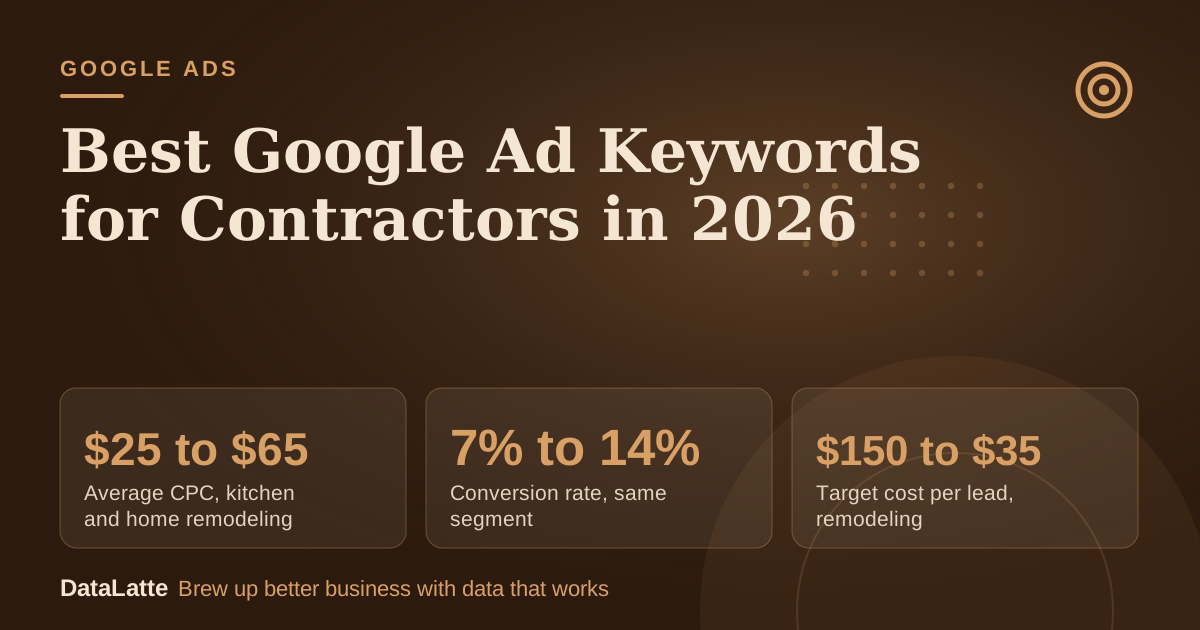
A general contractor should bid on project-plus-place searches, such as "kitchen remodel contractor [city]", in exact and phrase match, and block DIY and job-seeker searches with negative keywords. A 2026 PPC agency guide puts kitchen and home remodeling clicks at $25 to $65, with conversion rates of 7% to 14%. These are vendor ranges, not a quote for your trade or city, so use them as a starting point to test.
Search volumes depend on your city, so this page covers keyword types instead. The budget example at the end uses labelled assumptions.
→
Average CPC, kitchen and home remodeling
Paid Media World, secondary
→
Conversion rate, same segment
Paid Media World, secondary
→
Target cost per lead, remodeling
Paid Media World, secondary
→
Local Services Ads cost per lead
Ruban KT, secondary
See Sources at the end of the article. Cards marked Assumption are examples, not results.
Which Keywords Bring Contractor Leads?
Pick searches that name a project and, where possible, a place. Someone who types "bathroom remodel contractor [city]" is further along the buying path than someone typing "bathroom ideas". Higher intent usually means a higher click price, so the aim is qualified clicks, not the cheapest ones.
| Intent | Example keyword pattern | Note |
|---|
| Hire for a project | "kitchen remodel contractor [city]", "basement finishing [city]" | Highest intent, highest cost |
| Local, near me | "general contractor near me", "home renovation [neighbourhood]" | Needs tight location settings |
| Specific job | "deck builder [city]", "roof repair [city]" | One ad group per job |
| Quote | "free estimate remodel [city]", "remodeling cost [city]" | Cost searches often come from researchers |
These are patterns to test, not proven winners. Review each one in your own search terms report after two or three weeks.
Should Contractors Split Campaigns by Job Type?
Usually yes. The same Paid Media World guide gives cost ranges that differ sharply by sector, from $25 to $65 per click for kitchen and home remodeling to $45 to $140 for commercial general contracting. A single campaign that mixes both will spread one budget across very different costs and deal sizes.
Keep residential remodels, commercial work and emergency repairs in separate campaigns. Each one can then carry its own budget, ad copy and landing page, and you can see which job type is paying for itself.
Which Match Types Should a Contractor Start With?
Exact match gives the most control and the fewest unrelated clicks. Phrase match widens reach a little while keeping the core meaning of the keyword. Broad match can show ads on related searches you have not chosen, which is risky when a click is expensive and conversions are not yet tracked.
Start with exact and phrase match for your three or four core jobs. Add broader terms only after you have a few weeks of calls and form fills to judge them against. Until then, every click should match a job you actually take.
Which Negative Keywords Protect the Budget?
The Paid Media World guide states that over 65% of wasted ad spend in construction campaigns comes from three query types: job seekers, DIY and educational searches, and low-ticket handyman work. Blocking those at account level is the quickest saving. Add plural forms and close variants, because a negative for "job" will not automatically block "jobs".
- Job intent: jobs, hiring, apprenticeship, salary, union
- DIY intent: diy, how to, tutorial, youtube, video
- Product intent: materials, wholesale, supplier, lumber prices
- Low-ticket intent: cheap, affordable, budget, handyman, free quote
- Out-of-scope trades: any trade you do not offer, such as electrical work for a remodel-only firm
Use the same review habit for every local business. The
electricians keyword guide and
cleaning services keyword guide list the trade-specific negatives that apply to neighbouring services.
Why Do Contractor Campaigns Need Call Tracking?
Paid Media World reports that over 70% of qualified contractor leads arrive by phone rather than through a form. If only form fills are tracked, the bidding system will favour keywords that produce forms, even when the phone calls from other keywords are worth more.
Set up call tracking with a dynamic number on the landing page, and set a minimum call length so that short, accidental calls do not count as leads. Then compare calls against quotes and signed jobs, not just against clicks.
Are Local Services Ads Worth Testing?
Local Services Ads can be a useful companion to search campaigns for local trades. Ruban KT reports cost per lead of $100 to $300 for businesses with these ads, depending on competition, and says they can bring 2.5 times higher quality traffic than standard search ads. Both are secondary figures from a single agency, so test on your own leads before relying on them.
Local Services Ads show a Google Guaranteed badge and bill per lead, not per click, which makes cost easier to predict. Compare that model against standard search in a
florist keyword guide if your business sells a service with a similar lead pattern.
What Does a $1,500 Month Buy?
Every input below marked assumption is a planning figure, not a result. A lead here is a form fill or call, not a signed job. The CPC and conversion rate sit inside the vendor ranges above, but your own numbers will differ.
| Line | Value |
|---|
| Monthly budget (assumption) | $1,500 |
| Average CPC, kitchen remodel (assumption, within $25 to $65) | $30 |
| Clicks | 50 |
| Conversion rate (assumption, within 7% to 14%) | 10% |
| Leads | 5 |
| Cost per lead | $300 (within $150 to $350) |
| Leads that get a quote (assumption) | 50%, about 2.5 quotes |
| Quotes that sign (assumption) | 20%, about 0.5 jobs |
| Average kitchen job value (assumption, low end of $40,000 to $180,000) | $40,000 |
| Revenue per month | about $20,000 |
| Ad spend as share of revenue | 7.5% |
On these assumptions, one signed job arrives roughly every two months. If the click price rises to $65 with the same conversion rate, the budget buys about 2.3 leads at roughly $650 each, which is above the vendor range. Check your own cost per lead before you commit to a monthly budget.
FAQ
What is the average cost per click for contractor keywords?
The Paid Media World guide gives $25 to $65 for kitchen and home remodeling and $45 to $140 for commercial general contracting, both in major metros. Expect your city and trade to fall somewhere in or near those ranges.
How many keywords should a contractor start with?
Ten to fifteen exact and phrase match keywords across three or four core jobs is a practical start. One ad group per job keeps each ad relevant to the search.
Should contractors use broad match?
Not until conversion tracking is working. Start with exact and phrase match, then widen only when calls and form fills show that the extra searches produce quotes.
What negatives matter most for contractors?
Job-seeker terms, DIY and tutorial searches, and low-ticket words such as cheap or handyman. The Paid Media World guide ties over 65% of wasted spend to these three query types.
Sources
- Google Ads for Construction Companies: 2026 PPC Guide, Paid Media World (secondary, agency guide dated July 27, 2026)
- Google Ads for Construction Companies, Ruban KT (secondary, agency guide dated August 1, 2025)
- Popular Construction Keywords, WordStream (secondary, keyword suggestions and market context)
- Google Ads for Construction Companies, CLIQ Marketing Content (secondary, service page with no benchmark figures)
Want a contractor account built around jobs rather than clicks? See the
Google Ads service or
book a free audit.
Free for local businesses
Want this applied to your business?
I'll review your Google presence, local SEO, and ad accounts — and send you a specific action plan within 48 hours. No pitch, no pressure.