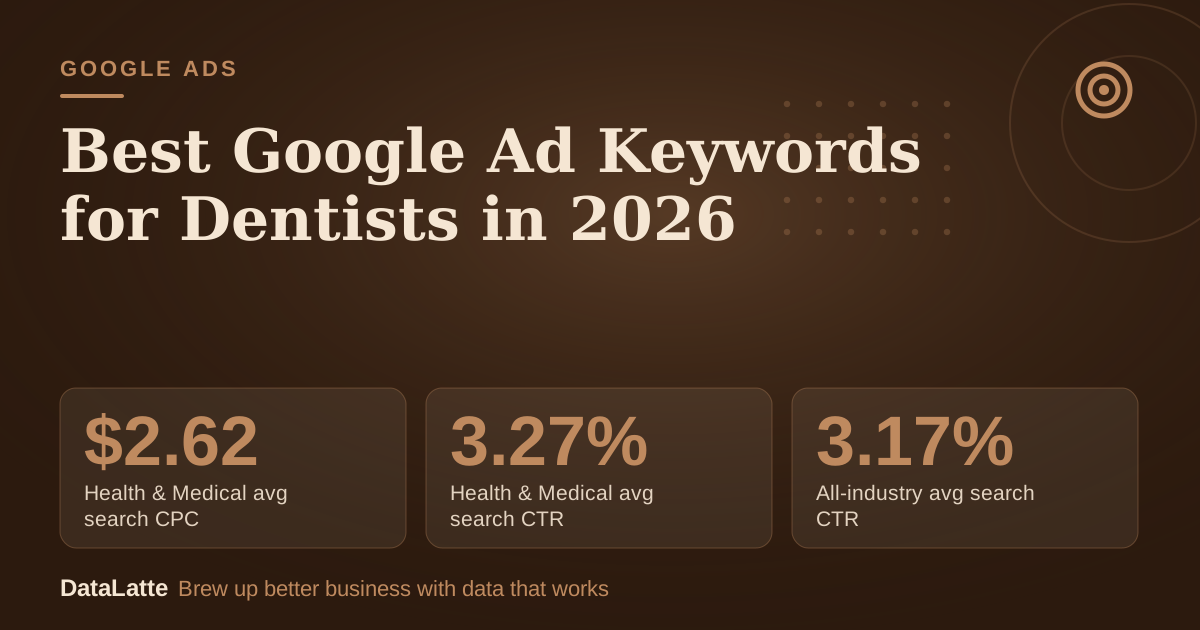
The best Google Ads keywords for a dentist are urgent, treatment-specific and city-specific searches, such as "emergency dentist" plus your city, "dental implants" plus your city, or "Invisalign" plus your city. Broad one-word terms like "dentist" attract many researchers and few people ready to book. No dentist-specific cost per click or search volume was found in the sources reviewed, so this page uses the closest sourced benchmark, WordStream's Health & Medical average, and labels every example figure as an assumption. Check volumes for your city in Google Keyword Planner.
→
Health & Medical avg search CPC
WordStream benchmark, dated page, not dentist-only
→
Health & Medical avg search CTR
Same source, Health & Medical
→
All-industry avg search CTR
Same source, all industries
→
All-industry avg search CPC
Same source, all industries
See Sources at the end of the article. Cards marked Assumption are examples, not results.
Which Keywords Should a Dental Practice Start With?
Group keywords by what the patient wants, then by how soon they want it. The table lists themes to test, with the intent behind each. It is a starting list, not a ranking, and each phrase should be paired with your city or service area.
| Theme | Example search | Intent |
|---|
| Urgent care | "emergency dentist [city]" | Needs an appointment soon |
| New patient | "dentist accepting new patients [city]" | Ready to book |
| High-value treatment | "dental implants [city]", "Invisalign [city]" | Researching a larger fee |
| Cosmetic | "teeth whitening [city]", "veneers [city]" | Comparing options |
| Insurance | "dentist that takes [insurer] [city]" | Checks cover before booking |
| Family | "pediatric dentist [city]" | Parent looking for a practice |
Specific phrases usually reach people closer to a booking than a broad term does. A dentist's ad for "teeth whitening" also needs a landing page that matches it, so the visitor sees the offer they clicked on. The same logic applies to other appointment-based health businesses. The
chiropractor keyword guide and the
acupuncture keyword guide cover similar booking patterns.
Which Match Type Should a New Dental Account Use?
Phrase and exact match give a new account the most control over which searches trigger ads. Broad match reaches more searches, but it also brings in more irrelevant ones, so it is harder to read in the first months. Start with phrase and exact match on your core treatment terms and watch which searches come through.
Add broader matches once conversion tracking works and you have enough booking data to judge them. Until then, a small set of specific phrases is easier to review each week than a large set of loose ones. Keep a record of which keywords produce calls or form submissions, not only clicks.
What Negative Keywords Do Dentists Need?
Negative keywords stop your ads from showing on searches you do not want. A DentalRank guide, a vendor blog rather than a benchmark, names common examples for dental practices: "free", "cheap", "jobs" and "DIY". Its example warns that paying for searches such as "free dentist" or "DIY tooth whitening" can drain a budget faster than expected.
Start with these groups and then prune them using the search terms report:
- Job and training searches: jobs, salary, hiring, school, course
- Do-it-yourself and free: DIY, home remedy, free, cheap
- Supplies and equipment: supplies, wholesale, equipment
- Treatments you do not offer, such as a specialty you refer out
Review the search terms report weekly during the first month. Add new negatives as irrelevant searches appear, and check that you are not blocking a term you actually want, such as a plural or a close variant of a treatment you offer.
How Should a Dental Practice Set Location Targeting?
A dental practice serves patients within a practical travel distance, so location settings should follow that distance. DentalRank suggests refining targeting to a radius of about 5 to 10 km around the practice, then checking location reports to exclude areas that draw clicks but no visits. The same vendor notes that the setup can be edited without ending the campaign.
Treat that radius as a starting point, not a rule. A practice in a dense city may need a tighter radius, while a rural practice may need a wider one. Check where bookings actually come from, then adjust. The same reasoning applies to other local businesses; the
barbershop keyword guide shows how a service-area radius shapes which searches are worth paying for.
What Does a Month of Dental Ads Cost? A Worked Example
Every input below is an assumption, except that the CPC is borrowed from the Health & Medical benchmark and used only as a stand-in. A conversion here means a booking request or call, not a completed treatment. Replace each input with your own numbers before deciding anything.
| Item | Calculation | Result |
|---|
| Monthly budget | Assumption | $1,500 |
| Cost per click | Assumption, based on Health & Medical benchmark | $2.62 |
| Clicks | $1,500 / $2.62 | about 573 |
| Conversion rate | Assumption | 5% |
| Conversions | 573 x 5% | about 29 |
| Cost per conversion | $1,500 / 29 | about $52 |
| Show-up rate | Assumption | 75% |
| New patients | 29 x 75% | about 22 |
| Cost per new patient | $1,500 / 22 | about $68 |
Benchmarks are averages across many advertisers, and the health benchmark is not specific to dentists, so a dental account in a major city may pay more per click. Whether $68 per new patient is worth paying depends on what a new patient is worth to the practice over time. Only the practice owner can set that figure.
FAQ
How much does a click cost for a dentist on Google Ads?
The sources reviewed do not publish a dentist-specific cost per click. The closest figure is WordStream's Health & Medical average of $2.62 per search click, on a page that has not been updated recently. Your cost will depend on your city, keyword and landing page.
Should a dental practice use broad match keywords?
Start with phrase and exact match for a new account. Consider broader matches only once conversion tracking works and you have enough booking data to read the results.
Which negative keywords should a dentist add first?
Common starting points are "free", "cheap", "jobs" and "DIY", as listed in DentalRank's guide to dental Google Ads mistakes. Add more as the search terms report shows irrelevant searches.
How do I find search volumes for my city?
Use Google Keyword Planner with your city and treatment names. No search volumes were published in the sources reviewed for this article, so do not rely on figures from other pages.
Sources
- WordStream: Google Ads Benchmarks for YOUR Industry. Benchmark averages by industry; the page is dated, so check the current report before relying on the figures.
- DentalRank: The Top 5 Google Ads Mistakes That Cost Dentists Thousands. Vendor blog, secondary to dental practice experience; used for negative keyword examples and radius suggestion.
Want a dental keyword list built for your city? See the
Google Ads service or
book a free audit.
Free for local businesses
Want this applied to your business?
I'll review your Google presence, local SEO, and ad accounts — and send you a specific action plan within 48 hours. No pitch, no pressure.