CTV Advertising Boston MA: Local Business Guide 2026
July 6, 2026·Nataliia Rumiantsewa· 7 min read All posts
Connected TV (CTV) advertising lets a Boston business place video ads in front of households watching streaming services such as Hulu, Peacock, and Tubi. Targeting by location means the ad reaches people watching at home rather than commuters or visitors. CTV builds familiarity before a customer needs the business, while search captures demand that already exists. Published sources do not cover CTV pricing, so this guide uses assumption-labelled budgets and benchmarks from Google Ads for the paid search that usually runs alongside.
What can a Boston business expect from CTV advertising?
CTV ads run on streaming services rather than on search results pages. A Boston coffee shop, salon, or fitness studio can choose a geographic target so the ad is shown to households near the business. The ads are typically longer than social video and play full-screen, which suits brand-building goals.
Clicks are rare in this format. Success depends on brand recall and on whether people later search for the business by name. A business should set its expectations around those outcomes before judging the channel by cost per click.
Which streaming platforms suit Boston local businesses?
The platforms most often named for local campaigns are Hulu, Peacock, Tubi, Amazon Prime Video with ads, and Paramount+ with Pluto TV. Each platform has a different audience mix, so the choice should follow where the target customers actually watch. A business that serves families and one that serves commuters may need different platforms.
Before committing, request quotes from two or three options and compare the audience data each platform offers for the chosen ZIP codes. Brand familiarity with a platform is a weak reason to choose it, because the audience and price matter more than the name.
How do Google Ads benchmarks set expectations for CTV?
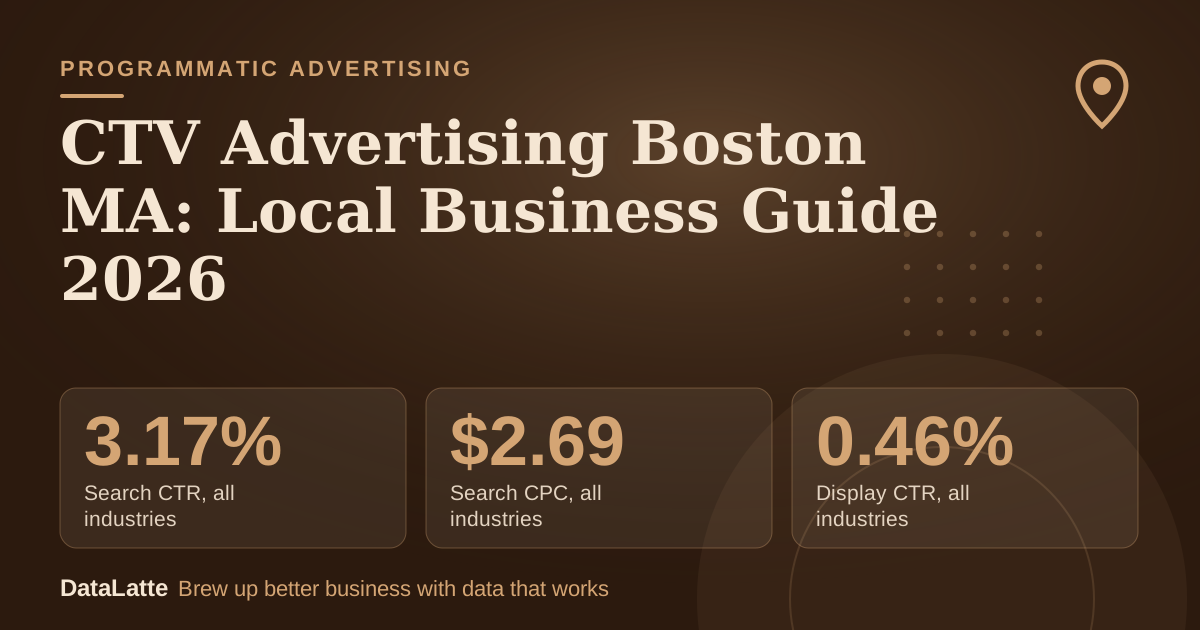
Benchmarks cannot predict what a CTV campaign will cost, because CTV pricing is outside the sources used here. They do give a reference point for the paid search that often runs alongside. WordStream's compiled averages show that across all industries, search click-through rate is 3.17% and display click-through rate is 0.46%. The average search cost per click is $2.69, and the display average is $0.63 (WordStream, secondary).
3.17%→
Search CTR, all industries
WordStream benchmark
$2.69→
Search CPC, all industries
WordStream benchmark
0.46%→
Display CTR, all industries
WordStream benchmark
35 million→
Websites and apps on Google Display Network
Google Ads Help
See Sources at the end of the article. Cards marked Assumption are examples, not results.
Industry differences matter. WordStream lists legal search CPC at $6.75, well above the all-industry average, so a law firm in Boston will usually pay more per click than a bakery. Google's help page describes Display campaigns as reaching people across 35 million websites and apps, which shows the scale of the broader network that display and streaming plans draw on (Google Ads Help, primary). Use the all-industry figures as a starting point, then replace them with account data once it exists.
What does a worked Boston CTV budget look like?
The example below uses assumptions, not sourced rates. Replace every input labelled assumption with quotes from the chosen platform before making a decision.
Inputs:
Monthly CTV budget: $1,000 (assumption)
Campaign length: 3 months (assumption)
CTV cost per 1,000 impressions (CPM): $30 (assumption)
Average frequency per household per month: 4 (assumption, a planning target for brand recall)
Calculation: $1,000 ÷ $30 × 1,000 gives about 33,333 impressions per month (assumption-based). Divided by a frequency of 4, that is about 8,333 households reached per month. Total spend over three months is $3,000.
The table below compares the same $1,000 monthly spend across three options. The search rows use sourced WordStream averages, while the CTV row depends on the assumed CPM.
The two channels answer different questions, so the table shows cost structure rather than a winner. If a CTV quote comes back well above or below $30, rerun the arithmetic with the real figure before deciding.
How should a Boston business measure a CTV campaign?
Measure CTV through signals that show recall rather than clicks. Compare direct searches for the business name in Google Search Console and the Google Business Profile for the weeks before launch with the flight period. Branded search volume in Google Ads is another signal, since people who remember an ad often search for the name later.
Ask every new customer how they heard about the business, and record the answers in the same format each time. Website direct traffic during the flight is also useful. A few weeks is rarely enough for a brand-building channel, so plan for a campaign long enough for these patterns to appear.
For a business that already runs other paid channels, the Amazon Ads guide and the Bing Ads guide explain how those channels can be measured against the same baseline.
How do Boston CTV plans compare with other US metros?
Boston is one of several US metros where local businesses test CTV. The Detroit CTV guide and the Minneapolis CTV guide show how similar campaigns are structured in those markets. The planning principles carry over: define a geographic target, set a realistic frequency, and compare results against a pre-launch baseline.
Audience density and competition for inventory can change CPMs from one city to another. Because city-level rates are not in the sources for this guide, a Boston plan should be built from local quotes rather than from figures for another city.
FAQ
Is CTV advertising worth it for a small Boston business?
It can be, if the goal is brand recall in a defined area and the budget can support a campaign of several months. Compare the cost with paid search using the same arithmetic shown above. Search delivers clicks quickly, while CTV builds familiarity over time.
Which platform should a Boston business start with?
Start with the platform where the target customers already watch. Compare audience profiles and quotes from two or three options before committing.
How do I know if CTV is working?
Look for changes in direct searches for the business name, branded search clicks, and "how did you hear about us" answers during and after the flight. One week of data is not enough to judge the channel.
Should CTV replace Google Ads?
No. CTV and search serve different stages of the customer journey. Search captures demand that already exists, while CTV builds the name recognition that makes those searches more likely.
To see how paid search could complement a streaming campaign for a Boston business, review the account with the Google Ads service, or request a free audit.
Free for local businesses
Want this applied to your business?
I'll review your Google presence, local SEO, and ad accounts — and send you a specific action plan within 48 hours. No pitch, no pressure.
Local marketing strategist with 10+ years at global agencies — OMD, Dentsu, GroupM, and BBDO. Now helping small businesses get the same data-driven edge. Based in Europe, working with clients in the US, UK, Australia, and beyond.