CTV Advertising El Paso TX: Local Business Guide 2026
July 6, 2026·Nataliia Rumiantsewa· 7 min read All posts
Connected TV (CTV) advertising places short video ads inside streaming TV content on internet-connected screens. For a local business in El Paso, TX, that means buying ads that run on streaming services rather than cable. Paramount's ad glossary describes CTV ads as non-skippable, typically 15 or 30 seconds, shown full-screen. Most campaigns are bought programmatically, so budget, targeting and frequency are set in a dashboard. This guide covers the format, the pricing terms, a worked budget example, and how to measure results.
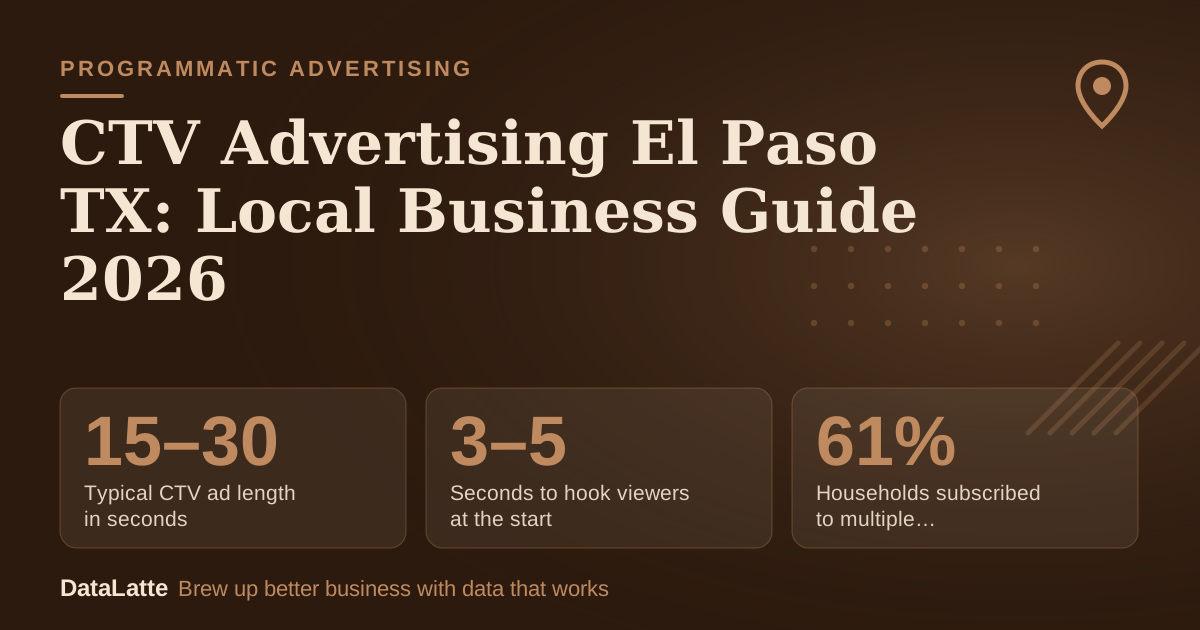
15–30→
Typical CTV ad length in seconds
Paramount Ads Manager glossary
3–5→
Seconds to hook viewers at the start
Paramount Ads Manager glossary
61%↑
Households subscribed to multiple streaming services
Teads citing IAB Compass (secondary)
Assumption
$40→
Example programmatic CPM in US dollars
Adwave example page; used as an assumption for planning
See Sources at the end of the article. Cards marked Assumption are examples, not results.
What CTV advertising means for an El Paso business
CTV stands for Connected TV, a television that connects to the internet and allows viewers to stream content. Simpli.fi defines CTV advertising as video ads delivered through streaming content on internet-connected screens, including smart TVs and devices such as Roku and Fire TV. Seedtag describes it as ads delivered through Connected TV environments, including streaming platforms and smart TV applications.
The audience is spread across services. A Teads guide (secondary), citing IAB Compass, reports that 61% of households subscribe to multiple streaming services. That means one streaming service rarely covers a neighbourhood on its own. The same guide cites EMARKETER saying 71% of net new streaming subscriptions over the past nine quarters have been ad-supported.
The sources cited here do not give El Paso household figures. Check the audience reporting inside any platform's ad manager before committing budget to a specific ZIP code set.
How long CTV ads run and how they should open
Paramount's glossary says CTV ads typically run 15 or 30 seconds and appear full-screen. It also recommends a strong opening hook within the first 3–5 seconds to engage streaming viewers. For a 15-second spot, that means the business name or the core problem should appear almost immediately, not after a logo intro.
Amazon Ads notes that video completion rates for CTV tend to be very high because many streaming services do not allow ads to be skipped. A message that opens well is likely to be seen to the end, so the first seconds carry most of the weight.
A practical 15-second structure for a local business: the first 3–5 seconds show the business name and the reason to care, the middle seconds show the service or result, and the final seconds give one clear call to action, such as a phone number or street name. Keep to one message per spot. Spanish-language creative is a decision for the business based on its own customers; no source here measures its effect in El Paso.
How CTV ads are bought and priced
Paramount's glossary defines programmatic advertising as automated technology that buys and serves ads in real time, with the platform purchasing inventory that matches advertiser-set criteria. Amazon Ads states that streaming TV ads are currently purchased programmatically, meaning they are bought and sold digitally by an automated system.
Two pricing terms appear across CTV guides. CPM is the price per thousand impressions. Amazon Ads also describes cost per completed view (CPCV), which measures the price of each completed ad, alongside video completion rate (VCR). When comparing quotes, ask which of these the platform uses.
Adwave's Netflix guide (vendor page) gives an example of a $40 programmatic CPM and says a $200–400 monthly test budget would deliver roughly 5,000–10,000 impressions across Netflix and other streaming platforms. Treat that as one vendor's example. Live pricing changes, so confirm the current rate in the buying dashboard.
Which streaming inventory can a local business reach?
Paramount's glossary separates three types of inventory. Ad-supported video-on-demand (AVOD) services are free or lower-cost streaming services supported by ads. Free ad-supported streaming TV (FAST) channels are free for viewers and supported entirely by advertising, with Pluto TV given as an example. Premium subscription services also sell ad space through programmatic access.
Programmatic platforms can reach a wide catalogue. ClicksGeek (secondary) describes The Trade Desk and similar platforms as giving access to inventory across millions of websites, apps and streaming services. Availability of a given service in El Paso is not confirmed by these sources, so check each platform's live help page for current options.
File specifications also vary. A media seller's page notes that streaming giants such as Amazon and Apple each set their own rules for resolution, frame rate, bitrate and format. Confirm specs for each platform before uploading creative.
What does a worked CTV test budget look like?
The example below uses assumed inputs so the arithmetic is visible. Replace the assumptions with real quotes from your buying platform.
Inputs (all assumptions):
Monthly budget: $400
CPM: $40 (the example rate from the Adwave page above)
Video completion rate: 90%
Average frequency: 4 impressions per household per month
The impression count sits inside the range Adwave gives for a $200–400 test, which is a useful sanity check. If the live CPM is higher, the same budget reaches fewer households, so the test should be sized to the quote, not to this example.
How should El Paso businesses set targeting and frequency?
Geographic targeting is the main lever. Most platforms let you draw a radius around the business or choose specific ZIP codes. Start with the areas where existing customers already live, and confirm the platform reports impressions in those ZIP codes before launch. For a location-based comparison, the geofencing guide for local businesses explains how location targeting differs across channels.
Frequency caps limit how often one household sees the ad. The 4-per-month figure above is a planning assumption, not a platform rule. Set the cap in the dashboard and watch whether reach grows or the same households keep seeing the spot.
Demographic filters such as age or income are available on some platforms. Use them only where the business has a clear customer profile, and record which filters were applied so results can be compared later.
How do you measure a CTV campaign?
CTV rarely produces clicks the way search does, so measure the signals that move. Track CPCV and VCR from the platform report. Then look at changes in branded searches, direct website visits and new-customer answers to "how did you hear about us?" during the campaign and after it.
Compare these against a period with no campaign running, using the same method each time. The guide to tracking marketing ROI for local businesses sets out how to connect channel spend to outcomes without overclaiming. A test long enough to show a trend is more useful than a single week of data.
CTV also works alongside other channels. For example, a business might use CTV to build awareness while in-app advertising and search capture people who are ready to act. Treat each channel's numbers separately so one does not get credit for another's results.
FAQ
Are CTV ads skippable?
Paramount's glossary describes CTV ads as non-skippable video advertisements. Amazon Ads says many streaming services do not allow ads to be skipped, which is why completion rates are high. Some platforms or ad formats may differ, so check the format you are buying.
What is the difference between AVOD and FAST?
AVOD refers to free or lower-cost streaming services supported by ads. FAST channels are free for viewers and supported entirely by advertising. Both are ad-supported, but FAST is a channel model rather than a subscription service with an ad tier.
How much should a small business spend on a CTV test?
The sources here do not set a required minimum. The worked example uses an assumed $400 monthly budget to show the maths. Minimums and recommended spends differ by platform, so check the current figures on the buying platform before committing.
Is CTV the same as streaming TV ads?
Largely, yes. Amazon Ads defines streaming TV as digital distribution of video across devices with an internet connection, rather than a cable signal. CTV refers to the television or device receiving the stream, while streaming TV describes the content delivery.
Running local advertising in El Paso? DataLatte helps small businesses plan channel budgets and measurement. Book a free audit or see the Google Ads services.
Free for local businesses
Want this applied to your business?
I'll review your Google presence, local SEO, and ad accounts — and send you a specific action plan within 48 hours. No pitch, no pressure.
Local marketing strategist with 10+ years at global agencies — OMD, Dentsu, GroupM, and BBDO. Now helping small businesses get the same data-driven edge. Based in Europe, working with clients in the US, UK, Australia, and beyond.