CTV Advertising Dallas TX: Local Business Guide 2026
July 6, 2026·Nataliia Rumiantsewa· 7 min read All posts
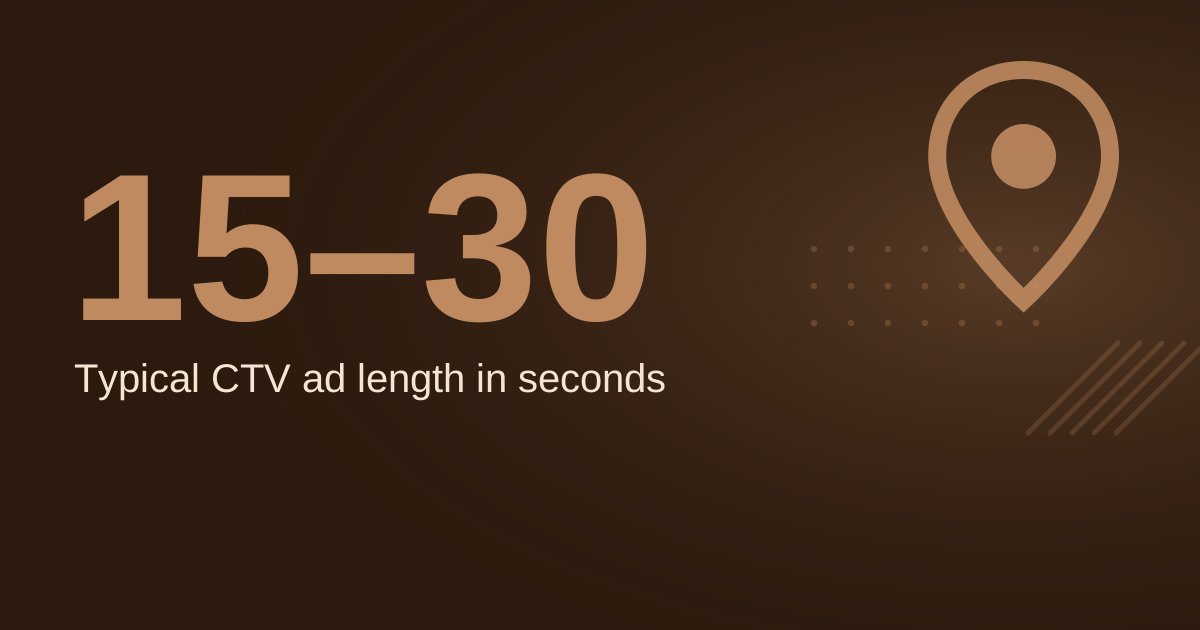
CTV advertising in Dallas lets a local business run short video ads inside streaming content on internet-connected TVs and devices. According to Paramount Ads Manager's glossary, CTV ads are non-skippable, typically run 15 or 30 seconds, and appear full-screen. Most CTV inventory is bought programmatically, so an automated system buys and serves ads against targeting criteria the advertiser sets. The practical question for a Dallas business is which platform, targeting, and measurement setup fits its service area and budget.
What counts as CTV advertising?
Simpli.fi describes CTV as Connected TV, a television that connects to the internet and allows viewers to stream content. CTV advertising delivers video ads through that streaming content, including on smart TVs and devices such as Roku, Fire TV, and gaming consoles. Seedtag describes the same idea as ads delivered through Connected TV environments, including streaming platforms and smart TV applications.
Streaming ad inventory comes in a few forms. Ad-supported video-on-demand (AVOD) services are free or lower-cost streaming services supported by ads. Free ad-supported streaming TV (FAST) channels are free for viewers and supported entirely by advertising, with Pluto TV given as an example by Paramount Ads Manager. Priority Media Agency notes that unlike traditional TV, VOD ads appear on streaming services, catch-up TV, and connected devices.
How much viewing is actually on streaming?
Streaming audience figures are the first thing to check before committing budget. The numbers below come from different sources, and only one of them is a direct measurement from a named study. Treat the vendor claim as a starting point, not a benchmark for your market.
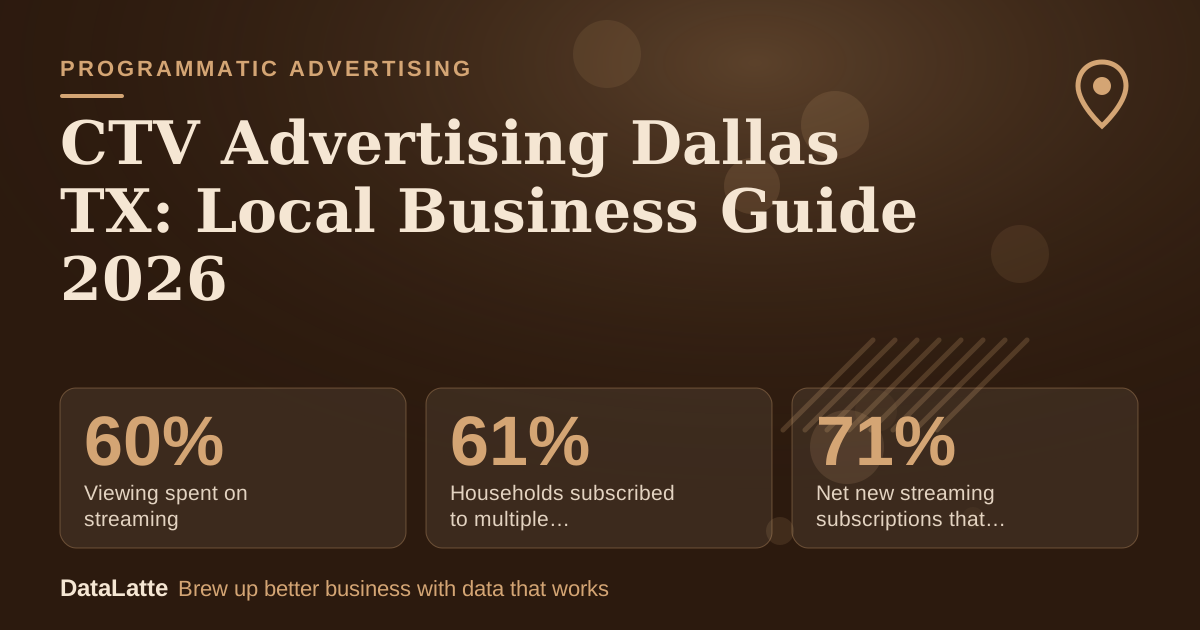
60%→
Viewing spent on streaming
tvScientific vendor page, no source or date given
61%→
Households subscribed to multiple streaming services
IAB Compass, cited by Teads (secondary)
71%↑
Net new streaming subscriptions that are ad-supported
EMARKETER over past nine quarters, cited by Teads (secondary)
15-30s→
Typical CTV ad length
Paramount Ads Manager glossary
See Sources at the end of the article. Cards marked Assumption are examples, not results.
The tvScientific local business page states that 60% of viewership is spent on streaming, but it gives no source or date. The Teads guide reports that 61% of households subscribe to multiple streaming services and that 71% of net new streaming subscriptions over the past nine quarters have been ad-supported. Those two figures point to a fragmented audience, which is why household-level targeting matters more than channel loyalty.
Which streaming platforms can a Dallas business buy?
Access depends on the platform and on the buying tool you use. Amazon states that its streaming TV ads are currently purchased programmatically, meaning they are bought and sold digitally by an automated system (Amazon Ads). ClicksGeek describes programmatic platforms such as The Trade Desk as offering access to inventory across millions of websites, apps, and streaming services (ClicksGeek, secondary).
Netflix is reachable through programmatic partners. Adwave's guide says programmatic access through its platform opens the door to Netflix's audience alongside other premium streaming services (Adwave). Check each platform's live help page for current ZIP-level inventory, minimums, and whether a given service is available through your chosen buying tool, because those details change.
How should a local business set up targeting?
ZIP-code or radius targeting is the lever most local businesses care about. Start with the service area your customers actually drive from, then compare that area with the household data your buying tool offers. Programmatic buying works on criteria the advertiser sets, so the setup is only as good as the audience definition you enter.
Targeting works differently from geofencing. Geofencing reaches people whose phones enter a defined area, while CTV reaches households on their TV screen. The geofencing advertising guide explains when that difference matters. Frequency caps are worth setting in the platform, then checking against your own reach reports so the same household does not see the same ad too often.
What makes a CTV ad work?
The first seconds matter most. Paramount's glossary recommends a strong opening hook within the first 3–5 seconds of a CTV ad to engage streaming viewers. Because many streaming services do not allow ads to be skipped, completion rates tend to be high, and Amazon notes that cost per completed view (CPCV) measures the price of each completed ad (Amazon Ads).
Video specifications are not uniform. Beasley's Tampa CTV page notes that streaming giants such as Amazon and Apple each set their own rules for resolution, frame rate, bitrate and format (Advertise In Tampa, vendor). Export your file to each platform's spec sheet, not a single generic preset. Interactive formats also exist, where viewers can engage directly with ad messages on a TV screen (DivisionD, vendor), but they add production and buying complexity.
Worked example: what can a $400 test buy?
Adwave's guide gives a worked example: at a $40 programmatic CPM, a $200–$400 monthly Netflix test delivers roughly 5,000–10,000 impressions across Netflix and other streaming platforms (Adwave). The calculation below uses the top of that range and adds assumptions for the outcome side. The assumptions are illustrative, not sourced, and should be replaced with your own data.
Inputs:
Monthly test budget: $400 (assumption, top of Adwave's example range)
CPM: $40 (from Adwave's example)
Average frequency: 4 impressions per household per month (assumption)
New customers per 100 households reached: 1 (assumption)
The 5-to-1 result depends entirely on the assumed conversion rate and purchase value. If your real conversion is half the assumption, the same test returns 2.5 to 1. Use the ROI tracking guide to replace those inputs with measured numbers before you scale.
How do you launch a CTV test in Dallas?
Work through these steps before the first impression is bought:
Define the service area by ZIP code or radius, and write down the customer types you want to reach.
Pick one or two platforms from the list you can buy through, and confirm the current minimum with the platform's live help page.
Build two or three 15-second and 30-second cuts, each with a strong opening hook in the first few seconds.
Export files to each platform's specifications rather than reusing one file for all.
Set a frequency cap and a test length long enough to read the results, then record a baseline for branded search and direct website visits.
Decide in advance which result would justify scaling, so the test ends with a decision rather than a debate.
For channels that capture the search demand a CTV campaign creates, the Google Ads service page covers how paid search fits alongside brand campaigns.
How should you measure CTV results?
CTV is a brand-building channel, so it rarely produces a click the way search does. Measure it through indirect signals: branded search volume, direct website visits during the flight, and a consistent "how did you hear about us?" question at the point of sale. Track CPCV and completion rate for the video itself, because a high completion rate with a weak branded search lift tells you something different from the reverse.
Do not treat vendor dashboards or illustrative mockups as results. Use your own analytics and compare the campaign window against a comparable period without ads. If you need a clean baseline before launch, the free audit can help you set one up.
FAQ
Are CTV ads skippable?
According to Paramount Ads Manager, CTV ads are non-skippable video advertisements served within streaming TV content. Amazon notes that many streaming services do not allow ads to be skipped, which is why completion rates tend to be high.
What is the difference between CTV and AVOD?
CTV refers to the internet-connected television or device where streaming happens. AVOD refers to ad-supported video-on-demand services that are free or lower-cost for viewers. A CTV campaign can run on AVOD inventory, but the two terms describe different things.
What does CPCV measure?
Cost per completed view (CPCV) measures the price of each completed ad. Amazon lists it alongside video completion rate as one of the metrics used in CTV programmatic pricing (Amazon Ads).
How long should a CTV test run?
The sources in this guide do not give a recommended test length. Set a length that gives you enough impressions and enough weeks to read branded search and direct traffic changes, and confirm any platform minimums on its live help page.
Local marketing strategist with 10+ years at global agencies — OMD, Dentsu, GroupM, and BBDO. Now helping small businesses get the same data-driven edge. Based in Europe, working with clients in the US, UK, Australia, and beyond.