July 6, 2026·Nataliia Rumiantsewa· 6 min read All posts
A Denver business can run connected TV (CTV) ads aimed at the zip codes it serves and pay by CPM, the cost per 1,000 views. None of the sources reviewed for this guide publishes a Denver-specific CTV rate, so local prices have to come from vendor quotes. The practical path is to request written quotes for Denver zip codes, run a small test with a tracking method, and decide on results. The sections below cover targeting, reach, a worked budget with assumption-labelled inputs, and creative.
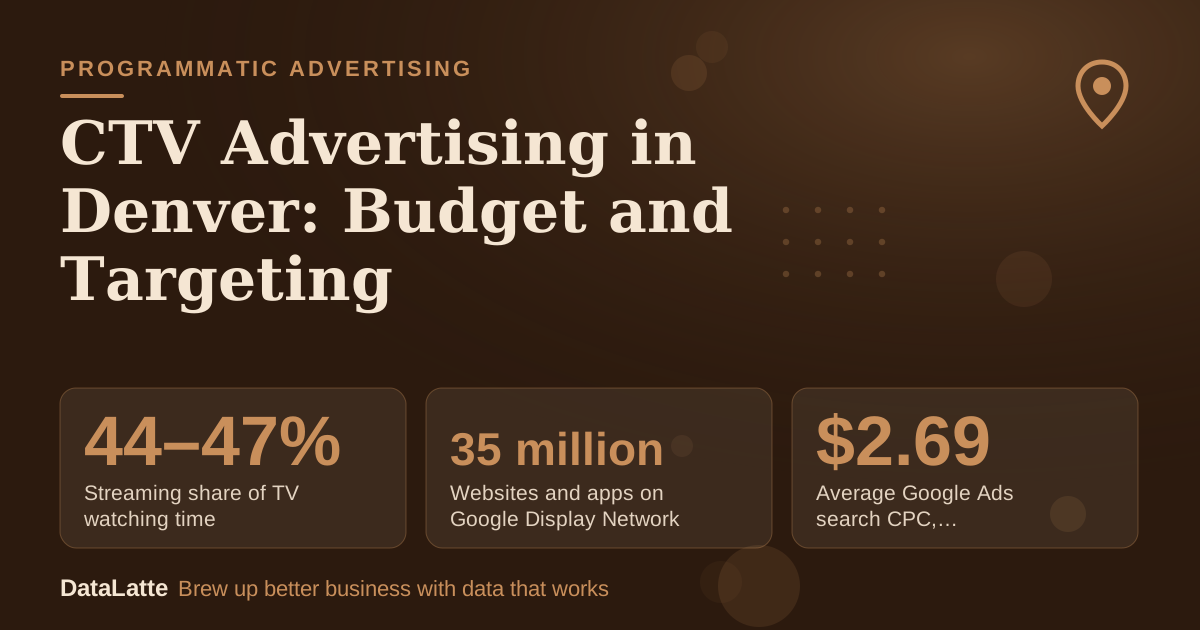
44–47%↑
Streaming share of TV watching time
SmartyAds, vendor claim
35 million→
Websites and apps on Google Display Network
Google support, primary
$2.69→
Average Google Ads search CPC, all industries
WordStream, secondary, older benchmark
26.2%↑
Growth in local digital video and OTT spend, 2021
eMarketer via MNTN, secondary
See Sources at the end of the article. Cards marked Assumption are examples, not results.
How does local targeting work for CTV in Denver?
Traditional TV was sold by Media Market. MNTN Research, a CTV vendor (secondary), says Nielsen created 210 distinct markets for this purpose, and describes them as imprecise because each covers a large area and does not let a business define its own service area. Many platforms now target by city or zip code, which is the setting a Denver business would use to limit delivery to its own neighborhoods.
Ask each vendor which Denver zip codes it can include and how small an audience it will accept. If customers come from a handful of neighborhoods, a metro-wide buy spends money on people who will never visit the business. The same zip-level setup applies in other metros, and the Phoenix, Minneapolis and Detroit guides walk through those settings.
Does CTV reach enough viewers to matter?
SmartyAds, a CTV ad platform, states that streaming captures 44–47% of all TV watching time and that 99% of CTV ads achieve high completion. These are vendor claims, so check them against a platform's own reporting before relying on them. The Google Display Network reaches across 35 million websites and apps, which is a reach figure, not evidence of customer outcomes.
Be careful when comparing prices. The WordStream average search CPC of $2.69 is a price per click taken from a benchmark page first published in 2016. CTV is priced per 1,000 views, so the two numbers cannot be compared directly. A fair comparison needs the cost per new customer from each channel, measured over the same period.
How do you turn a CTV budget into views?
Divide the budget by the CPM, then multiply by 1,000. Views equal budget ÷ CPM × 1,000. A view is an impression, not a person, so one household can account for several views. Local targeting narrows the pool, and the platform's estimated audience for the chosen zip codes shows how many households are reachable.
The example below uses a fictional fitness studio. Every input is an assumption, not a Denver statistic or a real campaign.
Input or result
Value
Basis
Test budget
$1,000
assumption
CPM
$30
assumption, replace with a vendor quote
Views
about 33,300
$1,000 ÷ $30 × 1,000
Households in target zip codes
6,000
assumption
Average views per household
about 5.6
33,300 ÷ 6,000
Value of a new member, first year
$600
assumption, use gross margin
Members needed to break even
2
$1,000 ÷ $600 = 1.67, rounded up
Two members out of 6,000 households sounds easy. The hard part is attribution. MNTN notes that CTV can offer near-live reporting, depending on the platform, while linear TV reporting usually arrives after a campaign ends. TV ads rarely produce clicks, so new members should be tracked directly with a promo code, a QR code linking to a landing page, and a "how did you hear about the business?" question on every sign-up.
What should a CTV ad say?
Filmkraft, an agency that interviewed a CTV executive (secondary), says both 15-second and 30-second spots can work, depending on how complex the message is. The same interview recommends a persistent URL, because viewers may not give a 30-second spot their full attention. It also advises placing ads in the first slot of a commercial break, where attention is highest.
Keep the message to three parts: the business name, the neighborhood, and one action, such as a promo code or a URL that shows a first-visit offer. The interview's budget advice assumes $200,000 a month in ad spend, far above the $1,000 test in the example, so its scale should be treated as a different case. A small Denver budget needs a simpler plan with one offer and one tracking method.
Should a Denver business start with CTV or search?
CTV works best as an awareness layer. It reaches people who are not searching for the business yet. Search and a Google Business Profile capture people who are already looking for a service, so they should be funded first. A local search channel such as Bing Ads for local businesses can also be tested with a small budget before CTV.
Once search tracking shows a steady number of new members, a CTV test can be added with a fixed budget, a review date, and a stop rule. Stopping is a valid result when the members needed to break even are not reached. Setting that rule in advance prevents the test from continuing on hope alone.
FAQ
How much does CTV advertising cost in Denver?
None of the sources reviewed publishes a Denver CTV rate. Ask each platform or vendor for a written quote for the specific zip codes, and use that CPM in the views formula above.
Can I target only my neighborhood?
Many platforms let advertisers target by city or zip code, according to MNTN Research. Confirm the minimum audience size the platform requires for the zip codes chosen.
How much should I test with?
The example in this guide uses a $1,000 test as an assumption. Choose a budget that can be lost entirely without harm, and set the break-even number before the campaign starts.
How do I know a CTV campaign worked?
Use a promo code, a QR code, and a "how did you hear about the business?" question. Count new customers, not only views, and compare them with the break-even number set in advance.
Local marketing strategist with 10+ years at global agencies — OMD, Dentsu, GroupM, and BBDO. Now helping small businesses get the same data-driven edge. Based in Europe, working with clients in the US, UK, Australia, and beyond.