July 6, 2026·Nataliia Rumiantsewa· 7 min read All posts
Connected TV (CTV) advertising lets a New Orleans business run video ads on streaming services such as Hulu and Peacock, aimed at households in chosen ZIP codes. Platform prices and minimums change often, so the current figures must be checked in each ad manager before any budget is committed. This guide explains how to set targeting, how to run a small test, and how to judge results against search benchmarks that can be verified. Every figure is either sourced or labelled as an assumption.
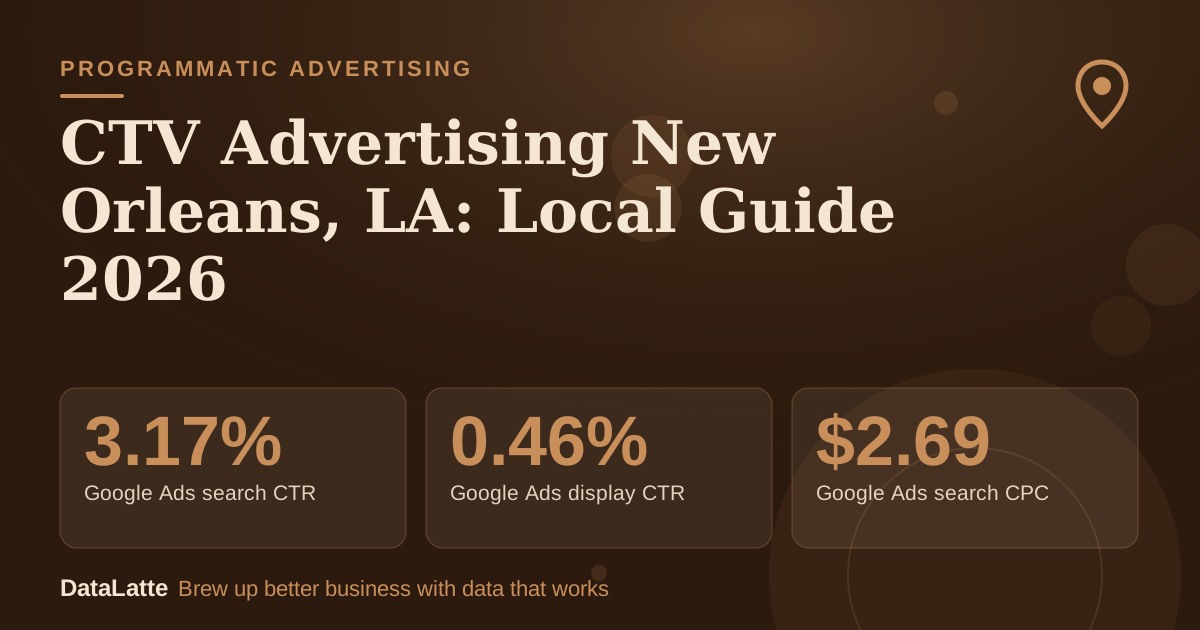
3.17%↑
Google Ads search CTR
All industries, WordStream benchmarks
0.46%↑
Google Ads display CTR
All industries, WordStream benchmarks
$2.69→
Google Ads search CPC
All industries, WordStream benchmarks
$0.63→
Google Ads display CPC
All industries, WordStream benchmarks
See Sources at the end of the article. Cards marked Assumption are examples, not results.
Does CTV Advertising Fit a New Orleans Local Budget?
CTV is a brand-building channel, so it works best alongside measurable search or display spend rather than replacing it. The practical question is whether the monthly budget can fund a test long enough to show results. A test that runs for only one week rarely reveals much about recall.
Pricing differs by platform and changes over time. Before setting a budget, open the self-serve ad manager for each platform under consideration and record its current minimum spend and CPM (cost per thousand impressions). Those current numbers should drive the plan, not older guides.
How Do Google Ads Benchmarks Help Plan a CTV Test?
Google Ads benchmarks are not CTV benchmarks. They do, however, give a fixed reference point for the search and display spend that sits beside CTV in the same marketing mix. WordStream reports an average search click-through rate of 3.17% and an average search cost per click of $2.69 across industries, with display averages of 0.46% CTR and $0.63 CPC (WordStream).
Google describes Display campaigns as reaching people across 35 million websites and apps, plus YouTube and Gmail. Display ads are responsive by default, so several assets are uploaded and Google selects the combinations that perform best (Google Ads Help). That makes Display a practical companion to CTV when the goal is to reach people who have already seen a video.
How Should You Set Up Targeting in New Orleans?
Start with geography. Enter the business address, choose a radius the business can genuinely serve, and then add or remove specific ZIP codes based on where existing customers live. A barbershop serving a few neighbourhoods should not pay to reach the whole metro area.
List the ZIP codes where most current customers come from, using booking or point-of-sale records. (Assumption: most small shops can export this data.)
Set a radius that matches the real service area, then compare it with the ZIP list.
Add one demographic filter, such as age or household type, and test it against an unfiltered version.
Set a frequency cap in the platform and review it after two weeks.
Keep the first test to a single audience. Changing several filters at once makes the result impossible to interpret.
What Does a 4-Week Test Budget Look Like?
The example below uses assumptions, so each input should be replaced with real figures. Assumption: a $600 four-week CTV test at a $25 CPM. At that CPM, $600 buys about 24,000 impressions ($600 divided by $25, multiplied by 1,000).
For comparison, the WordStream average search CPC of $2.69 would buy roughly 223 clicks from $600, and the display CPC of $0.63 would buy roughly 952 clicks. These outcomes measure different things. Search and display count clicks, while CTV counts impressions and then depends on brand recall.
A simple split of the same $600 might allocate $400 to the CTV test and $200 to search ads for people who later search the business name. (Assumption: this split is a starting point, not a benchmark.)
Which Streaming Platforms Should a Local Business Test First?
Most small businesses should begin with one self-serve platform and one audience, then expand only after the first flight has produced data. The table below lists the questions to answer in each platform's ad manager before buying. It contains no prices, because the sources available do not verify current platform rates.
Platform
What to check before buying
Typical fit for a local business
Hulu
Current self-serve minimum and ZIP-level targeting options
Default first test for a single neighbourhood audience
Peacock
Whether sports or event inventory is available in the market
Businesses that want sports-viewing households
Tubi
Current CPM compared with Hulu in the same ZIP codes
Broader reach at a possibly lower price point
Paramount+ with Pluto TV
Available ad-supported inventory and targeting controls
CTV rarely produces a direct click, so results have to be read through indirect signals. Compare these measures before, during, and after the flight:
Searches for the exact business name in Google Search Console or Google Business Profile
Branded search clicks in Google Ads, if those campaigns run
Direct website visits
A consistent "how did you hear about us?" question at checkout or booking
Allow at least 60 to 90 days before judging the test. Compare results against the business's own baseline rather than an industry average, because none of the sources used here provide a CTV conversion benchmark.
FAQ
How much should a New Orleans business spend on its first CTV test?
Use the minimum that the platform allows for a multi-week flight, then add assumptions of your own. The $600 example above is one option. Confirm current minimums in the ad manager before committing.
Is CTV better than Google Ads for local businesses?
They serve different purposes. CTV builds recognition among households in the chosen ZIP codes, while search captures people already looking for the service. Most local plans use both, and search results are easier to measure directly.
Can CTV target tourists in New Orleans?
ZIP-code targeting reaches households that live in the selected areas. If visitors are part of the audience, run a separate campaign and measure it on its own.
How long should a CTV test run?
Plan for at least 60 to 90 days of data before judging brand effects. Shorter tests can show whether creative and targeting are working, but not whether sales have changed.
Local marketing strategist with 10+ years at global agencies — OMD, Dentsu, GroupM, and BBDO. Now helping small businesses get the same data-driven edge. Based in Europe, working with clients in the US, UK, Australia, and beyond.