June 4, 2026·Nataliia Rumiantsewa· 8 min read All posts
A US local business can run connected TV (CTV) ads by buying 15- or 30-second video spots for streaming screens, either through a self-serve platform or an advertising partner, and limiting them to a defined local area. CTV now accounts for more than a third of total TV viewing, according to Comcast Advertising. Whether it pays off depends on what a customer is worth to you and whether people search for your business afterwards, so start with a small, measured test.
This guide compares the buying routes, explains geographic targeting, works through a break-even calculation and sets out how to measure a test. Platform pricing changes, so get current minimums and rates in writing before you commit.
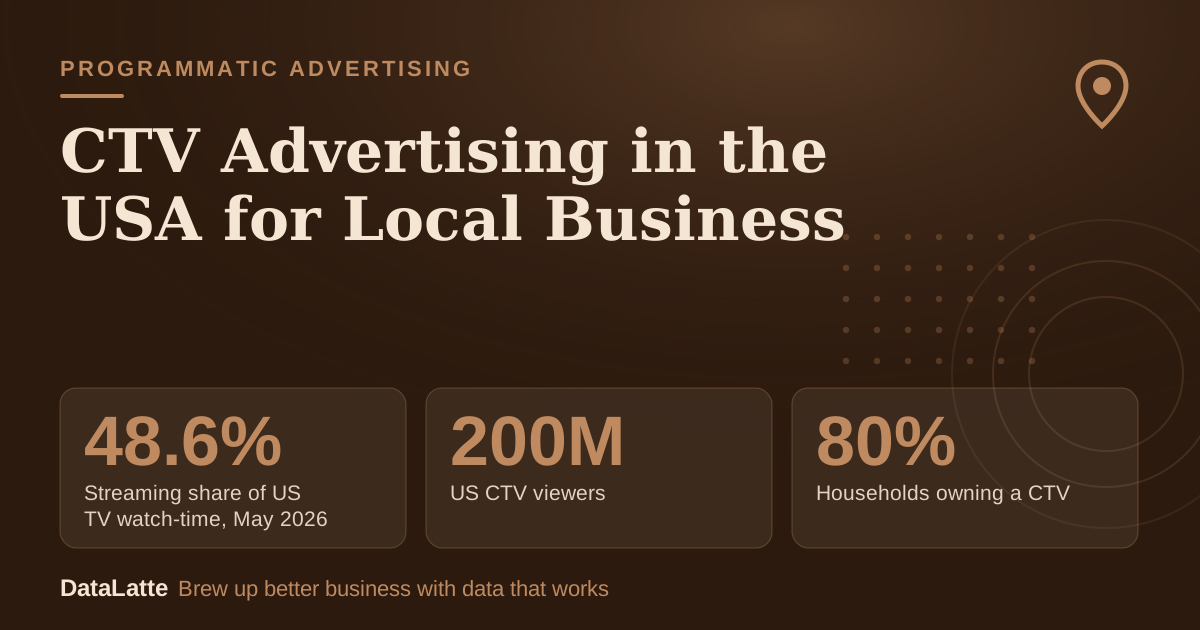
48.6%↑
Streaming share of US TV watch-time, May 2026
Nielsen Gauge via AI Digital, secondary
200M↑
US CTV viewers
tvScientific, vendor claim
80%↑
Households owning a CTV
tvScientific, vendor claim
35M→
Websites and apps on Google Display Network
Google Ads Help, primary
See Sources at the end of the article. Cards marked Assumption are examples, not results.
Which buying route fits a local business?
Comcast Advertising describes two main routes: a full-service agency that handles strategy, inventory, optimisation and reporting, or a self-serve platform where the advertiser buys placements directly. The table below sets out how the two differ for a single-location business. It reflects the general trade-offs Comcast describes, not a price list.
Factor
Self-serve platform
Full-service agency
Who builds the plan
You, with platform tools
Agency strategists
Typical fit
Small budgets, one or few locations
Larger budgets, multi-market plans
Geographic control
You choose areas in the platform
Agency sets targeting with you
Reporting
Platform dashboard, self-read
Agency-prepared reports
Main risk
Setting targeting too broadly
Paying for management you do not need
Comcast says self-serve platforms may be more budget-friendly, which matters most for a first test. Ask each option for its minimum spend and fees before you decide.
How does geographic targeting work for a local business?
Paramount's CTV dictionary lists several geographic options: country, state, DMA (Designated Market Area), ZIP code and radius targeting around a specific address. It notes that geo-targeting is particularly valuable for regional businesses. For a single location, ZIP or radius targeting usually matches the real trade area better than a whole DMA.
A DMA can cover a wide region, including suburbs and towns far from your shop. Buying one spends budget on viewers who cannot reasonably visit you. Check whether your platform supports ZIP or radius targeting, and ask whether those options change the price per thousand impressions.
Custom audiences are the other lever. Paramount lists audiences built from first-party data such as CRM email lists and website visitors. A local business with a customer list can reach people already familiar with it, which is often a stronger starting point than broad demographics.
What does a small CTV test need to break even?
CPM means cost per thousand impressions. Paramount defines it as (total spend divided by impressions) multiplied by 1,000. Rearranged, impressions equal spend divided by CPM, multiplied by 1,000. A break-even check tells you how many customers the test must bring in to cover its cost.
The inputs below are assumptions, not sourced rates. Replace them with the quote you receive for your ZIP codes.
Test budget: $500 (assumption)
CPM quoted for your ZIP codes: $25 (assumption)
Gross profit per new customer over the first year: $120 (assumption)
Share of impressions reaching your trade area: 100% (assumption, which simplifies the example)
At a $25 CPM, $500 buys about 20,000 impressions. Break-even needs $500 divided by $120, about 4.2, rounded up to 5 customers, or roughly 4,000 impressions per customer. If gross profit per customer is $60, you need 9 customers. A test that cannot plausibly reach that count is not worth running alone.
Which local businesses should try CTV first?
Businesses with a defined local trade area and repeat purchases have the most to gain. Gyms, cafes, salons and pet groomers fit that profile, because one customer may return many times. CTV builds familiarity, so people recognise your name when they later search for you or see your business listing.
CTV does not capture someone ready to book today. Search does that. Before a test, make sure your Google Business Profile is complete and that a search campaign is ready to catch people who look you up. The Bing Ads guide for local businesses covers a second search channel if you want wider capture.
Keep the first creative simple: who you are, what you offer, where you are, and one clear action. The metro guides for Phoenix and Detroit show how the same logic applies in specific markets.
How should you measure a CTV campaign?
Give CTV its own tracking. A dedicated promo code, a vanity URL or a separate phone number lets you separate CTV-driven visits from search visits. Compare branded search volume and bookings during the flight with the 30 days before it. Impressions alone do not show customers.
Common mistakes to avoid:
Buying a whole DMA when only a few ZIP codes form your trade area.
Judging CTV on last-click conversions, the way you judge search.
Running CTV with no search campaign to catch the follow-up searches.
Signing up without a written quote that covers minimums, data fees and creative costs.
Before you increase spend, decide what result would justify it. Set that threshold from your break-even figure, not from the impression count.
FAQ
Do I need a production company to make a CTV ad?
Not necessarily, but the spot should look like a TV commercial. Paramount notes that CTV ads typically run 15 or 30 seconds and are full-screen and non-skippable, so plan the script to fit. Get quotes from videographers, since costs vary widely.
Can I run CTV ads in several cities at once?
Platforms that support geographic targeting let you set separate locations. Confirm the minimum spend per market before you split a budget, because each campaign may carry its own minimum.
How long until I see results?
Awareness builds through repeated exposure. Compare branded search and bookings during and after the flight, and treat the first month as a calibration period rather than a verdict.
Is CTV worth it on a small monthly marketing budget?
Usually search comes first. A complete business profile and a search campaign capture people who already want your service. CTV makes more sense once those basics work and you have a clear break-even figure.
Where should a single-location business start?
Start with ZIP or radius targeting around your address, a 15-second spot and a tracked promo code. Compare the results with your search data before increasing spend. For help setting this up alongside search, see Google Ads for local businesses.
ctv advertisingconnected tvlocal business marketing usahulu adspeacock advertisingpluto tv adstubi advertisingstreaming tv adsprogrammatic advertisinglocal tv advertising
Want hands-on help?
See how DataLatte handles CTV Advertising for local businesses.
Local marketing strategist with 10+ years at global agencies — OMD, Dentsu, GroupM, and BBDO. Now helping small businesses get the same data-driven edge. Based in Europe, working with clients in the US, UK, Australia, and beyond.