CTV Advertising Atlanta GA: Local Business Guide 2026
July 6, 2026·Nataliia Rumiantsewa· 7 min read All posts
Connected TV (CTV) advertising lets Atlanta local businesses run short video ads on streaming services such as Hulu and Peacock, with targeting by ZIP code and household demographics. A small, time-boxed test is the practical starting point. The sources behind this guide do not publish CTV prices or minimum spends, so every CTV cost in the worked example is a labelled assumption. The sourced benchmarks come from Google Ads search and display averages, which set expectations for how paid media is usually judged.
How does CTV advertising work for Atlanta local businesses?
CTV ads run in streaming apps and on smart TVs, usually as full-screen video between or around programmes. The main reason it suits a local business is geographic control. You can point the campaign at households in the ZIP codes where your customers already live, rather than buying broad national inventory.
The format works differently from search. A search ad waits for someone to type a query. A CTV ad reaches people who are not looking for anything at that moment, so its job is to make your name familiar before the need arises. That means judging it on brand signals over a longer window, not on clicks alone.
For a salon, fitness studio or coffee shop in Atlanta, the practical question is whether the households you can reach are close enough to visit. If your service area is a few neighbourhoods, a ZIP-based campaign keeps spend focused. If it covers the whole metro, the cost per household rises and the test needs a larger budget.
Which streaming platforms should Atlanta businesses consider?
The platforms most often discussed for local CTV include Hulu, Peacock, Tubi, Amazon Prime Video with ads, Paramount+ and Pluto TV. Each carries different content and audiences, so the right choice depends on who you want to reach. Hulu is a common first test because its self-serve tools support ZIP targeting, but the sources here do not confirm current minimum spends or CPMs for any platform.
Check each platform's current terms directly before committing budget. Minimums, creative rules and targeting options change, so confirm figures in the platform's own ad documentation and build the test around what it lists. Programmatic buying platforms give access to several streaming inventories from one dashboard, but they add setup work and usually a higher starting commitment. For a first test, a single platform is easier to read and easier to cancel.
What benchmarks can a CTV test be measured against?
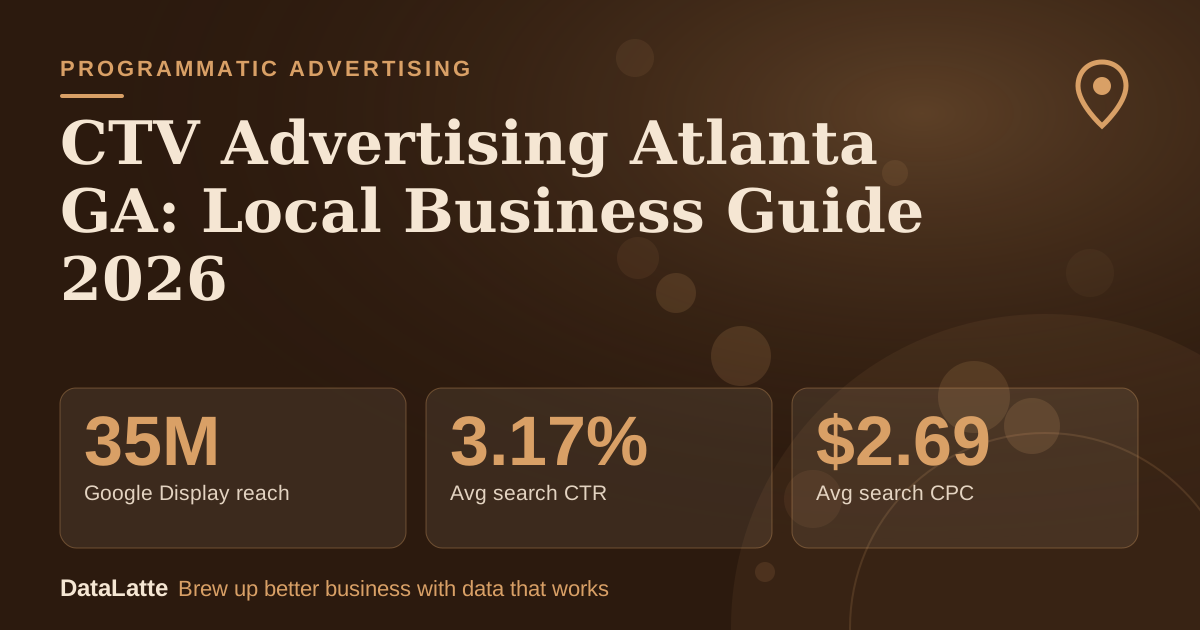
CTV has no widely published average click rate in these sources, so the honest benchmark is the one you set before launch. The closest sourced comparisons come from Google Ads averages across all industries. WordStream reports a 3.17% average search click-through rate, a 0.46% average display click-through rate, a $2.69 average search cost per click and a $0.63 average display cost per click (WordStream, secondary).
35M→
Google Display reach
Websites and apps, Google Help (primary)
3.17%→
Avg search CTR
All industries, WordStream (secondary)
$2.69→
Avg search CPC
All industries, WordStream (secondary)
0.46%→
Avg display CTR
All industries, WordStream (secondary)
See Sources at the end of the article. Cards marked Assumption are examples, not results.
These figures describe click-based channels, so they do not predict CTV results. They show the scale of averages a local advertiser already uses when judging paid media. Google's help documentation confirms that its Display Network reaches people across 35 million websites and apps, plus Google-owned properties such as YouTube and Gmail (Google Ads Help, primary). That is a separate channel from CTV, so treat it as context.
For a CTV test, measure brand signals instead: branded searches, direct website visits and how often new customers mention the ad when asked how they heard about you.
How do you build a 4-week CTV test budget?
Start with a test small enough to lose without serious harm and large enough to show a pattern. The worked example below uses assumed inputs throughout, because no source here confirms CTV pricing.
Inputs, all labelled as assumptions:
Test budget: $600 over 4 weeks (assumption)
CPM, cost per 1,000 ad impressions: $30 (assumption)
Households in your target ZIP cluster: 6,000 (assumption)
Impressions = $600 ÷ $30 × 1,000 = 20,000 (calculated from assumed inputs). Average frequency = 20,000 ÷ 6,000 ≈ 3.3 impressions per household (calculated from assumed inputs).
The table compares three budget scenarios using the same assumed CPM and household count:
Scenario (assumption)
Flight length
Total budget
Impressions at $30 CPM
Avg impressions per household
Light test
4 weeks
$400
13,333
2.2
Standard test
4 weeks
$600
20,000
3.3
Extended flight
8 weeks
$1,200
40,000
6.7
The extended row shows how quickly frequency climbs. Doubling the flight doubles the impressions per household, so a longer run needs a clear reason, such as a seasonal peak, before you commit.
For comparison, the sourced average search cost per click of $2.69 would buy about 223 clicks from $600, assuming you pay the average rate. That is a search-channel figure and does not show CTV performance, but it gives a reference point for how the money is used.
A step checklist for the test:
Pick one platform and confirm its current minimum and CPM in its own documentation.
Draw the ZIP cluster around your real service area and count the households you can reach.
Set a total budget and divide it by weeks, not days, to keep the flight simple.
Write down the metric you will judge on before the first impression runs.
Schedule a review after 4 weeks and decide whether to extend, change the creative or stop.
How should Atlanta businesses set targeting and frequency?
ZIP-code targeting is the most important control. Start with the ZIP codes your current customers come from. If you already have a customer list, check which postcodes appear most often and build the cluster from those. A radius around your address works when you have a single location with a clear catchment.
Demographic layers such as age and household income can narrow the audience further. Use them only if they match the customer you actually serve. A family-focused business may want household composition, while a fitness studio may want an age band. The sources here do not give recommended ranges, so set these from your own customer data.
Frequency is a judgement call. Too few impressions per household may not register, and too many can annoy viewers. The worked example lands near 3.3 impressions per household, a reasonable starting point to test. Change it only after the first flight shows how your audience responds. Search tools can help you check whether the names of Atlanta customers appear in branded queries during the test, though they cannot show household reach directly.
How do you measure whether CTV is working?
Judge a CTV campaign on several signals together. Branded search volume in Google Search Console or Google Ads, direct website visits and the share of new customers who say they heard about you from the ad are all useful. None of these proves cause on its own, so compare the same measures before and during the flight.
Keep a simple log. Record the start and end dates, the ZIP cluster, the total spend and the impressions the platform reports. Add a weekly note of the same brand signals. A clear pattern across three or four weeks is more useful than a single spike.
If you run paid search alongside CTV, watch those campaigns too. A rise in branded search after a flight suggests people are remembering the name. The Amazon Ads guide for local business and the Bing Ads guide for local business cover other channels you may already track.
FAQ
Is CTV advertising worth it for a small Atlanta business?
It can be, if your service area is local enough to reach through ZIP targeting and you can afford a test long enough to show brand signals. Start with one platform and a fixed budget, then decide after the test.
How much should I spend on a first CTV test?
The sources here do not confirm a minimum. The worked example uses a $600 four-week test as an assumption. Check current minimums on the platform you choose, then size the test to what you can afford to run without expecting an immediate sales spike.
Which metrics matter for CTV compared with Google Ads?
CTV is judged more on brand signals, such as branded searches, direct visits and self-reported discovery, than on clicks. Google Ads averages for search and display click-through rates are context only, since they measure a different type of ad.
Can CTV replace Google Ads for local leads?
No. CTV builds familiarity, while search captures people who are already looking. Many local businesses run both so that brand awareness and search intent support each other.
Running local advertising in Atlanta? DataLatte helps small businesses plan paid media around measurable goals. Start with a Google Ads review or book a free audit.
Free for local businesses
Want this applied to your business?
I'll review your Google presence, local SEO, and ad accounts — and send you a specific action plan within 48 hours. No pitch, no pressure.
Local marketing strategist with 10+ years at global agencies — OMD, Dentsu, GroupM, and BBDO. Now helping small businesses get the same data-driven edge. Based in Europe, working with clients in the US, UK, Australia, and beyond.