CTV Advertising in Sacramento, CA: Local Guide 2026
July 6, 2026·Nataliia Rumiantsewa· 7 min read All posts
Connected TV (CTV) advertising lets a Sacramento, CA business run short video ads inside streaming TV content on internet-connected screens. According to Paramount Ads Manager's glossary, CTV ads are non-skippable, typically run 15 or 30 seconds, and appear full-screen. The practical questions for a local firm are who is watching, what each completed view costs, and how to measure results. This guide covers those points with sourced figures, a worked budget, and a starter checklist.
What is CTV advertising and who watches it?
CTV stands for Connected TV, a television that connects to the internet and allows viewers to stream content. Simpli.fi (secondary) describes CTV advertising as video ads delivered through streaming content on smart TVs and devices such as Roku, Fire TV, and gaming consoles. The format is distinct from cable: Amazon Ads defines streaming TV as the digital distribution of video content across devices with an Internet connection, rather than a cable signal.
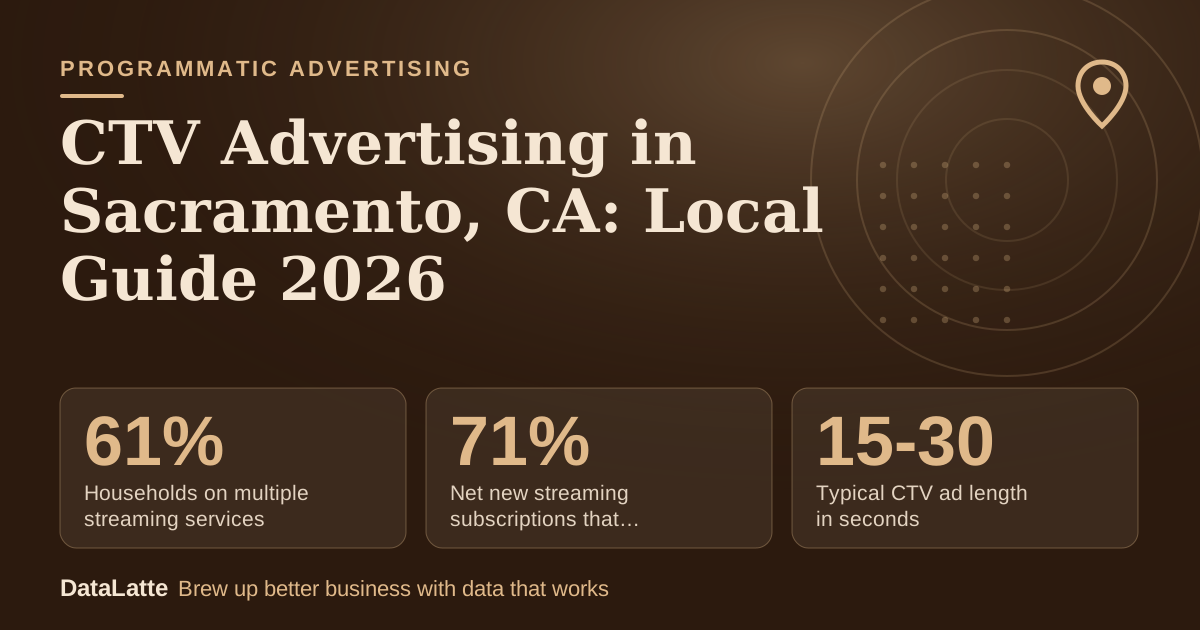
Household habits explain why the format matters. Teads (secondary) cites IAB Compass for the share of households on several streaming services, and reports EMARKETER's finding on ad-supported subscriptions.
61%→
Households on multiple streaming services
IAB Compass via Teads (secondary)
71%↑
Net new streaming subscriptions that are ad-supported
EMARKETER via Teads over past nine quarters (secondary)
15-30→
Typical CTV ad length in seconds
Paramount Ads Manager glossary
Assumption
$40→
Programmatic CPM in Adwave example
Adwave example figure, not a Sacramento rate
See Sources at the end of the article. Cards marked Assumption are examples, not results.
These are national patterns, not Sacramento household counts. Confirm local audience size inside the platform's own reporting before you set a budget.
How do streaming ads get bought and targeted?
Streaming ads are bought through automated systems. Amazon Ads states that Amazon streaming TV ads are currently purchased programmatically, meaning they are bought and sold digitally by an automated system. ClicksGeek (secondary) describes programmatic platforms such as The Trade Desk as giving access to inventory across millions of websites, apps, and streaming services.
For a local business, this means you buy either through a self-serve streaming ad tool or through a demand-side platform. The location and audience filters you can set depend on the tool you choose. Check its current settings before committing spend, and use location filters to keep impressions near your service area.
Location-based targeting works differently on mobile. The geofencing advertising guide explains how that approach compares with household-level TV reach.
What makes a 15 or 30 second CTV ad work?
Because most CTV inventory cannot be skipped, attention is built in, but the first seconds still decide whether a viewer stays engaged. Paramount's glossary recommends a strong opening hook within the first 3–5 seconds. Amazon Ads notes that the video completion rate of CTV ads tends to be very high because many streaming services do not allow ads to be skipped.
Technical rules vary. Advertise In Tampa (secondary) notes that each streaming platform sets its own rules for resolution, frame rate, bitrate and format. Pull the current creative specification from each platform before you produce files.
One structure to test (assumption): a brand mark in the first 3–5 seconds, the core offer or result in the middle, and a clear call to action with your city and phone number in the last five seconds.
What does CTV cost per completed view?
CTV is usually priced on impressions, and the sources describe two more measures. Cost per completed view (CPCV) measures the price of each completed ad, and it sits alongside video completion rate (VCR) among the metrics used in CTV programmatic pricing, according to Amazon Ads.
Adwave gives one example: a $200–400 monthly test at a $40 programmatic CPM delivers approximately 5,000–10,000 impressions across Netflix and other streaming platforms. That is a vendor example, not a Sacramento rate. Use the worked budget below to model your own numbers.
Input or result
Value
Basis
Monthly test budget
$400
Assumption
Programmatic CPM
$40
Example from Adwave page, not a local rate
Impressions
10,000
$400 / $40 x 1,000
Completion rate
90%
Assumption
Completed views
9,000
10,000 x 90%
Cost per completed view
about $0.04
$400 / 9,000
Households reached
5,000
Assumption
Average frequency
2 per household per month
10,000 / 5,000
Replace the assumptions with your platform's quoted CPM, the completion rate in its report, and a household estimate from its audience tool. If the frequency is too low for recall, extend the flight or raise the budget rather than shortening the campaign.
Which streaming services should a local business consider?
Service types differ in how they are funded. Ad-supported video-on-demand (AVOD) services are free or lower-cost streaming services supported by ads. Free ad-supported streaming TV (FAST) channels are free for viewers and supported entirely by advertising, with Pluto TV as Paramount's example.
Programmatic access can reach several premium services at once. Adwave states that programmatic access through its platform opens the door to Netflix's audience alongside other premium streaming services. Ask any buyer which services and channels are included in a single buy, and whether you can exclude ones that do not fit your customers.
Confirm current ad options for named services such as Hulu and Peacock directly with each platform before budgeting, because availability and minimums change.
How should a local business measure CTV results?
CTV builds familiarity more than immediate clicks, so measurement starts before launch. Record a baseline for branded searches, direct website visits, and how customers say they heard about you. Then compare the same metrics during and after flight. The marketing ROI guide covers how to attribute these signals without overclaiming.
Checklist for the first flight:
Save baseline numbers for branded search and direct visits two weeks before launch.
Export completed views, completion rate, and CPCV from the platform report each week.
Add a "how did you hear about us" question to every new-customer intake.
Compare branded search clicks if you also run Google Ads.
Review after the full flight, not after the first few days.
How do you start a small CTV test?
Start with a single audience, one creative, and a fixed budget. Use the worked example as a template: set the monthly amount, confirm the platform's CPM, and calculate completed views before you launch. Keep the test long enough for the trend to appear, and change one variable at a time, such as the opening hook or the offer.
The sources used for this guide do not list a minimum for any platform. Check the current pricing page of the platform or demand-side tool you plan to use. The $400 monthly figure in this article is an assumption for the worked example.
Is CTV the same as streaming TV advertising?
They overlap. Amazon Ads defines streaming TV as digital distribution of video across internet-connected devices rather than a cable signal, and CTV ads run inside that streaming content. The terms are often used interchangeably in platform guides.
Can CTV ads be skipped?
CTV ads are described as non-skippable in Paramount's glossary, and Amazon Ads notes that many streaming services do not allow skipping, which is why completion rates tend to be high.
Does CTV produce clicks like search ads?
CTV is primarily a brand-building format. Measure it through completed views, branded search, direct visits, and customer surveys rather than expecting clicks alone.
Local marketing strategist with 10+ years at global agencies — OMD, Dentsu, GroupM, and BBDO. Now helping small businesses get the same data-driven edge. Based in Europe, working with clients in the US, UK, Australia, and beyond.