CTV Advertising for San Diego Local Businesses in 2026
July 6, 2026·Nataliia Rumiantsewa· 7 min read All posts
CTV advertising lets a San Diego, CA business run short video ads on streaming TV, meaning televisions that connect to the internet rather than receiving a cable signal. Ads typically run 15 or 30 seconds, appear full-screen, and are often non-skippable. Most CTV inventory is bought programmatically, so an automated system purchases ad space that matches the targeting you set. For a small business, the practical path is a four-week test on a budget you can afford to lose, measured against search and brand signals, then expanded only if the results hold.
What counts as CTV advertising?
Connected TV is a television that connects to the internet and allows viewers to stream content, including smart TVs and external devices such as streaming sticks and gaming consoles (Simpli.fi, secondary; Teads, secondary). CTV ads are video placements inside that streaming content. Paramount's glossary describes them as non-skippable and full-screen, typically running 15 or 30 seconds (Paramount Ads Manager).
Three terms come up often when comparing inventory:
Term
What it means
Practical reading
CTV
Ads delivered through internet-connected TV streaming
The umbrella category
AVOD
Free or lower-cost streaming services supported by ads
Ad-supported subscription tiers
FAST
Free channels supported entirely by advertising, such as Pluto TV
Free-to-watch channels
The definitions above come from Paramount Ads Manager. Which services offer ad inventory, and at what price, changes often, so check each platform's current help pages before you commit.
Is the streaming audience big enough for a local business?
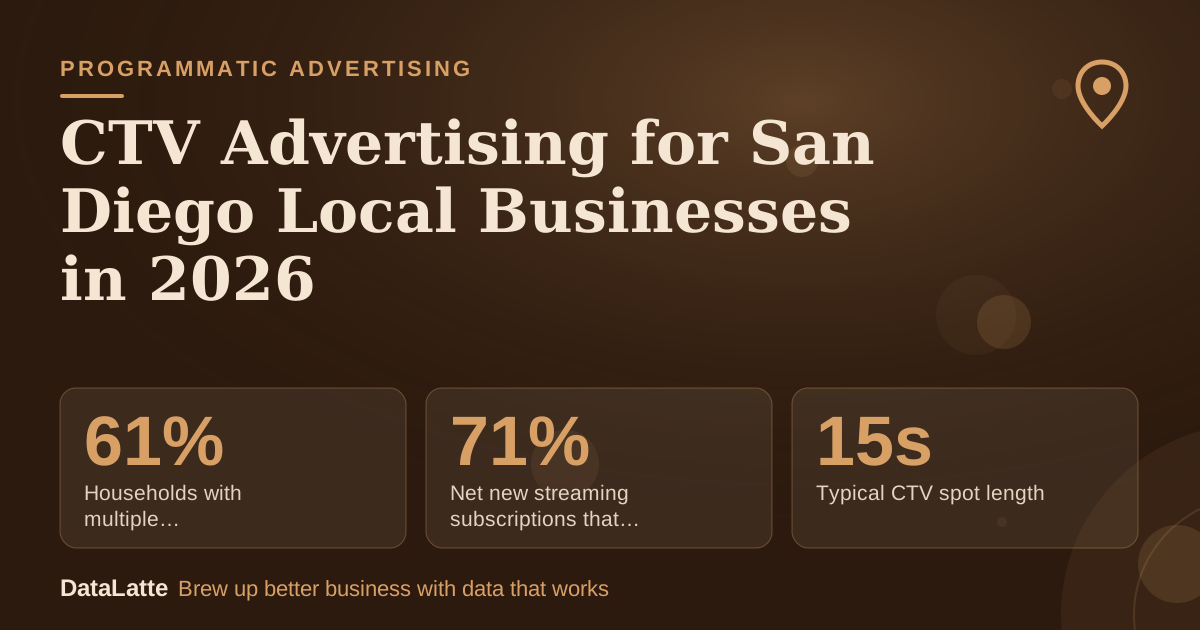
The national figures are strong, but they are not San Diego-specific. Teads, citing IAB Compass, reports that 61% of households subscribe to multiple streaming services (secondary). EMARKETER reports that 71% of net new streaming subscriptions over the past nine quarters have been ad-supported (secondary, via Teads). Those numbers suggest that many households now see ads while streaming, and that the ad-supported tier is where subscriber growth has concentrated.
61%→
Households with multiple streaming subscriptions
IAB Compass, cited by Teads (secondary)
71%↑
Net new streaming subscriptions that are ad-supported
EMARKETER, past nine quarters, cited by Teads (secondary)
Assumption
$40→
Programmatic CPM in a published vendor example
Adwave example rate, per its Netflix guide (vendor)
15s→
Typical CTV spot length
15 or 30 seconds per Paramount glossary (vendor)
See Sources at the end of the article. Cards marked Assumption are examples, not results.
Streaming ads also differ from in-app placements. If you are weighing both, the in-app advertising guide for local businesses covers how those formats compare on reach and targeting.
How do San Diego businesses buy CTV ads?
Programmatic advertising uses automated technology to buy and serve ads in real time, with the platform purchasing inventory that matches criteria the advertiser sets (Paramount Ads Manager). Amazon says its streaming TV ads are currently bought this way, with ads bought and sold digitally by an automated system (Amazon Ads).
Programmatic platforms such as The Trade Desk give access to inventory across millions of websites, apps, and streaming services (ClicksGeek, secondary). Adwave describes programmatic access to Netflix inventory alongside other premium streaming services (Adwave). The buying route you pick affects minimums, targeting controls, and reporting, so compare them side by side rather than assuming one fits every budget.
Amazon also notes that CTV pricing can use cost per completed view (CPCV), which measures the price of each completed ad, alongside video completion rate (VCR) (Amazon Ads). Ask any vendor which metric they bill on before you approve a budget.
What does a small test budget actually buy?
Adwave's published example says a $200 to $400 monthly Netflix test budget, at a $40 programmatic CPM, delivers approximately 5,000 to 10,000 impressions across Netflix and other streaming platforms (Adwave). You can check that arithmetic yourself: impressions equal budget divided by CPM, multiplied by 1,000.
Here is a worked example for a San Diego studio. All inputs are assumptions for illustration, not quotes.
Monthly budget: $300 (assumption)
CPM: $40, taken from the Adwave example (assumption for your market)
Test length: 4 weeks (assumption)
Share of impressions that play to completion: 80% (assumption)
Impressions: $300 ÷ $40 × 1,000 = 7,500 per month.
Completed views: 7,500 × 80% = 6,000.
CPCV: $300 ÷ 6,000 = $0.05 per completed view.
If your real CPM is higher, the impression count falls in proportion. Run the same division with the rate your platform quotes before approving anything. Because the example uses assumed completion, replace the 80% with the completion rate your campaign reports.
How should a San Diego business set up a test?
A short launch checklist keeps the first campaign measurable:
Write the hook first. Paramount's glossary recommends a strong opening hook within the first 3 to 5 seconds, because viewers engage early or not at all (Paramount Ads Manager).
Choose 15 or 30 seconds. A shorter spot forces one clear message; a longer one leaves room for a fuller story.
Set geographic targeting around your address and the neighbourhoods where customers already live. The geofencing advertising guide explains how location targeting works across channels.
Pick one buying route and one budget, then hold both fixed for the full test.
Write down your baseline for search volume, direct visits, and new-customer enquiries before the first impression runs.
Review at 30 days, and decide at 60 to 90 days whether to scale.
Keep the test simple. Changing the creative, targeting, and budget at the same time makes results impossible to read.
How do you measure CTV results?
CTV rarely produces immediate clicks. Its job is to build recognition that shows up later in branded search, direct visits, and customers who say they heard about you from an ad. The marketing ROI tracking guide for local businesses sets out how to tie those signals to revenue without overclaiming.
Amazon notes that CTV completion rates tend to be very high because many streaming services do not allow ads to be skipped (Amazon Ads). That makes completion a weak signal for quality. Compare your branded search and direct traffic in the weeks after launch against your baseline, and ask new customers how they found you every time.
If you want a second opinion on the numbers before you spend, a free audit can check your tracking setup, and Google Ads services can capture search demand that CTV creates.
FAQ
Is CTV advertising the same as streaming ads?
Not exactly. Streaming ads are one part of CTV. CTV covers any ad delivered through internet-connected TV, including streaming platforms and smart TV applications (Seedtag).
Are CTV ads skippable?
Paramount's glossary describes CTV ads as non-skippable video advertisements served within streaming TV content (Paramount Ads Manager). Some services, including free ad-supported channels, may differ, so confirm the format with the platform.
What is the difference between AVOD and FAST?
AVOD refers to free or lower-cost streaming services supported by ads. FAST refers to streaming channels that are free for viewers and supported entirely by advertising, with Pluto TV given as an example (Paramount Ads Manager).
How long should I test before judging CTV?
This guide suggests a 60 to 90 day window for brand effects to appear, based on the measurement approach above. Set that window before launch so you do not judge the campaign too early.
Local marketing strategist with 10+ years at global agencies — OMD, Dentsu, GroupM, and BBDO. Now helping small businesses get the same data-driven edge. Based in Europe, working with clients in the US, UK, Australia, and beyond.