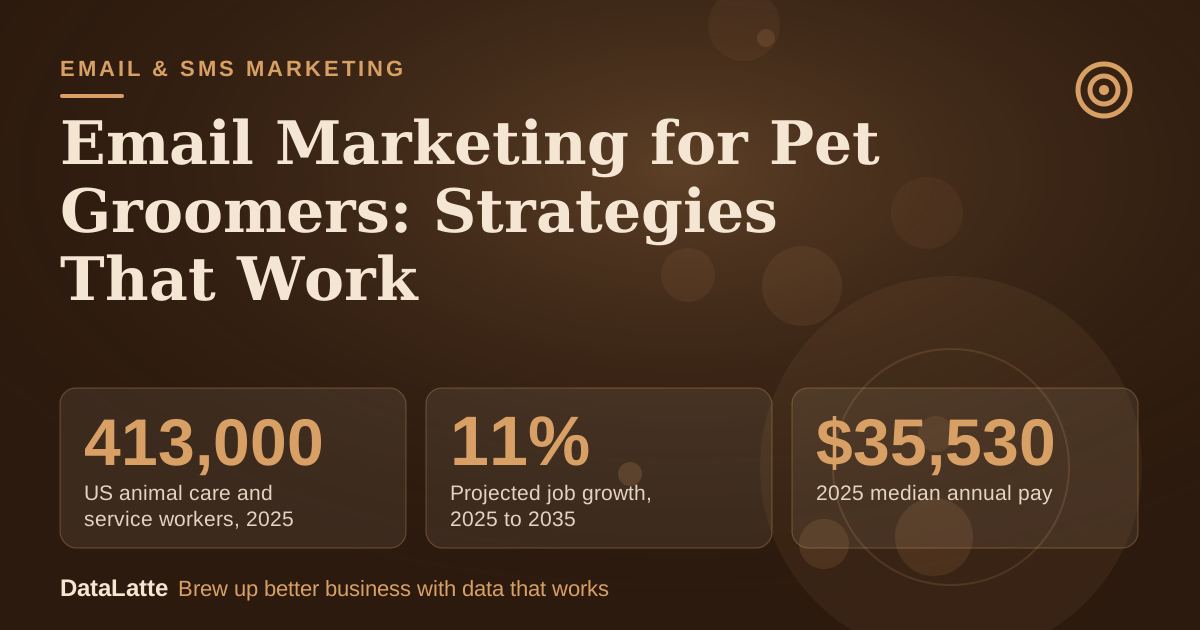
A pet groomer gets the most from email by sending a few useful messages to clients who have already booked: a welcome note after the first visit, a rebooking reminder timed to the coat, and a seasonal notice before busy periods. Start with the clients already in your booking system, keep each message to one action, and judge results by rebookings rather than opens. The US Bureau of Labor Statistics counted 413,000 animal care and service workers in 2025, so competition for repeat clients is real.
→
US animal care and service workers, 2025
BLS
↑
Projected job growth, 2025 to 2035
BLS, much faster than average
→
2025 median annual pay
BLS, animal care and service workers
↑
Projected employment change, 2025 to 2035
BLS
See Sources at the end of the article. Cards marked Assumption are examples, not results.
Why Is Email a Good Fit for a Grooming Business?
Grooming is repeat work. Clients come back on a cycle shaped by their dog's coat, size and lifestyle, so a message that arrives before the next appointment is useful rather than intrusive. The Bureau of Labor Statistics says animal care and service workers "bathe animals, trim nails, clip hair, and attend to other grooming needs," which describes the service your clients already buy from you (
BLS).
Email reaches clients you already have. It does not find strangers, and that is its strength. Hibu's guide to dog grooming marketing says a Google listing and a website help new clients find you, while existing clients are the ones you can contact directly (
Hibu).
Owners also expect convenience. Hibu cites a survey finding that 90% of customers prefer booking appointments online, so every email should link straight to the booking page rather than asking the client to call (
Hibu, citing Calendesk; secondary).
Which Emails Should a Groomer Send First?
Three messages cover most of the value. Each asks for a single action, so the client does not have to choose between several options.
| Email | When to send | One action |
|---|
| Welcome | Within a day of the first visit | Save the next appointment |
| Rebooking reminder | Before the interval you set for that coat | Book now |
| Seasonal notice | Before busy periods you choose | Reserve a slot |
Set the rebooking interval yourself. The schedule should follow each dog's size, breed, coat and lifestyle, and no published national figure replaces your own client records. Segment your list by groom type, such as full groom, bath and brush, or nails only, then write each reminder for that group. A nails-only client should not receive a full-groom package offer.
Hibu also recommends a referral program. Its guide cites a study saying referred customers spend 200% more than the average customer, though that figure comes from a secondary source and should be checked before you quote it to clients (
Hibu; secondary).
How Often Should You Email Clients?
The sources do not set a sending frequency for grooming clients, so treat any number as a test. A practical starting point is one rebooking reminder per client cycle plus one seasonal notice, then watch unsubscribes and replies for a few months. If replies or unsubscribes rise after a run of sends, reduce the frequency.
Timing matters more than volume. A reminder sent after a client has already booked elsewhere wastes a send, and a reminder sent too early feels like noise. Use the date of the last appointment and the coat's usual cycle to schedule each send, not one fixed calendar date for everyone.
If your clients receive texts too, do not send the same message through both channels in the same week. One clear message works better than two repeated ones.
Pick the tool you can keep using. Many grooming businesses already run a booking or management system, and that system may include reminders. Check that first before buying a separate email platform. Comparing booking software for service businesses, such as
Jobber vs ServiceTitan for small local businesses, shows what to look for in scheduling and reminder features.
If your booking system cannot send reminders, a free email plan can cover a small client list. Confirm the contact limit and daily send cap on the plan's current page, because those limits change. Invoices and payment records should stay in your accounting tool. For comparing those, see
FreshBooks vs QuickBooks for local businesses.
Social posts can support email without replacing it. If you schedule posts across platforms,
Hootsuite vs Sprout Social for small businesses compares the tools most often used for that work.
Which Legal Rules Apply to Marketing Email?
This article does not cover email law, and the sources used here do not set out marketing email rules. Before you send a campaign, check the rules that apply in the country where your clients live. Consent, opt-outs, sender identification and record keeping differ between the US, UK, Australia and Canada, so a message allowed in one place may need changes in another.
Make unsubscribing easy and honor it promptly. Keep your booking form clear about whether clients are agreeing to appointment reminders, promotional offers or both, because those can be treated differently.
Do not offer a discount or free groom in exchange for a Google review. Check Google's current review policy on its help pages before running any review request.
How Do You Know If Email Works?
Open rates are unreliable as a signal. Privacy features in some mail apps can record opens that never happened, so use bookings as your main measure. Give each email a unique booking link or a discount word that the front desk can ask for, so a booking can be matched to a send.
Check three numbers every month: bookings that came from email, unsubscribes per send, and client replies that mention the message. Compare this month against your own last three months. Industry averages from other sectors do not describe a grooming client list, so avoid using them as targets.
Google Business Profile matters too. Hibu advises responding to reviews, good or bad, because reviews are visible to potential clients (
Hibu). Email can invite clients to leave a review, but the review itself should be left freely.
What Could One Rebooking Email Produce?
The example below uses assumptions, not benchmarks. Replace each input with your own numbers after your first send.
| Input | Value |
|---|
| Clients emailed (assumption) | 300 |
| Clients who book within two weeks (assumption) | 8%, so 24 bookings |
| Average groom price (assumption) | $60 |
| Revenue from the send | 24 × $60 = $1,440 |
| Tool cost (assumption: booking system already includes email) | $0 |
| Net monthly value before staff time | $1,440 |
Staff time is not in the table, and it matters. If writing and sending the email takes two hours of front-desk work (assumption), the return depends on whether those hours would otherwise go to bookings. The number to watch is not the revenue from one send but the bookings that repeat each month.
FAQ
How often should a pet groomer email clients?
No published standard exists in the sources used here. Start with one rebooking reminder per client cycle and one seasonal notice, then check unsubscribes and replies before adding more.
Is email better than text for groomers?
Neither is better in general. Use the channel your clients already respond to, and do not send the same message through both in the same week.
Should I use a free email plan?
Check the current contact limit and send cap before relying on a free plan. If your booking software already sends reminders, test that first.
Can I offer a discount for a Google review?
Do not offer a discount or free service in exchange for a review. Check Google's current review policy on its help pages before running a review request.
Sources
- Hibu: 8 Essential Dog Grooming Marketing Strategies (vendor blog, January 2025; cites Pew, Calendesk and Annexcloud figures, which are secondary)
- Bureau of Labor Statistics: Animal Care and Service Workers (2025 employment, growth and median pay)
- Groomsoft: The Role of Social Media and Online Marketing in Growing Your Grooming Business (software vendor blog, October 2024; secondary, no statistics used)
Want help setting up client reminders and tracking rebookings?
Book a free audit to get a review of your current booking and email setup.
Free for local businesses
Want this applied to your business?
I'll review your Google presence, local SEO, and ad accounts — and send you a specific action plan within 48 hours. No pitch, no pressure.