New year gym membership marketing works best when the sale starts in early December, the January offer rewards commitment instead of cutting price across the board, and the real work shifts to retention by week three. The available sources contain no national 2026 sign-up count, so a studio should plan around its own waitlist and lead data. The plan below runs from Dec 7 to Feb 14.
→
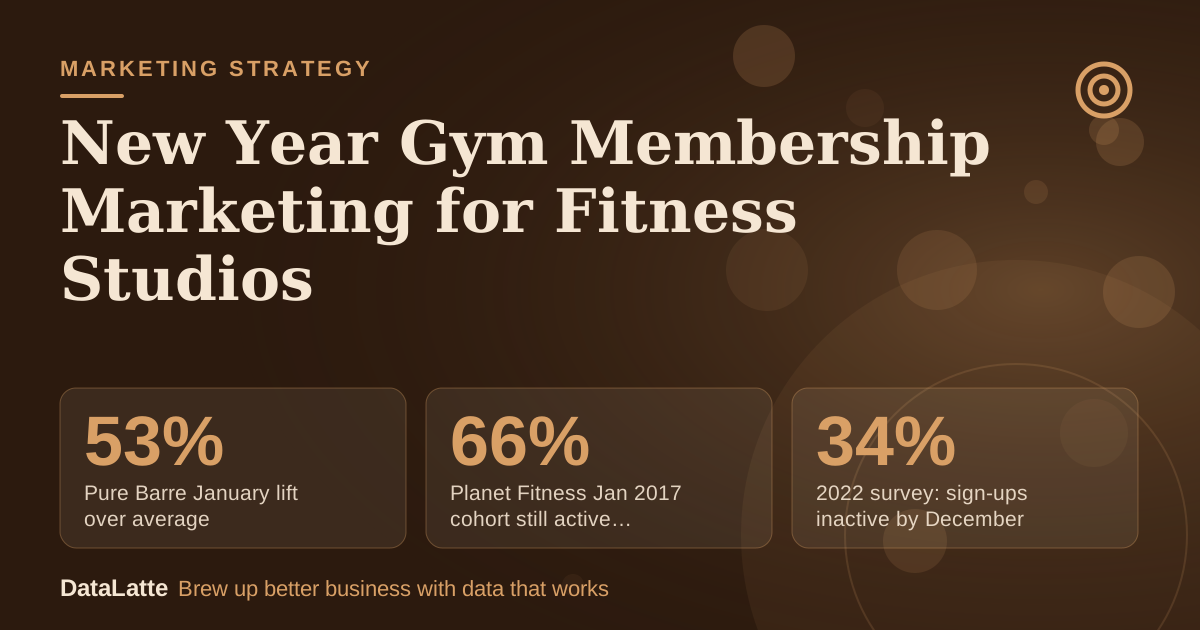
Pure Barre January lift over average
Bloomberg Second Measure, vendor data, published Jan 2018
↑
Planet Fitness Jan 2017 cohort still active at 10 months
Bloomberg Second Measure, vendor data, 2017 cohort
↓
2022 survey: sign-ups inactive by December
My Protein survey via KGUN 9, 2022
→
ClassPass quarterly retention at year end
Bloomberg Second Measure, vendor data, vs 16% for other boutique brands
See Sources at the end of the article. Cards marked Assumption are examples, not results.
What does January sign-up data actually show?
Published sign-up figures are old, vendor-made or anecdotal. Treat each as a direction, not a forecast.
| Figure | Source type | Age | Reliability flag |
|---|
| Planet Fitness: 79% more new customers in January than in the average month | Vendor transaction data, Bloomberg Second Measure (secondary) | Published Jan 2018 | Old; one large budget chain, not a boutique |
| Pure Barre: up to 53% more new customers than average in January | Same vendor (secondary) | Published Jan 2018 | Old; closest to a boutique class studio |
| Over a third of respondents signed up for a gym membership | My Protein survey, reported by KGUN 9 (secondary) | 2022 | Several hundred respondents; the surveying company sells fitness products |
| Exercising more is the top 2026 resolution | YouGov survey, via KGUN 9 (secondary) | Jan 1, 2026 | Shows intent, not purchases |
| Pittsfield Planet Fitness sign-ups "a quarter" of last year's | One front-desk employee, Whoopee radio | Jan 5, 2026 | Anecdote, one location |
The vendor itself advises against using its historical posts to infer period-over-period comparisons, so the 2018 numbers should not be projected onto 2027.
Why do local reports conflict on the January rush?
Local coverage points in different directions. The Pittsfield piece is titled "Pittsfield Gym Says the January Rush Isn't What It Used to Be" and quotes a front-desk employee who put new sign-ups at about a quarter of the prior year's number. The same article says most sign-ups now happen online, which makes new-member activity harder to gauge until monthly reports arrive at the end of January.
Other January 2026 headlines lean the other way.
Castanet reported that Kelowna gyms saw a surge in new members, and
Spectrum News ran "Gyms see New Year's rush" from Milwaukee.
ABC News 4 covered a January gym surge in the Lowcountry. None of these carry a figure usable here.
The practical reading: the rush varies by market and by gym type, and online sign-ups mean a studio's own funnel data is the only reliable gauge. Last January's lead count and trial bookings matter more than any headline.
What does retention data say about January joiners?
Retention evidence is thin but points to one useful idea: January joiners are not automatically the weakest cohort.
At Planet Fitness, 66% of the January 2017 cohort was still active at 10 months, against an average of 59% for the preceding 11 cohorts, according to
Bloomberg Second Measure (secondary, vendor data, 2017 cohort). The source adds a caveat: "active" may only mean an autopay account is still running. One budget chain with a $10 monthly fee is also a poor proxy for a class studio.
Survey data is less kind. In the 2022 My Protein survey, 34% of people who signed up had stopped using the membership by December, and over a quarter stopped after just 6 months (
KGUN 9, secondary).
Boutique spend patterns from the same vendor: new customers at SoulCycle, Pure Barre and YogaWorks spend under $300 in the first year on average, and more than 80% of boutique customers do not spend in the last quarter of year one. ClassPass quarterly retention averaged 39% at year end versus 16% for other boutique brands (all secondary, vendor data).
How should January offers protect margin?
A studio's goal in January is more committed members, not the most sign-ups at the lowest price. Single boutique classes run from $20 to more than $30 per the vendor data, so a deep percentage discount on a monthly plan erodes a margin that is already built on class capacity.
Safer structures add value instead of subtracting price: a short commitment, a bonus that costs little to deliver, or a founding-member perk. Whether members stay depends on habit, which makes a first-month price cut a weak lever. The table maps structures to studio type. These are suggestions, not sourced benchmarks.
| Studio type | January offer structure | What it protects | Retention hook |
|---|
| Boutique class studio | First-month intro pack with a 3-month commitment, plus one guest pass | Class fill and list price | Book the first 3 classes before the member leaves the desk |
| Yoga studio | Intro month tied to a set weekly class (for example the same Tuesday slot) | Off-peak capacity | Same teacher and same time to build a habit |
| Personal training | Assessment plus a 4-week block, with the next block priced at list | Trainer hours | Month-two goals set in the final session of block one |
Personal training has no sign-up or retention figures in the reviewed sources, so that row rests on structure alone.
Cancellation terms matter too. KGUN 9 reports that Arizona law allows cancellation by email, mail or the gym's website. Rules in other states are not covered in the sources; check local law before writing offer terms.
What should happen in December before the rush?
December is for building the list that January converts. The YouGov finding that exercising more is the top 2026 resolution is a demand signal, but it says nothing about how many people will pick a boutique studio.
A pre-sale gives existing leads a reason to commit before the January noise. Typical mechanics: a founding-member price for the first 20 or 30 buyers, a waitlist for the new-year class block, or a gift-purchase page for the holidays. Capacity limits keep the scarcity honest.
Audience building also starts here. The
Google Business Profile checklist covers hours, photos and the booking link, which are the first things a January searcher sees. For paid reach beyond search, the
CTV guide for fitness studios explains how connected TV fits a local studio budget. How ad costs move around the new year is not documented in the reviewed sources, so ask platforms for current rates before committing a budget.
Email and text are the cheapest December channels. The
email campaign ideas post and the
SMS platform comparison help pick tools for the pre-sale list.
What is the week-by-week plan from Dec 7 to Feb 14?
The list below assumes a boutique class studio with a booking system and an email list. Adjust dates to the studio's own schedule.
- Week of Dec 7: Set the January offer and the capacity cap. Build the pre-sale page and a unique promo code for each channel. Confirm the Google Business Profile booking link.
- Week of Dec 14: Send the pre-sale email and text to current members, past trials and the waitlist. Ask members for referrals with a named reward.
- Week of Dec 21: Keep the pre-sale open with a short reminder. Prepare January class schedules, intro-class slots and welcome messages.
- Week of Dec 28: Send "start the year here" messages with the exact first-class dates. Close the pre-sale at the cap.
- Week of Jan 4: Open the public January offer. Staff the front desk for intro classes and capture every walk-in into the booking system.
- Week of Jan 11: Check attendance of new members. Anyone who has not booked a second class gets a personal text.
- Week of Jan 18: Launch the referral push: each new member can bring one friend to a class.
- Week of Jan 25: Review cost per sign-up by channel. Shift budget toward the channels with real trial bookings.
- Week of Feb 1: Run a 4-week check-in with every January joiner. Offer a class-pack or challenge to keep the habit going.
- Week of Feb 8 to Feb 14: Count who is still booking. Send a "member of the month" or partner-workout invitation for the week of Feb 14.
The broader
12-month marketing calendar shows where this block sits in the full year.
How do referrals and group classes keep January members?
The retention sources are clear about the problem: many people stop within six months (My Protein 2022 survey) and most boutique customers are not spending by the last quarter of the first year (vendor data). The fix has to be built into the first weeks.
Group classes give a natural structure. Members who book the same class each week meet the same instructor and the same neighbors. A front-desk or instructor habit of learning names, and a text after a missed class, cost little and match how habit forms. No source measures how much these steps lift retention, so each studio should test them against its own attendance data.
Referral works best when the new member is invited to a class they attend together. A friend pass tied to a specific session fills a slot and gives the member a reason to show up. Reward the referrer after the friend attends, not after the friend merely signs up.
ClassPass retention at 39% versus 16% for other boutique brands (vendor data) suggests that flexibility and variety may help keep people active. That is a vendor finding about one model, not proof that any tactic works at a single studio.
What does a worked example look like?
All inputs are assumptions for a boutique studio. Replace each with real numbers.
Assumptions: list price $140 per month; variable cost $12 per member per month; ad and promotion budget $1,500 for December through January; comparison over the first three months.
- Offer A: 30% off for three months, which is $98 per month. Assumed result: 40 sign-ups.
- Offer B: first month $99, then $140 per month on a 3-month commitment, plus a guest pass. Assumed result: 32 sign-ups, because the discount is smaller.
| Item | Offer A | Offer B |
|---|
| Sign-ups (assumption) | 40 | 32 |
| 3-month revenue per member | $294 | $379 |
| Total 3-month revenue | $11,760 | $12,128 |
| Variable cost (3 months at $12) | $1,440 | $1,152 |
| After variable cost | $10,320 | $10,976 |
| After $1,500 promotion budget | $8,820 | $9,476 |
| Promotion cost per sign-up | $37.50 | $46.88 |
Offer B earns about $656 more after costs on eight fewer members, and the three-month price step-up is smaller in practice because members start closer to list. The cost per sign-up is higher for B, so the decision depends on class capacity: if the studio can fill classes with 32 members, the lower headcount also keeps rooms less crowded. This is an illustration, not a forecast.
How should the campaign be tracked?
Tracking has to separate sign-ups from staying power. The first needs a promo code or link per channel; the second needs attendance data from the booking system.
Core numbers to log weekly: leads, intro-class bookings, intro-class attendance, paid sign-ups, second-class bookings and cancellations. A member who has not returned after the first two weeks is the early warning, and a text from the studio is the response.
Record cost per paid sign-up by channel, but judge channels again at day 30 and day 60, since a cheap sign-up that never returns is not cheap. Because Pittsfield reports that most sign-ups now happen online, an online booking source field is a must.
For ad-driven traffic,
how to measure CTV ads for a local business covers pairing a code or landing page with the campaign. Google Business Profile calls and direction requests belong in the same weekly sheet.
FAQ
When should a fitness studio start new year membership marketing?
The plan here starts the week of Dec 7 with the offer and pre-sale page. That leaves time to build a list before January. The sources do not document an ideal start date, so the timing is a planning choice.
Are January sign-ups less loyal than other months?
Not necessarily. Bloomberg Second Measure vendor data shows 66% of Planet Fitness's January 2017 cohort active at 10 months versus 59% for the 11 prior cohorts (secondary; "active" may mean autopay is still running). It is one chain, with old data.
Is the January rush still as big as it used to be?
Evidence conflicts. A Pittsfield front-desk employee described sign-ups at about a quarter of the prior year's number, while other January 2026 local headlines describe surges. No national 2026 figure appears in the sources, so a studio's own prior-January data is the better guide.
Should a boutique studio discount heavily in January?
The sources do not test discount depth. Single boutique classes run $20 to more than $30, and the worked example above shows how a smaller discount with a commitment can earn more after costs under the stated assumptions.
Sources
A studio that wants a second set of eyes on its December pre-sale, ad budget and January tracking can request a
free audit.